


What if the right cancer screening decision isn’t choosing more tests, but choosing the ones that fit your risk? If you’ve searched for “cancer screening tests for men nyc,” you may already know recommendations can vary with age, smoking history, family history, and other personal factors. Screening can help detect cancer early, but it has limitations and may lead to follow-up testing.
This guide explains which screenings may be worth discussing, when those conversations commonly begin, and what to consider before deciding. It covers colorectal, prostate, lung, and skin cancer screening approaches, and why a screening result isn’t the same as a diagnosis. Symptoms call for medical evaluation, not simply a routine screening plan.
There’s no single checklist that fits every man. A primary care visit can help organize your age, health, and family history into a personalized discussion. Dr. John Abroon, a board-certified internist on Manhattan’s Upper East Side, provides annual physical exams and diagnostic care, creating an opportunity to review prevention questions and consider a clear next step.
Key Takeaways
- See how age and personal risk shape conversations about prostate, colorectal, and lung cancer screening, rather than relying on one universal checklist.
- Learn which cancer screening tests for men nyc readers may want to discuss, including PSA testing, colorectal screening options, and low-dose CT for eligible people with a smoking history.
- Understand how false-positive or false-negative results, overdiagnosis, and follow-up testing can affect the benefits and limitations of screening.
- Prepare for a more focused discussion by gathering family cancer history, noting relatives’ ages at diagnosis, and reviewing your own prior tests.
- Discover how an annual physical with a board-certified internist can help organize your health history and identify personalized next steps.
Cancer screening tests for men in NYC: what screening can, and cannot, tell you
Screening recommendations can feel confusing when age, family history, and past health findings differ from one person to the next. The goal isn’t to complete every available test, but to consider which options may offer useful information for your situation. Before weighing cancer screening tests for men nyc, it helps to understand what screening can and cannot tell you.
Screening looks for possible signs of cancer before symptoms appear. It can help detect disease earlier, but it can’t guarantee that cancer will be prevented, found, or treated with a better outcome. A reassuring result doesn’t rule out every cancer, while another result may need follow-up to clarify what it means. The general overview of Cancer screening also explains that approaches can vary, including by who is considered eligible.
Screening is a check before symptoms; diagnostic testing investigates a symptom or finding. The distinction matters because the right next step depends on why a test is being considered. A physician can put the test, your health history, and possible next steps in context.
Who may need to discuss cancer screening sooner?
Age can affect when a screening conversation begins. Family history, smoking history, and prior health findings may also change which options deserve attention. For example, a close relative’s cancer diagnosis or a substantial smoking history may be relevant to a physician’s assessment. These details provide context, not a diagnosis: a risk factor doesn’t mean someone has cancer, and its absence can’t rule cancer out.
Share what you know, even if some details are incomplete. Your clinician can consider the full picture rather than basing a screening plan on one fact alone.
Why a symptom evaluation is different from screening
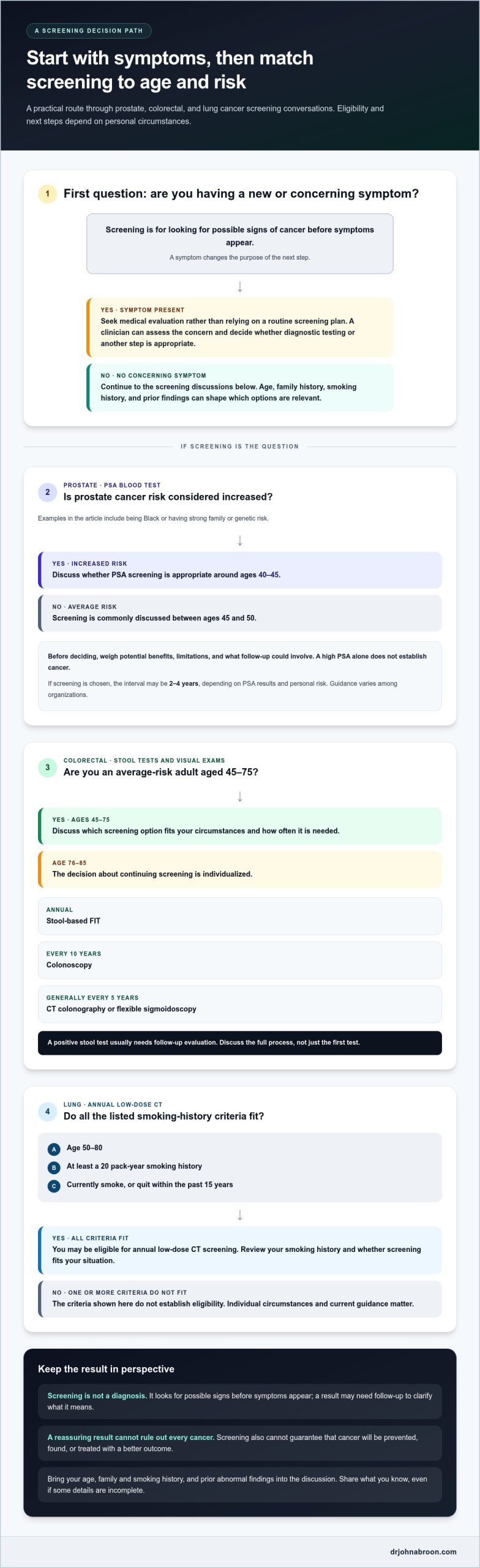
A new or concerning symptom calls for medical evaluation rather than waiting for a routine screening test or its usual interval. For instance, a persistent change in bowel habits deserves a conversation with a clinician; it doesn’t automatically mean cancer. The clinician can assess the concern and determine whether diagnostic testing or another step is appropriate.
A test intended for people without symptoms may not answer the same question as an evaluation prompted by a specific change. Be clear about what you’ve noticed, when it began, and whether it has changed. That information helps guide a focused discussion.
As a practical starting point, bring your age, relevant family and smoking history, and any previous abnormal findings to a primary care visit. An annual physical can provide time to review these details and frame your screening questions. The goal is a considered next step, not a generic checklist or a promise that one test can settle every concern.
Which cancer screening tests for men should you discuss in NYC?
Three common cancer screening discussions for men in NYC involve prostate, colorectal, and lung cancer. The options differ in how they work, when they may be considered, and what follow-up they can lead to. This comparison is a starting point, not a personal screening schedule. Eligibility depends on current guidance and individual circumstances, not gender alone.
| Screening discussion | Method | Who may be considered and what to discuss |
|---|---|---|
| Prostate | Prostate-specific antigen (PSA) blood test | Average-risk men commonly discuss screening between ages 45 and 50. Men at increased risk, including Black men and those with strong family or genetic risk, may discuss it at ages 40 to 45. Weigh possible benefits, limitations, and follow-up. |
| Colorectal | Stool-based tests, colonoscopy, and other visual exams | Average-risk adults generally start at 45 and continue through 75. Discuss which test suits your circumstances and how often it’s needed. |
| Lung | Annual low-dose CT scan | People ages 50 to 80 with at least a 20 pack-year smoking history who currently smoke or quit within the past 15 years may be eligible. Review smoking history and whether screening fits. |
Prostate cancer screening and the PSA blood test
A PSA test measures prostate-specific antigen in the blood. Guidance differs somewhat: the American Urological Association and Society of Urologic Oncology support offering screening discussions at ages 40 to 45 for people at increased risk, while the American Cancer Society uses age 45 for certain higher-risk groups and age 50 for average risk. These are discussion points, not a requirement to test. If screening is chosen, the interval may be two to four years depending on PSA results and personal risk. Ask how an elevated result would be assessed and what further evaluation could involve; a high PSA alone doesn’t establish cancer.
Colorectal and lung cancer screening
Common colorectal screening options include an annual stool-based FIT and colonoscopy every 10 years. CT colonography and flexible sigmoidoscopy are other options, generally at five-year intervals. A positive stool test usually needs follow-up evaluation, so discuss the full process, not just the first step. From ages 76 to 85, the decision to continue screening is individualized.
Lung screening uses a low-dose CT scan, not a standard chest X-ray. A pack-year means smoking an average of one pack daily for one year; two packs daily for 10 years also equals 20 pack-years. Review your full smoking history with a clinician, since eligibility criteria and individual health circumstances both matter.
No single screening schedule fits every man. At an annual physical, a primary care physician can help organize your age, history, and questions into a thoughtful discussion. An individualized preventive-health discussion can help clarify which screening conversations make sense for you.
Do the benefits of cancer screening outweigh the risks?
A screening test can offer useful information, but it can also create uncertainty. Whether the potential benefit is worth the possible downsides depends on the test, your health history, and your preferences. Screening isn’t risk-free, and choosing not to screen can also have consequences. A balanced discussion helps you weigh both sides without assuming every man should test or avoid testing.
| Potential benefits | Possible limitations |
|---|---|
| A test may find cancer earlier, when treatment options could differ. Some colorectal screening methods can also identify growths that may be removed before they become cancer. | A false positive suggests a possible problem that further evaluation does not confirm. This can lead to additional tests and worry. |
| A result can help you and your clinician decide whether more evaluation or a change in care is appropriate. | A false negative means a test doesn’t detect a cancer that is present. A normal result can’t rule out cancer completely. |
| For someone with relevant risk factors, screening may provide information that supports an informed care plan. | Overdiagnosis occurs when screening finds a cancer that would not have caused symptoms or harm during a person’s lifetime. It can lead to treatment that might not otherwise have been needed. |
What can happen after an abnormal screening result?
An abnormal result isn’t a cancer diagnosis. Depending on the test and result, a clinician may recommend repeating the test, reviewing it alongside other information, or pursuing additional evaluation. The next step varies, and not everyone with an abnormal result follows the same path. Before testing, ask what follow-up might be considered and how the result would be interpreted in light of your health history.
How shared decision-making supports a clearer choice
Shared decision-making means considering the evidence alongside your personal risk factors and priorities. A clinician can explain what a screening test may help detect, what it can miss, and what follow-up might involve. Clinical guidance offers a starting point, but it doesn’t replace a conversation about your circumstances. For men comparing cancer screening tests for men nyc, an informed choice means understanding both the potential value and the trade-offs.
Bring questions that make the discussion specific:
- What benefit could this screening offer someone with my health history?
- What are the test’s limitations, including the possibility of an unclear or inaccurate result?
- If the result is abnormal, what follow-up might be considered?
- How would my age, family history, or other health factors affect this decision?
An annual physical can provide a setting to review these questions and your broader health history. Dr. John Abroon is a board-certified internist and primary care physician on Manhattan’s Upper East Side. His published guide, Your Annual Physical Exam in NYC: A Complete Guide for 2026, offers additional context for preparing for that visit.
How to prepare for a cancer screening discussion in New York City
A little preparation can turn questions about cancer screening tests for men nyc into a focused conversation about your health. You don’t need to arrive with a decision already made. Bring the information you have, note what you’re unsure about, and discuss options and possible next steps with a clinician.
Bring the details that can shape your screening plan
Before your visit, gather details that may help your physician understand your health history. If you don’t know every answer, share what you do know.
- Family history: Note which relatives had cancer, the type of cancer, and their age at diagnosis, if available. A close relative’s cancer history can be relevant even if you don’t know every detail.
- Personal health information: List current medications, relevant medical conditions, prior procedures, and past findings that may affect screening decisions.
- Previous tests: Record the dates and results of earlier cancer screenings when you can. Recent reports from other clinicians can also provide context.
- Smoking history: If you’ve smoked, note approximately when you started and stopped, and how much you smoked over time. This information can help a clinician assess whether lung screening guidance may apply.
Bring recent outside records if they’re readily available, but don’t delay evaluation of a concerning symptom while collecting paperwork. For a broader overview of preparing for a primary care visit in Manhattan, the published Primary Care Physician NYC guide may also be useful.
Questions to ask at a screening appointment
Clear questions can help you understand why a test is being considered and what its result might mean. You might ask:
- Which screening tests, if any, are appropriate for me now, and what guidance informs that recommendation?
- How do my age, family history, smoking history, or previous findings affect the discussion?
- What are the test’s limitations, and what could an abnormal result lead to?
- Are there other reasonable options, including waiting or choosing a different screening method?
Ask about practical details, too. Coverage can depend on your plan and on whether a service is classified as preventive screening or diagnostic evaluation. Review your plan documents or contact your insurer for information specific to your coverage. Don’t assume every follow-up service is covered on the same terms.
New York State and New York City programs may offer screening assistance to eligible residents, but eligibility and available services can change. Check current details through official state or city sources before relying on a program. At an annual physical, a primary care physician can help organize your history and screening questions into a personalized discussion. Discuss your preventive-health questions with Dr. John Abroon.
Discuss your cancer screening plan with Dr. John Abroon in NYC
Screening decisions are easier to approach when your medical history and questions are considered together. Dr. John Abroon is a board-certified internist and primary care physician on Manhattan’s Upper East Side. His practice provides a setting for individualized preventive-health discussions, including a review of which cancer screening questions may be relevant to you. An annual physical can help organize that conversation without assuming every test is appropriate or that a particular screening will be performed.
What a personalized primary care discussion can cover
A clinician can consider your age, family history, smoking history, previous test results, and personal concerns alongside current clinical guidance. These details help frame the discussion, but they don’t determine a screening plan on their own. Recommendations can differ because people’s health histories and preferences differ, and guidance may change over time.
You can use the visit to talk through questions such as:
- Which aspects of my personal or family history may affect screening recommendations?
- Are there previous results or records that would help inform this decision?
- What are the potential benefits and limitations of the options being discussed?
- If more evaluation is appropriate, what kinds of next steps might be considered?
Dr. Abroon’s practice provides annual physical exams, diagnostic testing, and laboratory testing. These services support broader medical care, while specific screening questions and next steps are considered in the context of your health. A screening test can’t guarantee cancer prevention, early detection, or a particular outcome. The aim is a clear, evidence-led discussion that makes room for your questions and priorities.
Take the next step toward a personalized screening plan
If you’re unsure where to begin, bring your screening questions to an annual physical. Share what you know about relatives’ cancer histories, your past tests, and any concerns you want to address. If some details are missing, say so; the conversation can still help identify what information matters and which questions to explore further.
For men researching cancer screening tests for men nyc, a primary care discussion connects general guidance with individual circumstances. Dr. Abroon’s Upper East Side practice provides a patient-centered setting to review preventive-care questions with a board-certified internist, without treating a checklist as a substitute for personalized medical judgment.
Schedule an annual physical with Dr. Abroon to discuss preventive health and your screening questions.
Make your next screening conversation personal
You don’t need to resolve every screening question before speaking with a physician. Start by writing down the decision you’re facing, what matters most to you, and anything about your health history you want considered. That gives the conversation a clear starting point and connects general guidance to your circumstances.
Choosing among cancer screening tests for men nyc can involve weighing potential benefits against uncertainty and possible follow-up. A thoughtful discussion can help you understand those trade-offs and decide what feels appropriate with medical guidance. Your plan can be revisited as your health history, preferences, or current recommendations change.
Dr. John Abroon is a board-certified internist and primary care physician at an Upper East Side practice. An annual physical creates an opportunity to discuss preventive care and screening questions in the context of your overall health, without assuming one test is right for everyone.
Schedule an annual physical with Dr. Abroon and take a calm, informed step toward care that reflects your needs.
Frequently Asked Questions
Can cancer screening tests detect cancer before symptoms appear?
Yes. Screening is intended to look for certain cancers or precancerous changes before symptoms develop, but no test detects every case. A normal result can’t rule out disease completely, and an abnormal result doesn’t automatically mean cancer. If you notice a new or concerning change, arrange a medical evaluation rather than waiting for a routine screening date. Tell the clinician what changed and when you first noticed it.
Is a PSA blood test recommended for every man?
No. PSA screening involves weighing possible benefits, limitations, and follow-up, so it isn’t an automatic choice for every man. Current guidance commonly supports discussing screening at ages 45 to 50 for average-risk men, and at ages 40 to 45 for men at increased risk, including Black men and those with strong family or genetic risk. If researching cancer screening tests for men nyc, bring your health history and preferences to a clinician; a PSA result alone isn’t a diagnosis.
At what age should men start colorectal cancer screening?
For average-risk adults, major U.S. recommendations call for colorectal screening to begin at age 45, generally continuing through 75. The decision for adults ages 76 to 85 is individualized. A personal or family history may affect when screening starts or which method is suitable, so don’t rely on an average-risk schedule if those factors apply. Ask your clinician to review your history and current test intervals before deciding.
Can a nonsmoker get lung cancer screening?
Lung screening recommendations generally target people with a substantial smoking history, not all adults. Under current U.S. criteria, annual low-dose CT screening is recommended for eligible adults ages 50 to 80 with at least a 20 pack-year history who currently smoke or quit within the past 15 years. A person who has never smoked generally won’t meet these criteria. Symptoms call for medical evaluation, which is different from routine screening.
Does health insurance cover cancer screening tests in NYC?
Coverage depends on your plan, the test, and whether the service is preventive screening or diagnostic follow-up. Review your plan documents or contact your insurer about the specific test and any next steps, rather than assuming all related care is covered. New York’s Cancer Services Program provides certain screenings to eligible uninsured or underinsured residents, including colorectal screening starting at age 45. Check official state or city resources for current eligibility and available services.
What should I bring to a cancer screening appointment?
Bring your medication list, relevant medical history, and any previous screening dates or reports you can access. For family history, write down the relative, cancer type, and age at diagnosis if known. A simple timeline can help you explain past tests without relying on memory. If you have a symptom, note when it began and what has changed; share that information at the visit rather than treating it as a routine screening question.