


Imagine standing at the threshold of your residency appointment, only to realize a single missing paper could stall your entire future. It’s a common fear, but it doesn’t have to be your reality. Knowing exactly what to bring to immigration medical exam appointments is the primary factor in securing a seamless, single-visit experience. We understand the weight of this moment. The residency process is often filled with complex paperwork and shifting regulations, and the medical exam shouldn’t add to that burden.
You might feel anxious about lost childhood vaccination records or confused by the latest USCIS updates, such as the 01/20/25 edition of Form I-693. Rest assured, this guide provides the clarity you need for a stress-free visit. We’ll outline every necessary document, from government-issued identification to the specific immunizations required in 2026. By following this checklist, you can walk into your appointment with total confidence. You’ll be prepared to walk out with a sealed envelope and a clear path forward on your very first attempt.
Key Takeaways
- Verify you’re using the 01/20/25 edition of Form I-693 and carrying a valid government-issued photo ID to prevent immediate administrative delays.
- Understand the updated 2026 vaccination protocols, including which immunizations remain mandatory and how to handle non-English records with certified translations.
- Use our finalized checklist of what to bring to immigration medical exam appointments to ensure you’re prepared for every physical and diagnostic requirement.
- Discover how blood titer testing provides a reliable, science-based solution for applicants who can’t locate their original childhood health records.
- Streamline your visit to our Manhattan office by learning about day-of logistics like fasting requirements and the benefits of on-site diagnostic testing.
The Foundation: Mandatory Identification and USCIS Forms
Preparing for your residency application requires a high level of precision. When you’re determining what to bring to immigration medical exam appointments, your identity documents and official forms serve as the absolute baseline. These items allow Dr. Abroon to verify your profile and document your health status according to established medical standards for immigration. Arriving with a complete file ensures that your transition from the waiting room to the clinical suite is seamless and efficient.
Form I-693: Preparation Tips
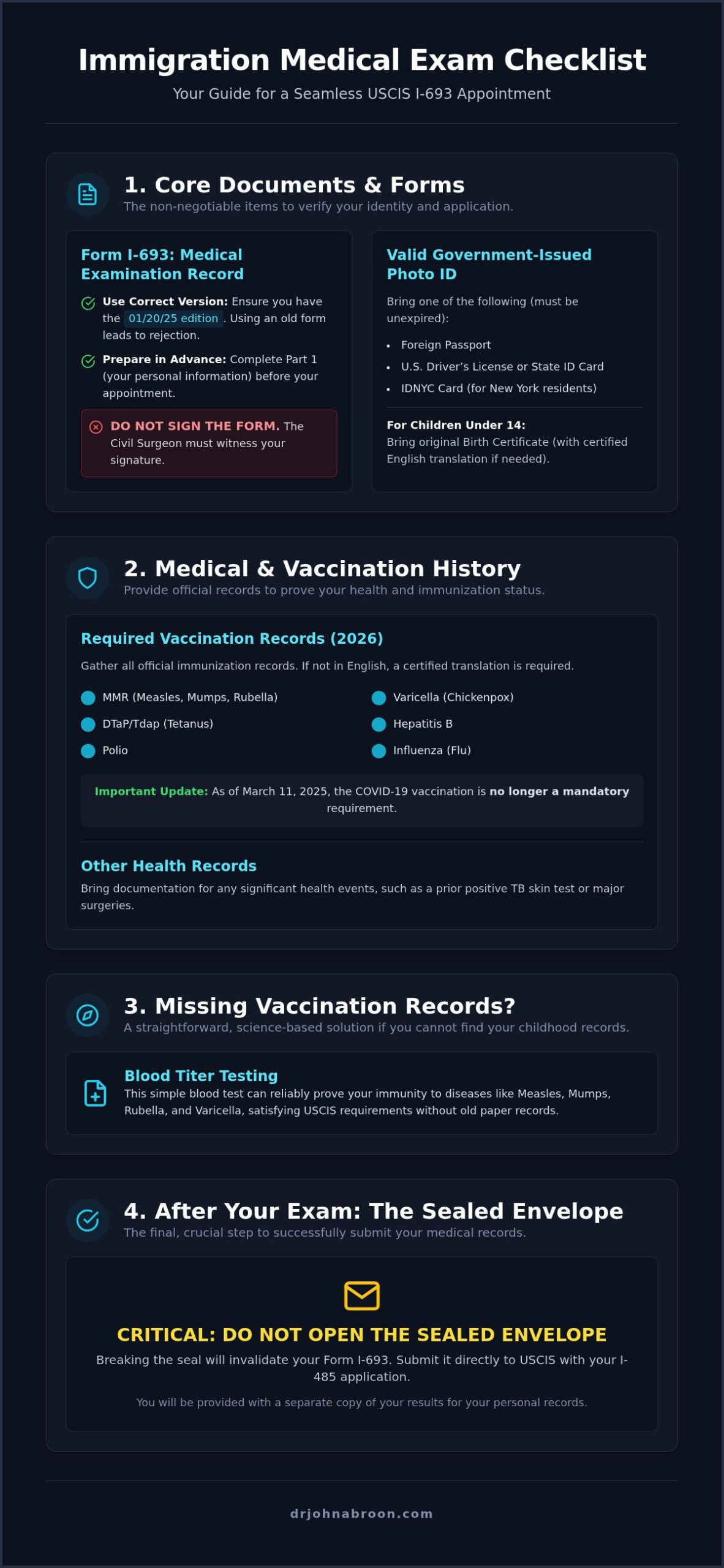
You must use the most current edition of Form I-693, titled the Report of Immigration Medical Examination and Vaccination Record. As of the current 2026 standards, USCIS only accepts the 01/20/25 edition. Using an outdated form version is the leading cause of administrative rejection, which can delay your residency by months. We recommend downloading the form directly from the official USCIS website to ensure you have the correct file. You should complete Part 1, which covers your personal information, before you arrive at our Upper East Side office. However, don’t sign or date the form. Dr. Abroon must witness your signature during the physical evaluation to certify the document’s legal integrity.
Valid Identification for International Applicants
A valid, government-issued photo ID is non-negotiable for every applicant. For most individuals, this is an unexpired foreign passport. If your passport is currently held by a consulate or USCIS for processing, you may provide a valid U.S. driver’s license or a state-issued identification card. New York residents also have the option to utilize the IDNYC card as a reliable form of identification. It’s vital that the name on your ID matches the name on your immigration filings exactly to avoid any discrepancies in your record.
Specific requirements apply to the youngest members of your family. For children under the age of 14, a government-issued photo ID isn’t always available. In these instances, you must bring the child’s original birth certificate. If the birth certificate is not in English, you’ll need to provide a certified translation. This level of detail protects the validity of the child’s application from the very start.
Once the clinical assessment and laboratory reviews are complete, you’ll receive the finalized I-693 in a sealed envelope. This is the “Sealed Envelope” protocol. You must not open this envelope under any circumstances. Breaking the seal renders the document void for your Form I-485 filing. Our team provides a separate copy of the results for your personal records, allowing you to keep the official version safely tucked away for USCIS.
Medical Evidence: Vaccination Records and Health History
Your medical history is the clinical heart of the I-693 process. While the previous section focused on your legal identity, this phase requires you to prove your health status through verified records. Determining exactly what to bring to immigration medical exam appointments regarding your health history can feel overwhelming, but organizing these documents ahead of time ensures Dr. Abroon can complete your assessment without requesting follow-up visits. If you’ve ever had a positive TB skin test or a significant surgery, having those specific reports ready is essential for a smooth evaluation.
The 2026 Vaccination Requirements Checklist
USCIS mandates specific immunizations to protect public health. You should gather official records from your home country, previous physicians, or school health offices. If these documents are in a language other than English, ensure you have a certified translation. For 2026, the requirements are strictly enforced based on age groups. Please note that as of March 11, 2025, the COVID-19 vaccination is no longer a mandatory requirement for immigration purposes, which simplifies the process for many applicants.
| Vaccine Type | Requirement Details |
|---|---|
| MMR (Measles, Mumps, Rubella) | Required for most applicants born after 1957. |
| DTaP/DTP/Tdap | Required for children and adults (tetanus booster every 10 years). |
| Polio (OPV/IPV) | Standard series required for children and specific adult cases. |
| Varicella (Chickenpox) | Required if no laboratory proof of immunity exists. |
| Hepatitis B | Required for children and adults through age 59. |
| Influenza (Flu) | Mandatory during the flu season (Oct 1 – March 31). |
Chronic Conditions and Specialist Clearances
If you manage a chronic condition or have a history of significant illness, transparency is your best strategy. Dr. Abroon needs to confirm that your condition is stable and doesn’t pose a public health risk. For those with a history of mental health concerns or substance use, bring a summary from your treating specialist. Similarly, if you’ve previously tested positive for Tuberculosis (TB), don’t rely on memory alone. Bring copies of prior chest X-ray reports or documentation of any treatment you completed. This proactive approach prevents the need for redundant testing.
Applicants with a history of infectious diseases like Syphilis or Gonorrhea should provide records of their diagnosis and completed treatment. For a deeper look at the entire clinical journey, you can review our Immigration Medical Exam in NYC: Your Complete Guide to the I-693 Process. Providing this medical evidence upfront allows us to maintain the highest clinical standards while respecting your time. Scheduling your immigration medical exam with a dedicated civil surgeon who understands these nuances is the most reliable way to secure your residency paperwork without unnecessary stress.
Missing Records: What to Do if You Have No Proof
It’s a common source of anxiety: you’re searching for childhood immunization cards that may have been lost across borders or decades. If you cannot find your original records, don’t worry. You aren’t alone, and your application isn’t doomed. A significant part of knowing what to bring to immigration medical exam appointments is understanding the alternatives when paperwork is missing. Dr. Abroon acts as a clinical partner to help reconstruct your medical history through verified science rather than guesswork.
One rule is absolute: never guess your vaccination dates. Entering estimated dates on Form I-693 can lead to administrative red flags or requests for evidence (RFEs) that stall your progress. If you aren’t certain of a date, we rely on diagnostic proof. This high standard of accuracy is why Dr. Abroon is trusted by the metropolitan medical community to handle high-stakes immigration paperwork with precision. We ensure every entry is backed by evidence that satisfies USCIS requirements.
Titer Testing: The Scientific Alternative
A titer test is a sophisticated laboratory blood test that measures the level of specific antibodies in your system. Instead of relying on a paper record from years ago, this test provides current, objective proof that you’re immune to certain diseases. It’s an elegant solution for those with lost records. We frequently use titer testing to clear requirements for MMR (Measles, Mumps, Rubella), Varicella (Chickenpox), and Hepatitis B. Dr. Abroon’s Upper East Side office provides on-site blood draws for your convenience. This ensures your diagnostic results are integrated directly into your file without requiring extra trips to outside labs.
Translating Your Records for USCIS
If you do have records but they’re written in your native language, they must be translated into English to be valid for your I-693. USCIS has strict protocols for this process. Self-translation is not accepted, even if you’re fluent in both languages. Every translated document must be accompanied by a signed “Certificate of Translation.” This certificate, signed by a competent translator, affirms that the translation is accurate and complete.
Our Manhattan staff is deeply familiar with the diverse language backgrounds of our patient base. We can guide you on how to secure these certifications so your records meet the necessary legal and clinical standards. This attention to detail is part of our concierge-level service, ensuring that every piece of evidence in your sealed envelope is beyond reproach. By combining rigorous science with clear documentation, we make the lack of original records a manageable hurdle rather than a barrier to your residency. Knowing what to bring to immigration medical exam visits includes preparing these translations well in advance of your appointment time.
Day-of Logistics: Preparing for Your Appointment in NYC
Success during your appointment depends on more than just your folders of paperwork. Knowing what to bring to immigration medical exam visits also involves preparing your body for the physical assessment and understanding the flow of our Manhattan practice. Our goal is to move you through the process with the calm, steady care that has defined our Upper East Side office since 1997. By attending to a few simple logistics, you can ensure your results are accurate and your experience is entirely stress-free.
Physical Preparation for the Exam
Physical comfort plays a significant role in a productive consultation. Wear loose-fitting clothing with sleeves that can be easily rolled up. This makes the required blood draws and physical assessments much more efficient. While standard immigration screenings for syphilis and tuberculosis typically do not require you to skip breakfast, staying well-hydrated is essential. Drinking plenty of water makes the laboratory portion of your visit significantly easier and more comfortable.
Be mindful of your intake before the exam. You should avoid heavy caffeine or strenuous exercise for at least two hours before your appointment. These factors can temporarily elevate your blood pressure or cause minor fluctuations in an EKG reading. We want to capture your health status at its most stable and baseline level. For more information on how we approach comprehensive wellness, you can read Your Annual Physical Exam in NYC: A Complete Guide for 2026.
Arriving at Dr. Abroon’s Upper East Side Office
Arriving at our office should be the easiest part of your day. We are conveniently located for busy applicants and easily accessible via the 6 or Q subway lines. We recommend arriving 15 minutes before your scheduled time. This window allows you to settle in and complete the final intake forms without feeling rushed. Our staff provides a concierge-level intake experience, guiding you through every signature with meticulous attention to detail.
Clarity regarding payment and communication is also vital for a smooth visit. We accept various payment methods for our services, and we encourage you to confirm your specific insurance coverage or self-pay options when you book. If you are not entirely comfortable communicating in English, please feel free to bring a trusted interpreter with you. Clear communication ensures that every medical instruction and history detail is captured with 100% accuracy. Schedule your immigration medical exam today to ensure every detail of your residency paperwork is handled by a board-certified expert who prioritizes your peace of mind.
Why Dr. Abroon is the Preferred NYC Civil Surgeon for I-693
Dr. John Abroon provides a sophisticated medical experience that far exceeds the standard clinic visit. As a board-certified internist and USCIS-designated Civil Surgeon since 1997, he offers elite credentials rooted deeply in the Manhattan medical community. While other providers might simply check boxes, Dr. Abroon approaches every I-693 with the same clinical rigor he applies as a Primary Care Physician in NYC. This level of authority ensures your health is evaluated thoroughly and your paperwork is handled with absolute precision. We position our practice as a “safe pair of hands” for those navigating the high stakes of the immigration process.
We understand that your time is valuable in a fast-paced urban environment. Many applicants feel overwhelmed when they learn what to bring to immigration medical exam appointments, especially when it involves coordinating multiple lab visits across the city. Our Upper East Side office minimizes this stress by providing on-site diagnostic testing, including blood work and EKGs. By offering these essential services under one roof, we reduce the number of visits required and maintain total control over the accuracy and security of your results. This concierge-level attention to detail is designed to make complex medical requirements feel manageable and steady.
Avoiding the “RFE” Trap
A single clerical error or an overlooked signature on your I-693 can trigger a Request for Evidence (RFE) from USCIS. These requests often lead to months of unnecessary delays in your residency process, causing significant anxiety. Dr. Abroon’s reputation for meticulousness is well-earned over nearly three decades of service. Our staff performs a comprehensive review of every document before the final seal is applied to the envelope. We take pride in our ability to help patients get it right the first attempt, providing the earned confidence that comes with elite medical care.
Schedule Your Appointment Today
Our practice is located in a prime Manhattan location, situated conveniently near major NYC immigration legal offices. This proximity allows you to coordinate your medical and legal requirements with ease. When you are ready to finalize your checklist of what to bring to immigration medical exam appointments, our team is here to guide you through the next steps. We invite you to experience a premium medical environment where high-end expertise meets genuine human connection. You can book your consultation through our website or by calling our office directly. Schedule your USCIS Medical Exam with Dr. Abroon today and ensure your path to residency is supported by a trusted expert who prioritizes your total well-being.
Your Path to a Successful Residency Application
Securing your residency is a journey that requires meticulous attention to detail. By following this 2026 checklist, you’ve taken a significant step toward ensuring your medical exam is a smooth, single-visit success. Remember that the foundation of your appointment lies in having the correct 01/20/25 edition of Form I-693 and unexpired identification. If you find your childhood immunization records are missing, don’t let anxiety take over. Scientific solutions like titer testing provide the objective proof USCIS requires without the need for guesswork.
Preparation is the key to a stress-free day. Organizing what to bring to immigration medical exam appointments ahead of time allows you to focus on the next phase of your life rather than administrative hurdles. At our Upper East Side practice, we combine elite medical credentials with a concierge approach to paperwork. As a board-certified internist and USCIS-designated civil surgeon since 1997, Dr. Abroon provides the on-site laboratory and vaccination services you need for a complete file.
Book Your NYC Immigration Medical Exam with Dr. Abroon today to secure your appointment with a trusted expert. We look forward to supporting you on this important milestone in your health and residency journey.
Frequently Asked Questions
Do I need to bring my own I-693 form to the appointment?
Yes, you should bring a printed copy of the most current Form I-693 to your appointment. For 2026, USCIS requires the 01/20/25 edition. Complete Part 1 of the form before you arrive, but you must not sign it until Dr. Abroon instructs you to do so during your physical evaluation. This ensures your signature is witnessed by a designated civil surgeon, which is a mandatory requirement for the legal validity of your document.
Can I get my required vaccinations at Dr. Abroon’s office during the exam?
Yes, Dr. Abroon’s Upper East Side office is equipped to provide all required vaccinations and on-site laboratory testing during your visit. This “all-in-one” approach is a core part of our concierge experience, designed to minimize the number of trips you need to make across NYC. When you’re considering what to bring to immigration medical exam appointments, having your previous records helps us determine exactly which immunizations you still need to meet current 2026 standards.
What happens if I have a positive TB test result?
If your initial TB blood test (IGRA) returns a positive result, it doesn’t mean your application is denied. It simply indicates that you’ve been exposed to the bacteria. In these cases, Dr. Abroon will require a chest X-ray to rule out active, infectious Tuberculosis. Our team will guide you through this diagnostic step with care, ensuring that all necessary medical clearances are documented correctly in your final report to satisfy USCIS public health requirements.
How long is the I-693 medical exam valid in 2026?
For forms signed on or after November 1, 2023, the I-693 remains valid for as long as your associated immigration application is pending with USCIS. This policy remains in effect for 2026, providing applicants with significant peace of mind. However, if your underlying application is denied or withdrawn, the medical results lose their validity. Understanding these timing nuances is essential for a successful filing, and our staff stays updated on all regulatory changes to protect your status.
Is the cost of the immigration medical exam covered by health insurance?
Most private health insurance plans don’t cover the cost of a medical examination performed specifically for immigration purposes. These exams are considered an administrative requirement rather than a standard clinical necessity. However, some plans may cover the cost of specific vaccinations or laboratory tests required during the process. We recommend contacting your insurance provider directly to verify your coverage details. Our office provides clear, transparent information regarding our self-pay options to help you plan your visit.
What if I am pregnant? Do I still need all the vaccinations?
If you’re pregnant or planning to become pregnant, certain vaccinations, particularly live virus vaccines like MMR or Varicella, may be medically deferred. Dr. Abroon will evaluate your health and provide the necessary waivers based on current medical guidelines. Regarding TB screening, a chest X-ray can often be performed with proper abdominal shielding, or it may be postponed. We prioritize the safety of both mother and child while ensuring your immigration paperwork remains fully compliant.
Can I bring a family member to translate for me?
Yes, you’re welcome to bring a family member or a professional interpreter if you feel more comfortable communicating in your native language. Accurate communication is vital when discussing your health history and understanding what to bring to immigration medical exam visits. While Dr. Abroon’s staff is experienced in working with a diverse patient base, having a dedicated person to assist with translation can provide an extra layer of reassurance and ensure every clinical detail is captured precisely.
How long does it take to get the final sealed envelope?
The timeline for receiving your sealed I-693 envelope typically ranges from three to seven business days. This duration depends primarily on the processing time for your laboratory results, such as the TB blood test and syphilis screening. Once all diagnostic data is returned and reviewed for accuracy, Dr. Abroon will sign the form and seal it in the mandatory envelope. We will notify you immediately when your documents are ready for pickup at our Manhattan office.