Civil Surgeon in NYC: Your Complete Guide to USCIS Medical Exams (2026)
Posted .
Last Tuesday, a patient walked into our Upper East Side office with a thick stack of USCIS paperwork and a look of visible exhaustion. They had spent over 15 days trying to coordinate with their regular primary care physician, only to find that a standard physical cannot fulfill the federal requirements for Form I-693. It’s a common hurdle. You’re likely feeling the same pressure to ensure every detail of your green card application is flawless. You need a designated civil surgeon who understands the specific legal nuances of immigration medicine to prevent costly RFE notices that can delay your residency for months.
Our practice, led by top-rated internist John Abroon M.D., provides the comprehensive care and precise documentation required to move your application forward. This guide clarifies the exact role of a civil surgeon, outlines the updated 2026 vaccination mandates, and explains what you can expect during your personalized diagnostic exam in our Manhattan facility. We’ll show you how to secure a correctly sealed medical envelope so you can approach your USCIS interview with total confidence.
Key Takeaways
Understand the specific legal requirements and the vital role a civil surgeon plays in securing your green card approval through the USCIS medical exam.
Learn how to distinguish between a civil surgeon and a panel physician to ensure you schedule the correct evaluation based on your current physical location.
Discover the essential medical records and documentation you must gather to streamline your appointment and avoid common processing delays.
Identify the unique advantages of visiting a board-certified internist for a personalized, comprehensive exam rather than a high-volume clinic.
Gain clarity on how health-related grounds of inadmissibility are screened, ensuring you feel prepared and empowered throughout the immigration process.
What is a USCIS Civil Surgeon and Why Are They Required?
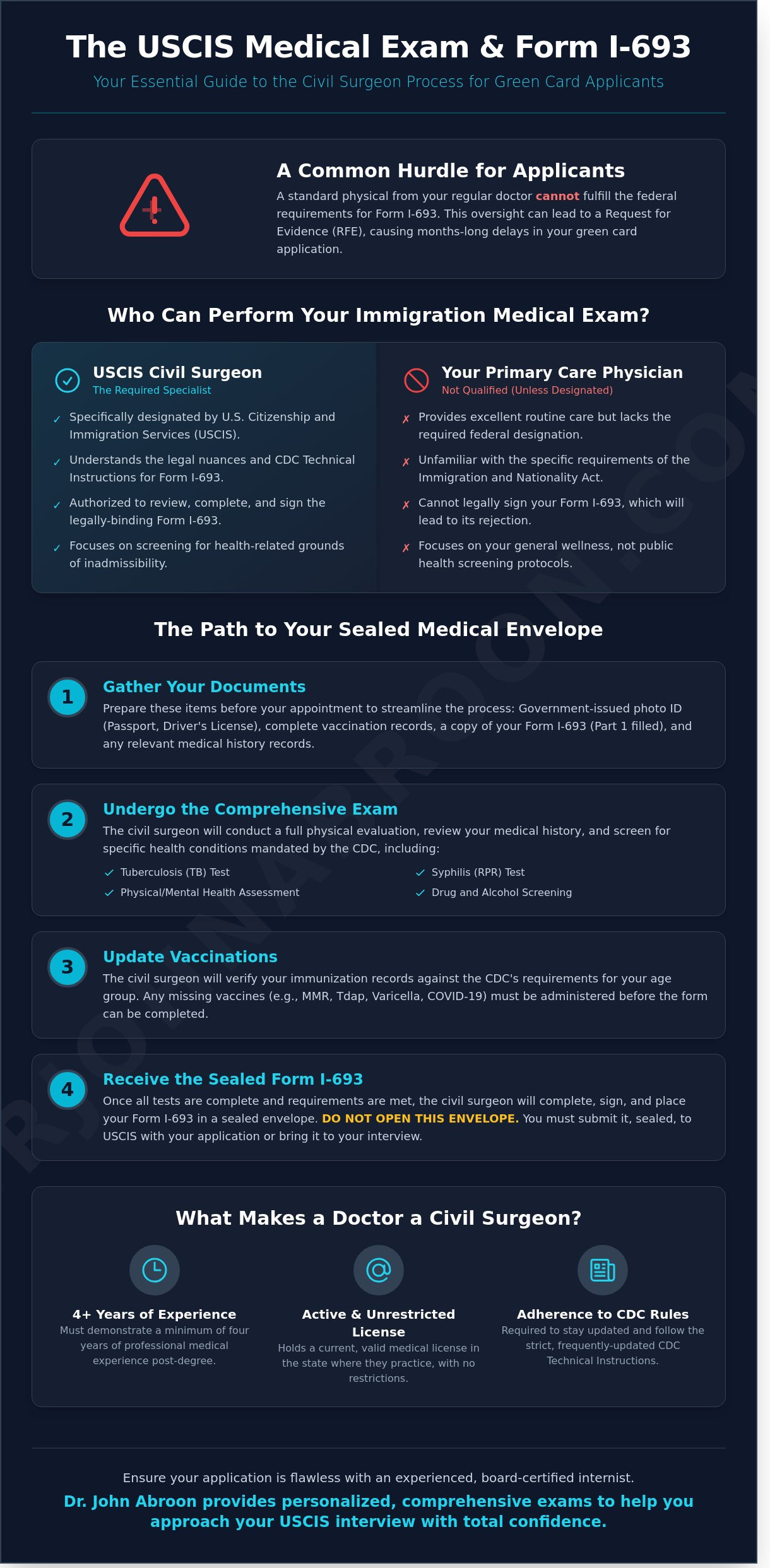
A civil surgeon is a licensed, experienced physician who has received a specific designation from U.S. Citizenship and Immigration Services (USCIS) to perform medical examinations for individuals applying for immigration benefits. While your primary care doctor provides excellent routine care, they cannot sign your Form I-693 medical results unless they hold this federal designation. To understand the full scope of this role, it helps to ask: What is a Civil Surgeon? Essentially, these doctors act as agents of public health, ensuring that every person seeking permanent residency meets the health standards established by federal law.
This designation serves a vital purpose within the United States healthcare system. The federal government requires these specific evaluations to protect the domestic population from communicable diseases and other health related conditions that could pose a public safety risk. By centralizing this responsibility among a select group of vetted physicians, USCIS maintains a high level of consistency and accuracy in medical reporting. This process ensures that every applicant receives a comprehensive screening that adheres to strict government protocols, regardless of which city they reside in.
The primary reason your regular physician cannot perform this exam involves the specialized nature of the paperwork and the legal weight it carries. The Form I-693 is a legal document, and the physician’s signature certifies that the applicant is not “inadmissible” on health grounds under Section 212(a)(1)(A) of the Immigration and Nationality Act. Because the consequences of an error can lead to a denied application, USCIS only trusts doctors who have demonstrated a deep understanding of immigration law and the specific diagnostic criteria required by the Centers for Disease Control and Prevention (CDC).
The Legal Requirement for Adjustment of Status
When you apply for a green card through the adjustment of status process, you’re transitioning from a temporary visa to Lawful Permanent Resident status. This shift is governed by federal mandates rather than state laws. Every applicant must undergo a medical exam to prove they don’t have conditions like active tuberculosis or syphilis, which are listed as significant public health risks. This requirement has been a cornerstone of U.S. immigration policy since the early 20th century, ensuring that the transition to permanent residency is safe for both the applicant and the community.
The USCIS Designation Process for Doctors
Attaining the status of a civil surgeon requires a doctor to undergo a rigorous application process. A physician must prove they have at least 4 years of professional medical experience and hold an active, unrestricted license in the state where they practice. They must also demonstrate that they’re currently engaged in a clinical practice. Once designated, these doctors are required to stay updated on the CDC Technical Instructions, which are updated frequently to reflect new vaccination requirements or screening methods. This ongoing education ensures that your exam reflects the most current medical standards required by the federal government.
Working with a dedicated professional like Dr. John Abroon provides the reassurance that your medical exam will be handled with clinical precision and personalized care. We focus on making this complex federal requirement feel manageable, providing a calm environment where your health and your immigration goals are our top priority. Our practice ensures that every detail of your Form I-693 is completed accurately, helping you move forward in your journey with confidence.
The Essential Role of a Civil Surgeon in the Immigration Process
A civil surgeon serves as a specialized medical evaluator designated by the government to ensure all applicants meet the health standards required for permanent residency. This role is distinct from that of a primary care physician because the focus shifts from general wellness to public safety. The primary responsibility involves screening for health-related grounds of inadmissibility. These are specific medical conditions or histories that, according to U.S. immigration law, might prevent an individual from obtaining a green card. By performing these evaluations, the doctor acts as a vital bridge between the applicant’s private health status and the legal requirements of U.S. Citizenship and Immigration Services (USCIS).
Technical precision is the hallmark of a successful examination. Any oversight, such as a missing date or an unchecked box on the official paperwork, can trigger a Request for Evidence (RFE). An RFE often delays an immigration application by 60 to 90 days, adding unnecessary stress to an already complex process. To avoid these setbacks, it is essential to Find a USCIS-Designated Civil Surgeon who maintains a rigorous protocol for document review. Adhering to the most current CDC Technical Instructions ensures that every screening, from blood work to vaccination verification, aligns with federal mandates.
Completing the Form I-693: Report of Medical Examination
The Form I-693 is the definitive record of your medical fitness. The civil surgeon must meticulously complete sections detailing your vaccination history, physical exam results, and lab findings. Once finished, the doctor signs the form and places it in a specialized envelope. You’ll receive this envelope in a sealed state; it’s vital that you don’t open it. If the seal is broken, USCIS will reject the document immediately. As of 2026, the validity of a signed I-693 remains indefinite if it was signed after November 1, 2023, which provides applicants with significant flexibility during long processing windows.
Screening for Communicable Diseases and Health-Related Grounds
The medical screening focuses on identifying “communicable diseases of public health significance.” This includes mandatory testing for Tuberculosis via an IGRA blood test, Syphilis (RPR), and Gonorrhea for specific age groups. Beyond physical ailments, the exam includes a mental health evaluation to identify disorders associated with harmful behavior. If there’s a past medical history of substance use, the doctor evaluates whether the condition is in remission according to specific CDC criteria. Our team at the office of Dr. John Abroon approaches these sensitive screenings with a blend of clinical expertise and personal empathy, ensuring your history is documented accurately and fairly.
Every step of this process is governed by strict adherence to the law, yet the experience doesn’t have to feel clinical or cold. A qualified physician ensures that all 15 plus required vaccinations are accounted for or administered. They translate complex medical findings into the specific format required by immigration officers. This specialized oversight protects the community while providing you with a clear, compliant path toward your new life in the United States. It’s a high-stakes task that requires a professional who is both a medical expert and a knowledgeable guide through the bureaucratic landscape.
Civil Surgeon vs. Panel Physician: Understanding the Key Differences
The primary distinction between a civil surgeon and a panel physician rests entirely on your physical location during the application process. If you’re applying for permanent residency from within the United States, you must visit a civil surgeon. These medical professionals are designated by U.S. Citizenship and Immigration Services (USCIS) to perform the I-693 medical examination. In contrast, panel physicians are doctors located outside the United States who are designated by the Department of State. They perform exams for individuals undergoing consular processing at U.S. Embassies or Consulates abroad.
While their titles differ, both roles require strict adherence to the medical screening criteria established by the Centers for Disease Control and Prevention (CDC). These standards were updated as recently as April 4, 2024, to reflect new vaccination requirements and screening protocols for communicable diseases. You cannot substitute one for the other. If you’re currently living in New York City and filing for an adjustment of status, a medical report from a panel physician in your home country won’t be accepted by USCIS. You’ll need a fresh examination from a locally authorized expert to ensure your health documentation meets current domestic standards.
The oversight bodies also differ significantly. USCIS maintains the official list of doctors authorized to perform these exams domestically. You can use the official tool to Find a Civil Surgeon in your area to confirm a doctor’s current standing. Panel physicians, however, operate under the jurisdiction of the Bureau of Consular Affairs. This distinction ensures that every applicant, regardless of their starting point, undergoes a standardized medical evaluation that protects public health within the United States.
When to See a Civil Surgeon (Inside the U.S.)
You’ll need to schedule an appointment with a civil surgeon if you’re pursuing the “Adjustment of Status” pathway. This process is for individuals already physically present in the U.S. on a valid visa who wish to transition to lawful permanent resident status. It’s a common requirement for those on H1-B specialty occupation visas, L-1 intracompany transfer visas, or K-1 fiancé visas after they’ve arrived and married. For Manhattan residents, seeing a local expert like Dr. Abroon provides a seamless, concierge-style experience. We manage the complex Form I-693 paperwork with precision, ensuring your medical history and vaccination records align perfectly with the latest USCIS 2024 guidelines. This local accessibility eliminates the stress of travel and provides a direct point of contact for any follow-up diagnostic needs.
Navigating these employment-based visas involves significant legal complexities beyond the medical exam. For those managing business or investment matters between the U.S. and Israel, for example, partnering with a specialized legal team like the Israel Cross Border Law Firm can be essential for a successful outcome.
When a Panel Physician is Required (Consular Processing)
Panel physicians are the required choice for applicants currently residing outside the United States. This path, known as consular processing, involves attending a medical interview in your country of residence before your visa is granted. These doctors are specifically appointed by the local U.S. Embassy or Consulate to handle high volumes of immigrant visa applicants. Unlike the paper-based I-693 forms used by a domestic civil surgeon, panel physicians typically submit their findings electronically. Most use the eMedical system, which transmits results directly to the Department of State. This digital integration speeds up the processing of the roughly 500,000 immigrant visas issued annually through overseas consulates. Once you enter the U.S. on an immigrant visa processed this way, you generally don’t need a new exam from a civil surgeon unless your initial results have expired or specific health follow-ups were mandated.
How to Prepare for Your Appointment with an NYC Civil Surgeon
Preparing for your immigration medical exam shouldn’t feel like a hurdle. When you visit our Upper East Side office, we prioritize a streamlined experience that respects your time and your peace of mind. Dr. John Abroon serves as a designated civil surgeon, providing the clinical authority needed to ensure your physical meets every USCIS requirement with precision. Gathering your complete medical history before you arrive is the most effective way to accelerate the process. A comprehensive record allows us to verify your health status immediately; this reduces the need for redundant testing and prevents unexpected costs during your visit.
Timing is critical for your green card application. USCIS guidelines for 2026 state that Form I-693 remains valid for two years after the civil surgeon signs it. You should ideally book your appointment at least 4 to 6 weeks before you plan to file your adjustment of status. This buffer accounts for lab processing times and any necessary follow-up shots. Many New Yorkers mistakenly wait until their interview date is looming. This creates unnecessary stress and can lead to missed deadlines if a lab result requires a retest. Our practice provides a calm, concierge-like environment to help you manage these tight windows with confidence and reliability.
Documentation Checklist: What to Bring to the Office
Arriving prepared is the best way to ensure a single-visit experience. You’ll need to provide several specific documents to satisfy federal requirements and help us complete your Form I-693 accurately. Please bring the following items to your appointment:
A valid government-issued photo ID, such as a current Passport or Driver’s License.
Comprehensive vaccination records, which must be translated into English by a certified professional if they are in another language.
Any previous chest X-rays or laboratory results related to Tuberculosis or Syphilis.
Please remember that missing or incomplete paperwork remains the number one cause of exam delays and rejected forms.
Understanding Vaccination Requirements and Lab Tests
The 2026 USCIS requirements include several mandatory immunizations to protect public health. During your exam, we’ll verify that you’re up to date on MMR (Measles, Mumps, Rubella), Polio, Tetanus and Diphtheria (Tdap), and Varicella. The COVID-19 vaccination remains a strict requirement for most applicants, and you must show proof of the most recent formula available. If you’re missing any doses, we can often administer them during your visit to keep your application on track. This tailored approach ensures you don’t have to visit multiple clinics to satisfy the government’s list.
Your appointment will also include mandatory blood work. These tests screen for Syphilis, Gonorrhea, and Tuberculosis for all applicants aged 18 to 44, though requirements vary for children and seniors. Lab results typically take 3 to 5 business days to process. If a test returns a positive result, you might need a return visit for a chest X-ray or further diagnostic evaluation. This is a standard part of the preventative screening process. Our team handles these steps with the personalized care you expect from a top-rated internist, ensuring you feel supported throughout every stage of the diagnostic journey.
Choosing Dr. John Abroon as Your NYC Civil Surgeon
Selecting the right medical professional for your immigration physical isn’t just a bureaucratic requirement; it’s a critical step in your path to residency. While many providers in New York City offer these exams, Dr. John Abroon brings the specialized insight of a board-certified internist to the process. Since establishing his practice on the Upper East Side in 1997, Dr. Abroon has spent over 25 years navigating the complexities of the New York medical landscape. Choosing a seasoned internist ensures that your exam goes beyond a simple checklist. If a diagnostic issue arises during your screening, you’re already in the hands of a diagnostic expert who can manage the situation immediately. This eliminates the need for external referrals that often cause significant delays.
Many high-volume clinics in Manhattan operate like assembly lines, sometimes processing 40 or 50 applicants in a single afternoon. These “exam mills” often lack the personal touch required to address unique health concerns or complex histories. Dr. Abroon prioritizes a tailored approach, dedicating the necessary time to every individual. His office at 34 East 72nd Street combines a sophisticated clinical environment with the latest medical technology. This ensures that every patient receives a comprehensive evaluation in a setting that feels professional and calm. You won’t feel like just another number in a waiting room; you’ll receive the focused attention of a top-rated physician who values your total well-being.
Concierge-Level Care for Your Immigration Journey
The atmosphere at our 72nd St. clinic reflects Dr. Abroon’s commitment to patient-centered care. We understand that the immigration process is often stressful and demanding. Our team provides a supportive environment where we handle complex medical histories with genuine compassion and clinical precision. Accuracy is our highest priority. We meticulously review every detail of your USCIS forms to prevent technical errors that could stall your application. This proactive focus on detail has helped thousands of patients complete their medical requirements since the practice opened. We ensure your paperwork is finished correctly the first time, saving you weeks of potential frustration.
Booking Your Civil Surgeon Appointment in Manhattan
Scheduling your consultation is straightforward and efficient to respect your busy schedule. You can call our office directly at (212) 288-0900 to find a time that works for you. We provide on-site diagnostic services, including blood draws and EKGs, so you don’t have to visit multiple facilities across the city. As a trusted civil surgeon, Dr. Abroon remains a premier choice for the international community in New York. We use state-of-the-art equipment to ensure your results are both fast and accurate. You’ll leave our office with the confidence that your health and your immigration status are in expert hands. We look forward to supporting you through this final medical milestone of your journey.
Secure Your Future with Expert USCIS Guidance
Completing your I-693 medical exam is a pivotal milestone in your immigration journey. It’s more than just a checklist; it’s about ensuring your documentation meets the rigorous 2026 USCIS standards for clinical accuracy. By understanding the differences between a panel physician and a designated civil surgeon, you’ve already taken a significant step toward a successful application. You don’t have to navigate these complex requirements alone or worry about administrative delays that could impact your status.
Dr. John Abroon brings 25+ years of experience as a board-certified internist to every consultation. Located conveniently on the Upper East Side, his practice combines elite medical expertise with a personalized, concierge-style approach. Whether you’re finalizing your permanent residency or adjusting your status, his deep familiarity with USCIS protocols ensures your exam is handled with the highest level of care and precision. This steady, reliable support allows you to focus on your new life in New York City while we manage the medical details. Schedule your immigration medical exam with Dr. John Abroon in NYC today. We’re here to provide the clarity and clinical excellence you deserve as you move forward with confidence.
Frequently Asked Questions
How do I find a USCIS designated civil surgeon near me in NYC?
You can find a USCIS designated civil surgeon by visiting the official USCIS website and using their “Find a Doctor” tool. Dr. John Abroon, a top-rated internist, provides these specialized exams at his Upper East Side office located at 34 East 72nd Street. We ensure every step of your application meets the 100% accuracy standard. This helps you avoid the common delays that affect 15% of applicants.
What is the difference between a civil surgeon and a regular doctor?
A civil surgeon is a doctor authorized by U.S. Citizenship and Immigration Services to perform specialized medical exams, while a regular doctor lacks this specific federal designation. Your primary care physician can treat your daily health needs, but they cannot legally sign Form I-693. Only an authorized professional can verify your health status for green card processing. This ensures your medical records comply with the strict 2024 CDC Technical Instructions.
Can a civil surgeon perform the exam via telemedicine?
No, a doctor cannot perform an immigration medical exam via telemedicine because the law requires a physical evaluation. USCIS regulations mandate an in-person assessment that includes a physical exam, blood tests, and a review of your vaccination history. At our NYC clinic, we conduct 100% of these evaluations face-to-face. You’ll need to visit our office for the required TB screening and syphilis testing.
How much does a civil surgeon charge for an immigration medical exam in NYC?
In New York City, the cost for an immigration medical exam typically ranges from $350 to $600 depending on the complexity of your health history. This fee covers the physical examination and the preparation of the sealed Form I-693. Lab tests for conditions like Syphilis or Gonorrhea often incur separate charges. We provide a transparent pricing structure. You won’t face unexpected costs during your visit to our Manhattan facility.
What happens if the civil surgeon finds a medical issue during the exam?
If a medical issue is identified, Dr. Abroon will discuss the findings with you and provide a clear path for treatment or referral. Finding a condition doesn’t mean your green card will be denied. Most issues fall under Class B conditions, which require notification but don’t prevent immigration. Only Class A conditions, such as active tuberculosis, require successful treatment before your Form I-693 can be finalized.
How long is the medical exam valid after the civil surgeon signs it?
Under the USCIS policy update effective April 4, 2024, any Form I-693 signed by an authorized doctor on or after November 1, 2023, does not expire. This change provides permanent validity for the medical exam in your immigration record. If your form was signed before that 2023 date, it typically remains valid for 2 years. This new rule simplifies the process for thousands of NYC applicants.
Do I need to bring my own Form I-693 to the civil surgeon’s office?
You don’t need to bring a blank copy of Form I-693 because our office provides the most current 14-page version for you. We maintain the latest government documents to ensure your application uses the correct edition. You should bring your government-issued photo ID and any official vaccination records you have. Having these documents ready allows our team to complete your file with precision.
Can a civil surgeon waive vaccination requirements for religious reasons?
A doctor cannot personally waive your vaccination requirements for religious or moral reasons. While we record your objections on Form I-693, only USCIS officers have the legal authority to grant a waiver. You’ll need to file Form I-601, Application for Waiver of Grounds of Inadmissibility, directly with the government. Approximately 5% of applicants seek these exemptions. We ensure your specific objections are documented accurately according to federal guidelines.