


Did you know that approximately 12% of adjustment of status denials in FY2025 were caused by medical issues, often stemming from simple vaccination errors? It’s completely natural to feel a sense of anxiety as you prepare for your USCIS appointment. Navigating foreign medical records while managing the logistics of a busy Manhattan schedule can feel overwhelming. You’ve worked hard on your application, and the last thing you want is a delay because of a missing document or an overlooked requirement.
This guide provides the clarity you need by detailing exactly what to bring to immigration medical exam nyc to ensure a seamless experience. We’ve compiled a foolproof 2026 checklist that covers mandatory identification, updated vaccination rules, and the specific medical records required by a civil surgeon. You’ll learn how to prove immunity without old records and how to navigate the latest USCIS policy changes, including the requirement to file your medical results alongside your initial application. By the end of this article, you’ll have a clear roadmap for a stress-free visit to our Upper East Side practice.
Key Takeaways
- Identify the specific forms of non-negotiable identification, such as a valid passport or U.S. driver’s license, required to establish your identity for the I-693 form.
- Understand exactly what to bring to immigration medical exam nyc, including childhood immunization records and the requirement for certified English translations of all foreign documents.
- Learn how to access the most current version of Form I-693 and which specific sections you’re responsible for completing before your appointment begins.
- Prepare for your visit to our Upper East Side office with practical logistics, including why you don’t need to fast for your required diagnostic blood work.
- Discover the advantages of a concierge-style medical exam that treats your USCIS requirement as a comprehensive health check rather than a simple administrative hurdle.
Mandatory Identification: Proving Your Identity to USCIS
Establishing your identity is the cornerstone of the entire immigration medical process. Without verified identification, our office cannot legally certify your Form I-693. This requirement exists because the medical exam is a formal legal procedure designed to evaluate health-based grounds for inadmissibility. To understand the legal framework behind these screenings, it’s helpful to look at the history of the Medical exclusion of immigrants, which underscores why accuracy in identification is so strictly enforced. When you’re considering what to bring to immigration medical exam nyc, your primary identification document is the most vital item on the list.
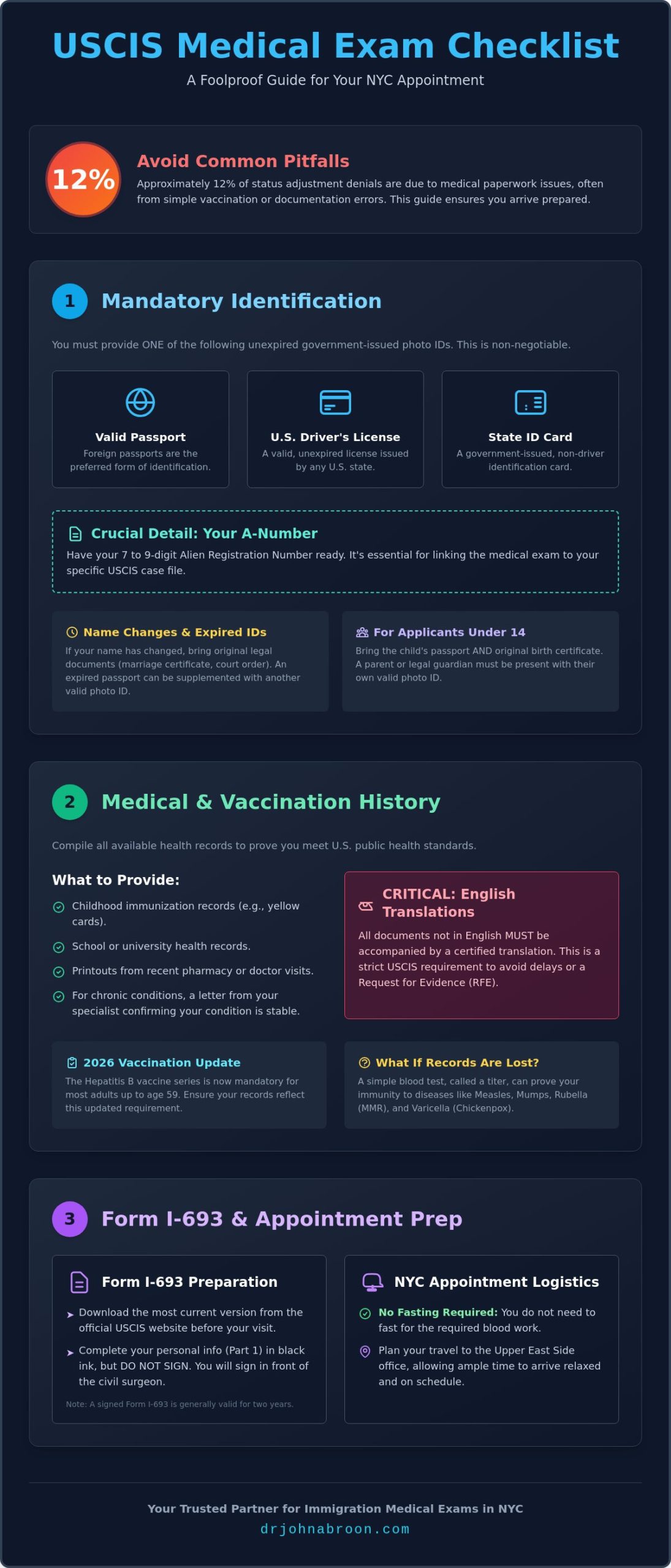
Our Upper East Side practice requires one of the following primary, unexpired documents to begin your appointment:
- A valid, unexpired foreign passport
- A U.S. Driver’s License
- A government-issued State Identification Card
Your Alien Registration Number, or “A-Number,” is also essential. This 7 to 9-digit number identifies your specific case in the USCIS system. Dr. Abroon’s team carefully cross-references your ID with your I-693 form to ensure every detail matches your official immigration records. Knowing exactly what to bring to immigration medical exam nyc helps you arrive at our office with confidence and peace of mind. This meticulous verification process reflects our commitment to clinical excellence and protects your application from administrative delays.
What to Do if Your Passport is Expired
If your foreign passport has expired and you’re waiting for a renewal, don’t panic. You can often use a secondary form of government-issued photo identification, such as a valid U.S. driver’s license. It’s vital that the name on your ID exactly matches the name on your USCIS application. If your name has changed due to marriage or a legal decree, you must bring the original court documents or marriage certificate to bridge the gap between your old ID and your current legal name. Because a signed Form I-693 is now generally valid for two years, getting the identification right at the start ensures your documentation remains robust throughout your application process.
Special Considerations for Minor Applicants
For children under the age of 14, the identification process is slightly different but equally rigorous. While a passport is preferred, we also require the child’s original birth certificate to establish the parental relationship. A parent or legal guardian must be present during the entire exam. The guardian needs to provide their own valid government photo ID to sign the necessary consent forms. This ensures that every member of your family receives the same high standard of personalized care that defines our Manhattan practice.
Vaccination Records and Medical History: What You Must Provide
Your medical history is much more than a list of past doctor visits. It is a clinical narrative that proves you meet the health standards required for residency. When preparing your documents, focus on gathering every piece of immunization data you possess. This includes childhood yellow cards, school health records, and printouts from recent pharmacy visits. If these records are in a language other than English, you must provide a certified translation. This ensures our team can accurately transcribe your history into the Form I-693 without any ambiguity or delay. Accuracy at this stage is the best way to avoid a Request for Evidence (RFE) later in your application process.
The standards for 2026 have specific requirements that differ from previous years. For instance, the Hepatitis B vaccine series is now mandatory for most adults through age 59, representing a shift toward broader public health protection. The 2026 ACIP vaccination schedule for immigration applicants mandates age-specific immunizations to ensure public health safety across the United States. Beyond vaccines, if you manage a chronic condition like heart disease or diabetes, please bring a brief letter from your specialist. This letter should state that your condition is stable and under control. Providing this proactive documentation allows Dr. Abroon to clear you quickly while maintaining the high standard of clinical authority our Upper East Side patients expect.
The ‘What If’ of Lost Records: Titer Testing
It is common for records to go missing during international moves. If you cannot find proof of your Measles, Mumps, Rubella (MMR) or Varicella vaccinations, we can perform titer testing. This simple blood test measures the level of antibodies in your system to prove you are already immune. Many of our patients prefer titers because they prevent the need for unnecessary injections. If you’re feeling unsure about your specific requirements, reviewing an Immigration Medical Exam in NYC: Your Complete Guide to the I-693 Process can help clarify your next steps.
Documenting Prior Treatment for TB or Syphilis
If you have ever tested positive for Tuberculosis (TB) or Syphilis, you must bring your previous treatment records. Modern USCIS standards require the Interferon-Gamma Release Assay (IGRA) blood test for TB screening rather than the older skin tests. If you have had a positive IGRA test in the past but completed treatment, your clear chest X-ray report and treatment completion certificate are essential. Having these items ready when you consider what to bring to immigration medical exam nyc ensures your appointment remains efficient. If you have questions about your specific medical history, scheduling a consultation with our boutique practice can provide the personalized reassurance you need for a successful exam.
Form I-693 and Administrative Preparation
The Form I-693 is more than a simple medical report; it’s a legal document that demands absolute precision. As of July 2026, USCIS strictly requires the 01/20/25 edition of the form. Using an outdated version will result in an immediate rejection of your medical results. When you are planning what to bring to immigration medical exam nyc, having a cleanly printed copy of this form is a great starting point, though our office can also provide one for you. We recommend completing the applicant information sections in black ink only. USCIS scanners are highly sensitive. Even a small amount of correction fluid or “white-out” can lead to processing errors or a Request for Evidence (RFE).
In 2026, the trend in elite Manhattan medical practices is moving toward digital verification and streamlined reporting. While the final submission must be a physical, signed document, Dr. Abroon’s office utilizes advanced record-keeping to ensure your data aligns perfectly with CDC vaccination requirements before the ink ever touches the page. This digital-first approach minimizes administrative errors and ensures your history is captured with clinical accuracy. It allows us to focus more on your well-being and less on correcting paperwork during your visit.
Common Mistakes in Part 1 of the I-693
Errors in the introductory sections are surprisingly common and can be costly. Your home address must match your current USCIS filing exactly, including apartment numbers and zip codes. Ensure your Alien Registration Number is written clearly without any missing digits. One of the most critical rules is to leave the signature and date fields blank. You must sign the form only while in the presence of the civil surgeon. Signing early invalidates the document, which means you’ll have to start over with a fresh copy and a new appointment.
The ‘Sealed Envelope’ Protocol
Once Dr. Abroon completes his assessment and the laboratory results are finalized, you will receive your results in a sealed, tamper-evident envelope. This is a non-negotiable legal requirement for USCIS. You must never open this envelope. If the seal is broken, USCIS will reject the medical exam entirely. However, we understand you need these records for your own files. As part of our patient-centered care, we provide a full photocopy of the completed form for your personal records. Knowing exactly what to bring to immigration medical exam nyc includes understanding how to handle the documents once the exam is finished to ensure your application remains secure.
NYC Logistics: Navigating Your Appointment on the Upper East Side
Navigating the streets of Manhattan requires a plan, and your medical appointment is no different. Our practice is located in the heart of the Upper East Side, offering a serene environment that stands in stark contrast to the city’s usual pace. When you consider what to bring to immigration medical exam nyc, remember that your physical preparation is just as important as your paperwork. One common concern for patients is whether they need to fast before their visit. For the standard USCIS blood work, fasting is not required. You may eat and drink normally before your appointment, which often helps you feel more comfortable during the diagnostic process. This personalized approach ensures you remain focused and relaxed throughout your time with us.
The timeline of your visit is designed for maximum efficiency. From the moment you check in at our reception desk to the final signature on your Form I-693, we prioritize a smooth, logical flow. Because Dr. Abroon also serves as a Primary Care Physician NYC: Comprehensive Internal Medicine on the Upper East Side, our facility is equipped to handle complex health narratives with clinical authority. Most appointments are completed within a single morning or afternoon session, though your laboratory results will take a few days to process. We maintain a steady, reassuring rhythm so you never feel rushed or overlooked during this significant step in your immigration journey.
Maximizing Efficiency During Your Visit
To ensure your day goes as planned, we recommend arriving 15 minutes before your scheduled time. This allows us to finalize your administrative details without cutting into your consultation with Dr. Abroon. We perform almost all required testing on-site, including EKG and blood specimen collection, which saves you from traveling to secondary labs across the city. We suggest wearing loose, comfortable clothing with sleeves that can be easily rolled up. This simple choice facilitates a more efficient physical exam and blood draw, allowing us to focus on your total well-being rather than logistical hurdles.
Insurance and Payment Preparation
It is helpful to understand that immigration medical exams are specialized administrative procedures and are typically not covered by standard health insurance plans. We operate as a concierge-style practice, which means we provide a level of dedicated attention and administrative precision that high-volume clinics cannot match. We accept various payment methods for your convenience. While there is a cost associated with the exam, the investment in a board-certified internist with over 25 years of experience often saves you money in the long run. By ensuring your application is perfect the first time, you avoid the significant expense and stress of Requests for Evidence (RFEs) or application denials. If you are ready to secure your appointment, contact our Upper East Side office today to speak with our welcoming staff.
Why Choose Dr. John Abroon for Your NYC Immigration Exam?
Selecting a civil surgeon is a consequential decision in the final stage of your residency application. While many clinics offer these services, John Abroon M.D. provides the sophisticated perspective of a board-certified internist who has practiced in Manhattan since 1997. This clinical depth ensures that your exam is handled with the same rigor as a complex diagnostic case. When you are finalizing what to bring to immigration medical exam nyc, choosing a practice that prioritizes precision over volume is the best way to protect your timeline.
Our Upper East Side office operates with a boutique, patient-centered philosophy. We understand that the immigration process is inherently stressful. Our goal is to replace that anxiety with a sense of calm reliability. Because we handle everything from in-office diagnostics to the final document sealing, you won’t need to navigate multiple facilities across the city. This streamlined approach reflects our commitment to your total well-being, ensuring that your Form I-693 is accepted by USCIS without the delay of a Request for Evidence (RFE).
Expertise Beyond the Checklist
John Abroon M.D.’s background as an internist allows him to identify underlying health issues that a standard screening might miss. This comprehensive view is vital for applicants with complex medical histories who need a doctor capable of nuanced clinical judgment. The level of detail we apply to immigration exams is the same standard we use for other critical assessments, such as those found in The Definitive Guide to Pre-Operative Medical Clearance in NYC (2026). You’ll benefit from direct communication with the doctor, ensuring your case is never delegated to a rotating staff member. This personal connection fosters a level of trust that is rare in a busy metropolitan medical community.
Secure Your Future with Confidence
A successful medical exam brings you one significant step closer to your Green Card and your life in the United States. To ensure your visit is productive, double-check your final checklist before heading to the Upper East Side:
- Valid government-issued photo identification (passport or driver’s license).
- Organized vaccination records with certified English translations.
- The correct 2026 edition of Form I-693 with Part 1 drafted.
- Specialist letters for any ongoing chronic conditions.
- A proactive, calm mindset.
Preparation is the key to a stress-free experience. When you know exactly what to bring to immigration medical exam nyc, you can focus on the excitement of your next chapter. We invite you to experience the difference that expert, compassionate care makes. Book your personalized consultation at our Upper East Side practice today and take the final step in your journey with total confidence.
Secure Your Residency with Clinical Precision
Navigating the final steps of your adjustment of status requires attention to detail and a trusted medical partner. By confirming you have the correct 2026 edition of Form I-693 and organizing your translated immunization records, you’ve already cleared the biggest hurdles. Understanding exactly what to bring to immigration medical exam nyc ensures that your visit to the Upper East Side is productive and free from administrative delays. Our team specializes in verifying your health status with the accuracy that USCIS demands. This allows you to focus on your future in the United States.
Dr. John Abroon is a USCIS-Designated Civil Surgeon and Board-Certified Internist who operates a top-rated Upper East Side practice. We provide the personalized, concierge-level care you deserve during this high-stakes process. Don’t leave your application to chance with a high-volume clinic. Schedule Your I-693 Immigration Medical Exam with Dr. Abroon Today and experience the peace of mind that comes with elite medical expertise. We look forward to supporting you on this journey toward your Green Card.
Frequently Asked Questions
What vaccinations are required for the immigration medical exam in 2026?
The CDC requires age-appropriate vaccinations including Measles, Mumps, and Rubella (MMR), Tetanus and Diphtheria (Tdap), Polio, Varicella, and Hepatitis B. If your appointment falls during the flu season, which runs from October 1 to March 31, you must also provide proof of the influenza vaccine. These requirements ensure public health safety and are a non-negotiable part of the I-693 medical clearance process.
Do I need to bring a translated version of my foreign vaccination records?
Yes, you must provide certified English translations for all medical documents originally issued in another language. This is essential for the accurate transcription of your records into the official Form I-693. Clear, professional translations prevent clinical misunderstandings and help our team verify your immunization history with the precision that USCIS expects from a designated civil surgeon.
What if I have lost all my childhood immunization records?
If your records are missing, we can perform titer blood tests to prove your immunity to Measles, Mumps, Rubella, and Varicella. This is a vital consideration when deciding what to bring to immigration medical exam nyc, as it may save you from unnecessary re-vaccination. If the titer results show you lack sufficient antibodies, Dr. Abroon can administer the required shots during your visit to our Manhattan office.
Is the COVID-19 vaccine still required for the USCIS medical exam in 2026?
No, the COVID-19 vaccination is no longer a requirement for the immigration medical exam as of March 11, 2025. While this was a mandatory component for several years, current USCIS and CDC guidelines have removed it from the list of required immunizations for the I-693. You don’t need to provide proof of this specific vaccine during your 2026 appointment unless the regulations change.
How long are the I-693 medical exam results valid after the doctor signs them?
Your completed Form I-693 is generally valid for two years from the date of Dr. Abroon’s signature. USCIS has eliminated the “60-day rule,” which means you no longer need to worry about the doctor’s signature date being too close to your filing date. This change provides much-needed flexibility for applicants navigating the often-lengthy adjustment of status timeline in New York City.
Can I have my immigration medical exam if I am currently pregnant?
Yes, you can safely complete the immigration medical exam while pregnant, though certain components will be modified. Dr. Abroon will defer live-virus vaccines, such as MMR and Varicella, until after you give birth. If a chest X-ray is required due to a positive TB test, we use double lead shielding to ensure the highest level of safety for both you and your developing baby.
Do I need to fast before my blood tests for the USCIS exam?
Fasting is not required for any of the blood tests performed during your immigration physical. You can eat and drink normally before your appointment at our Upper East Side practice. In fact, staying well-hydrated and having a light meal can make the blood draw process much smoother. Our goal is to ensure your experience is as comfortable and efficient as possible.
What happens if my IGRA tuberculosis test comes back positive?
A positive IGRA test indicates that you’ve been exposed to TB bacteria, but it doesn’t necessarily mean you have an active infection. If this occurs, you’ll need a chest X-ray to rule out active tuberculosis. Knowing what to bring to immigration medical exam nyc includes having your past TB treatment records ready, which can help Dr. Abroon provide the necessary clearance for your application.