


In Manhattan, true luxury isn’t found in a marble-lined lobby but in the immediate, undivided attention of a physician who understands your entire medical history. If you’ve spent more time in a waiting room than with your actual doctor lately, you’ve likely realized that traditional primary care often fails to meet the demands of a high-performance life. Learning how to choose a concierge doctor in nyc requires looking past the surface amenities to find a practitioner who acts as your central diagnostic hub.
You deserve a healthcare partner who prioritizes proactive prevention over reactive treatments and ensures your journey is never fragmented between disconnected specialists. We understand the frustration of brief, impersonal consultations and the difficulty of reaching a provider when it matters most. This guide provides the clinical standards and essential criteria you need to identify a premier Manhattan physician who aligns with your specific health goals. We’ll examine why limited patient panels are vital for direct access, how to evaluate comprehensive preventive screenings, and the importance of a trust-based relationship in navigating the complex 2026 medical landscape.
Key Takeaways
- Shift your healthcare strategy from reactive treatments to proactive wellness by understanding the unique advantages of the Manhattan concierge model.
- Prioritize clinical excellence by verifying board certification in Internal Medicine and seeking a physician with established roots in the NYC medical community.
- Evaluate the differences between boutique private practices and hospital-affiliated programs to determine if you prefer direct access to a specific physician or a larger system.
- Learn how to choose a concierge doctor in nyc by asking specific questions about patient-to-doctor ratios to ensure you receive dedicated time during every visit.
- Discover how a seasoned internist like Dr. John Abroon provides a sophisticated blend of diagnostic authority and personalized care tailored to your health goals.
Defining Your Priorities: Why NYC Concierge Medicine is Different
Living in Manhattan requires an agile approach to health. The city’s high-stress environment and fast pace don’t leave much room for the inefficiencies of traditional primary care. When you’re managing a demanding schedule, you need a medical partner who anticipates your needs rather than just responding to crises. Understanding what concierge medicine is helps clarify why this model has become the standard for those seeking a proactive, preventive strategy. It replaces the reactive “sick care” approach with a dedicated focus on long-term wellness and immediate accessibility.
When researching how to choose a concierge doctor in nyc, it’s essential to look beyond superficial VIP perks. While a quiet waiting room and premium tea are pleasant, the true value of this model lies in high-level clinical management. You aren’t just paying for a luxury experience; you’re investing in the internist’s ability to serve as your central diagnostic hub. This requires a physician who has the time to synthesize complex data, perform thorough Annual Physical Exams, and oversee every aspect of your healthcare journey with precision.
The Limitations of Traditional NYC Primary Care
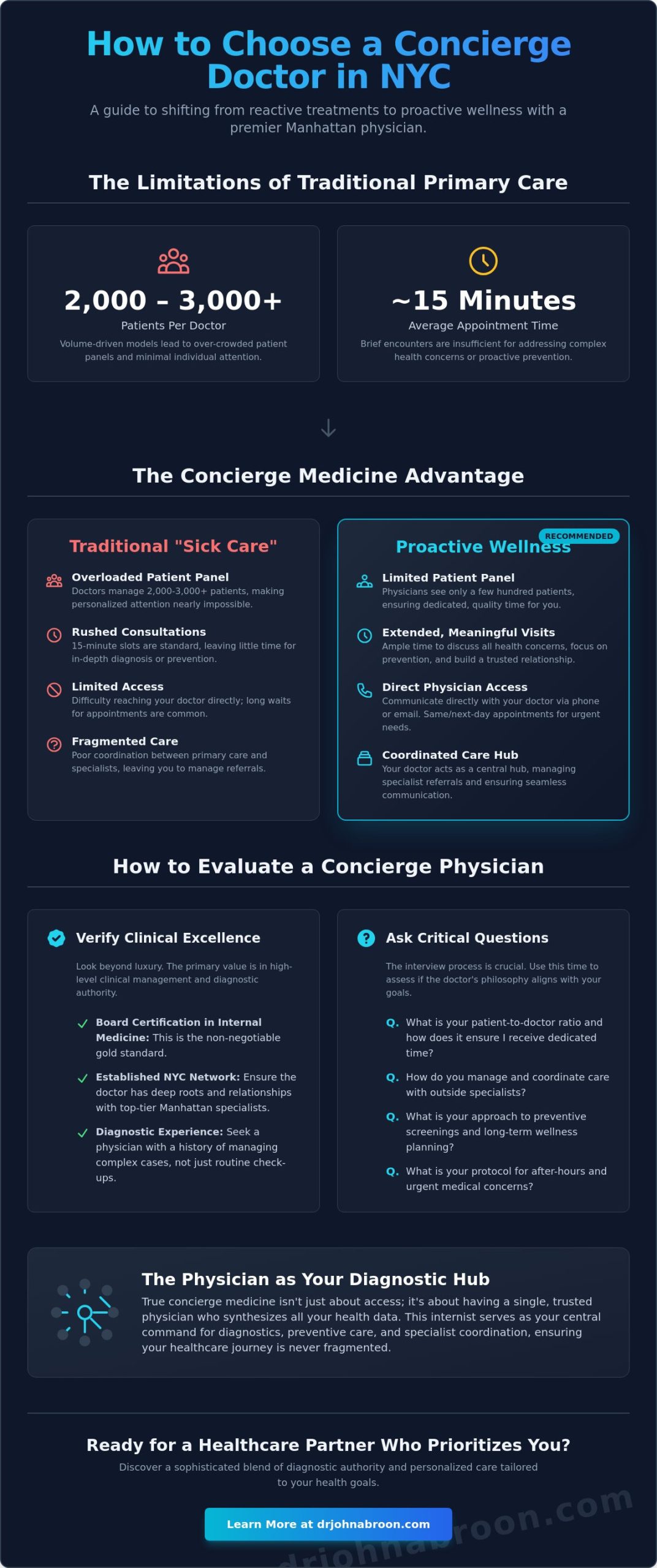
Standard insurance-based practices are typically volume-driven. In these settings, doctors may manage a panel of 2,000 to 3,000 patients, forcing them to see dozens of individuals every day just to cover overhead costs. This volume leads to the infamous 15-minute appointment. Such brief encounters are rarely enough to address chronic disease prevention or nuanced health concerns. On the Upper East Side, patients are increasingly moving away from this fragmented system. They recognize that a rushed consultation can’t replace the deep, diagnostic insight needed for true longevity.
The Core Benefits of the Concierge Model
The transition to a concierge practice provides several clinical advantages that go far beyond what a traditional office can offer. By limiting the patient panel to a few hundred people, a physician can ensure that care is always personalized. When you’re deciding how to choose a concierge doctor in nyc, consider these essential standards:
- Direct Communication: You should have a clear path to reach your board-certified internist whenever a concern arises, ensuring your questions don’t go unanswered.
- Immediate Availability: Same-day or next-day appointments for urgent medical needs help you avoid the stress of crowded urgent care centers.
- Coordinated Care: Your doctor should act as the conductor of your medical team, seamlessly managing referrals and communication with elite NYC specialists.
This model creates a steady, reliable rhythm for your healthcare. It ensures that while medical issues may be complex, your path to a solution remains clear and supported.
Evaluating Clinical Excellence: Beyond the Board Certification
Clinical synergy is the bridge between luxury service and life-saving medicine. While board certification in Internal Medicine is the gold standard baseline, it’s just the beginning of the evaluation process. A physician’s ability to synthesize data depends on their history with complex diagnostic cases. As you consider the ethical considerations of concierge medicine, remember that the primary benefit is the time your physician spends analyzing your health data rather than filling out insurance paperwork. This model allows for a depth of investigation that traditional practices simply cannot afford.
Knowing how to choose a concierge doctor in nyc involves looking for a practitioner who remains deeply embedded in the local medical community. This ensures they have established relationships with top-tier specialists across Manhattan. When a health concern becomes complex, these roots allow for a coordinated healthcare journey that feels steady and reliable. You aren’t just hiring a doctor; you’re gaining access to a curated network of medical excellence.
The Internist as a Diagnostic Hub
The cornerstone of high-level care is a comprehensive annual physical exam nyc. This shouldn’t be a generic check-up. It must be an exhaustive deep dive. A premier practice requires extensive in-office Diagnostic Testing capabilities. This includes EKGs, pulmonary function tests, and rapid lab processing. Having these tools on-site means faster answers and fewer trips to secondary facilities. Specialized knowledge in areas like Travel Medicine or Weight Loss Management further adds value, providing a holistic approach to your total well-being. If you value a physician who combines elite credentials with a warm, patient-centered approach, consider the concierge medicine services offered at our Upper East Side facility.
Vetting Years of Practice and Local Reputation
Reputation in Manhattan isn’t built overnight. When evaluating how to choose a concierge doctor in nyc, prioritize those with decades of experience on the Upper East Side. Longevity signals a practice that has successfully navigated the city’s complex healthcare environment. Look for a balance of traditional bedside manner and modern technology. While state-of-the-art facilities are vital, the healer’s touch and intuitive diagnostic skill remain irreplaceable. Peer rankings and hospital affiliations provide an objective measure of a doctor’s clinical standing. A seasoned professional who maintains these ties can offer a more seamless experience during hospitalizations or specialist referrals. This continuity of care is the hallmark of a truly sophisticated medical practice.
Choosing the Right Model: Boutique Private Practice vs. Hospital-Affiliated
Deciding between a boutique practice and a hospital-affiliated program is a pivotal step when learning how to choose a concierge doctor in nyc. Both models offer enhanced access, but they differ significantly in how that care is delivered. A boutique practice is typically physician-owned and operated. This structure removes the administrative layers that often separate a patient from their doctor. In contrast, hospital-affiliated programs provide access to a massive institutional system. While this sounds comprehensive, it can sometimes lead to a clinical environment where you are one of many in a large database.
The definition of What Is a Concierge Doctor often centers on the idea of a retainer for better access. However, the experience varies based on the physician-led approach. In a boutique setting, you build a trust-based relationship with the same internist during every visit. You won’t encounter a rotating staff of residents or “navigators” who act as gatekeepers. Instead, your board-certified physician manages your healthcare journey directly, ensuring that medical decisions are based on a deep understanding of your unique biology.
The Advantages of a Boutique NYC Practice
Privacy and discretion are paramount for many high-profile Manhattan residents. Boutique practices offer an intimate environment where your medical history remains confidential and your treatment plans are highly customized. These plans aren’t restricted by the rigid protocols often found in large hospital systems. This flexibility allows for more decisive diagnostic action and personalized preventative care. You benefit from a streamlined experience where the focus remains on your total well-being rather than institutional metrics.
When the Hospital Model Might Be Considered
Some patients consider the hospital model for its integration. Having your electronic records, imaging, and specialist notes all within one health system can be convenient. You might also gain earlier access to proprietary research or clinical trials. However, the downside is often a loss of that personalized touch. Large systems frequently involve more bureaucracy and red tape. You may find yourself speaking with a staff member rather than your actual doctor when an urgent concern arises. When determining how to choose a concierge doctor in nyc, ask yourself if you value access to a person or access to a system more.
- Consistency: Will you see the same doctor every time, or a rotating team?
- Directness: Does the model allow you to bypass call centers and administrative staff?
- Customization: Are treatment plans tailored to you or dictated by hospital policy?
The Interview: Critical Questions to Ask a Potential Concierge Doctor
Selecting your physician is an intimate process that requires more than a review of credentials; it requires a direct conversation. When you’re learning how to choose a concierge doctor in nyc, the initial consultation is your opportunity to audit the practice’s operational reality. You need to ensure that the promise of “enhanced access” translates into actual physician availability when a medical crisis occurs at an inconvenient hour. A sophisticated practice will welcome these questions, as they demonstrate your commitment to a high standard of collaborative care.
One of the most important metrics to uncover is the patient-to-doctor ratio. While a traditional primary care provider might manage 2,000 to 3,000 individuals, a premier concierge internist deliberately limits their panel to a few hundred. This specific reduction is what facilitates 30 to 60 minute appointments and same-day responses. Ask clearly about how the practice distinguishes between services covered by the annual retainer and those billed to your insurance provider. Transparency in these financial arrangements prevents future confusion and allows you to focus entirely on your health goals.
Questions Regarding Access and Logistics
“How do I reach you at 2 AM for an urgent medical question?” You should expect a direct line to your physician, not a call center or a rotating on-call service. Reliability is the cornerstone of the concierge model. You should also ask, “What is the typical wait time for a non-urgent physical exam?” In a high-functioning model, you shouldn’t wait weeks for a routine check-up. Finally, inquire about specialized needs: “How do you handle pre-operative medical clearance nyc on short notice?” Surgical schedules in Manhattan move quickly, and you need a doctor who can perform a thorough cardiac and pulmonary evaluation within 24 to 48 hours if necessary.
Questions Regarding Clinical Philosophy
Your physician’s philosophy dictates the quality of your preventive care. Ask: “How do you coordinate with my other specialists in Manhattan?” A great internist acts as the conductor of your medical orchestra, ensuring that fragments of care from cardiologists or endocrinologists are synthesized into a single, cohesive plan. This prevents the fragmented care often found in traditional systems. Inquire about their diagnostic suite as well: “What specific diagnostic tests do you perform in-house during an annual exam?” The presence of on-site EKGs or pulmonary function testing signals a commitment to immediate, data-driven action. Finally, ask how their approach to internal medicine has evolved with modern diagnostic tools. Medicine is not static, and your doctor should be at the forefront of integrating new clinical insights into your personalized wellness strategy.
If you’re ready to experience this level of dedicated, expert care, contact the office of Dr. John Abroon to discuss how our concierge membership can support your long-term health journey.
Personalized Care on the Upper East Side: The John Abroon M.D. Advantage
John Abroon M.D. represents the pinnacle of Manhattan internal medicine, offering a sophisticated blend of clinical authority and warm, patient-centered reassurance. With over 25 years of experience serving the Upper East Side, the practice has established itself as a trusted expert deeply rooted in the local medical community. This longevity ensures that while your health concerns may be complex, the care provided will be steady and personalized. When you’re finalizing your decision on how to choose a concierge doctor in nyc, the practitioner’s local standing and diagnostic precision remain the most critical factors.
The boutique setting of the facility is designed for discretion and comfort, providing an intimate alternative to the high-traffic hospital systems previously discussed. Here, the relationship between physician and patient is the priority. John Abroon M.D. provides a comprehensive range of in-office services, from advanced nyc concierge medicine to acute urgent care, ensuring you never have to navigate a fragmented system for your primary needs.
A Holistic Approach to Internal Medicine
True wellness requires more than symptom management; it demands a proactive look at your total biology. John Abroon M.D. integrates preventative screenings with specialized diagnostic testing, such as EKGs and pulmonary function tests, performed right in the office. This immediate data-driven action is a cornerstone of the practice. The expertise also extends to complex evaluations, including the immigration medical exam nyc and pre-operative clearances. Each patient receives a customized wellness plan tailored to the unique, high-performance lifestyle of a New Yorker.
Your Next Step Toward Elite Healthcare
Transitioning from a volume-based practice to a concierge model is a significant step toward reclaiming your health. A critical factor in how to choose a concierge doctor in nyc is the personal connection established during the initial consultation. This meeting ensures a personal fit and allows you to experience the approachable bedside manner of John Abroon M.D. firsthand. You’ll move logically from identifying your health needs to understanding a methodology that prioritizes your longevity. Schedule a consultation with John Abroon M.D. today to begin your partnership in elite healthcare.
Securing Your Future With Elite Manhattan Healthcare
Choosing a physician in Manhattan is about more than proximity. It’s about finding a central diagnostic hub that understands your unique biology. Throughout this guide, we’ve explored the necessity of clinical excellence and the advantages of a boutique model. As you determine how to choose a concierge doctor in nyc, remember that the most effective healthcare is built on direct access. Trust is the foundation of every successful doctor-patient relationship.
John Abroon M.D. provides this elite level of care. With over 25 years of experience in Manhattan, the practice remains a staple of the Upper East Side community. We’re highly regarded for precision in pre-operative medical clearances and executive physicals. Every consultation takes place within our sophisticated boutique office. You deserve a healthcare journey that is coordinated, proactive, and entirely focused on your longevity.
Experience the highest standard of personalized care, book your consultation with John Abroon M.D.
Your health is your most valuable asset. It deserves the undivided attention of a seasoned medical professional.
Frequently Asked Questions
What is the average cost of a concierge doctor in NYC?
Membership fees in Manhattan vary significantly based on the level of clinical service and the specific practice model. Generally, fees are structured into entry-level, mid-tier, and premium categories, with the latter often including comprehensive executive health packages. When researching how to choose a concierge doctor in nyc, it’s important to clarify exactly which clinical services are included in the annual retainer and which will be billed separately to your insurance provider.
Does concierge medicine replace my health insurance coverage?
No, concierge medicine is designed to supplement your health insurance rather than replace it. You still require a comprehensive insurance plan to cover external medical costs such as laboratory work, advanced diagnostic imaging, specialist consultations, and hospitalizations. The membership fee specifically pays for the physician’s time, immediate accessibility, and the highly personalized care coordination that traditional volume-based insurance models typically do not support.
Can a concierge doctor admit me to major NYC hospitals like Lenox Hill?
Many concierge physicians maintain admitting privileges or have strong professional ties with major Manhattan medical centers, such as Lenox Hill. This allows your doctor to oversee your care during a hospitalization, ensuring a steady and reliable transition between outpatient and inpatient settings. You should verify your physician’s specific hospital affiliations during your initial consultation to ensure they align with your preferred facilities in the city.
How is concierge medicine different from “Direct Primary Care” (DPC)?
The primary difference lies in the financial relationship with insurance companies. Concierge practices typically use a hybrid model, billing your insurance for covered clinical services while charging a retainer for non-covered amenities and enhanced access. Direct Primary Care usually operates on a “cash-only” basis and does not bill insurance providers at all. Understanding these distinct structures is a vital part of how to choose a concierge doctor in nyc that aligns with your financial strategy.
What happens if I need a specialist while under concierge care?
Your concierge internist acts as the central coordinator for your entire medical team. If a specialist is required, your physician will manage the referral process (coordinating with experts such as Dr. Rodrigo Ávila Cervantes · Spine Neurosurgeon), share relevant diagnostic data, and synthesize the specialist’s findings into your overall wellness plan. This prevents the fragmented care common in traditional systems and ensures that every medical decision is made with a complete, data-driven understanding of your entire health history.
Is a concierge doctor worth it if I am generally healthy and only need an annual physical?
Preventive care is the most valuable aspect of this model for healthy individuals. Rather than waiting for symptoms to appear, a concierge physician focuses on longevity through comprehensive screenings and proactive health management. Investing in this relationship while you’re healthy ensures you have a trusted expert who knows your baseline biology intimately if a complex medical issue ever arises. It’s about maintaining peak wellness rather than just treating illness.
How many patients does a typical NYC concierge doctor see compared to a standard internist?
A typical concierge doctor in Manhattan manages a limited panel of approximately 200 to 600 patients. This is a significant reduction from traditional primary care practices, where a single internist may oversee 2,000 to 3,000 individuals. This smaller ratio is exactly what allows for the unhurried, 60-minute consultations and same-day availability that define a premium medical experience. It ensures you never feel like a number in a database.
Can I use my HSA or FSA funds to pay for a concierge membership fee?
You can often use HSA or FSA funds for specific clinical services, such as diagnostic testing or annual physicals, but membership fees themselves are rarely eligible for reimbursement. The IRS generally views the retainer as a fee for access rather than a direct medical expense. It’s always best to consult with your tax professional or plan administrator to confirm which specific costs within a concierge practice qualify under current 2026 regulations.