


A medical diagnosis is rarely the final word on your future in the United States. Many applicants feel a heavy weight of anxiety as they research what diseases disqualify green card status, fearing that a past health struggle or a chronic condition might derail their entire immigration journey. It’s a common misconception that USCIS requires perfect health for approval. In reality, the medical exam is a public safety screening designed to identify specific, manageable risks rather than a test of physical perfection.
We understand that the complex medical jargon and the pressure of the civil surgeon’s exam can feel overwhelming. You deserve a clear, clinical perspective that replaces fear with facts. This 2026 guide provides a definitive list of current inadmissible conditions, explains how a qualified Civil Surgeon helps you meet federal standards, and outlines the paths toward a medical waiver if you need one. We’ll break down the latest vaccination requirements and the specific laboratory tests you’ll encounter during your appointment in Manhattan to ensure you feel prepared and supported every step of the way.
Key Takeaways
- Identify the four specific categories of health-related grounds that USCIS uses to determine admissibility during your medical evaluation.
- Clarify common misconceptions regarding what diseases disqualify green card status, including why chronic conditions like hypertension or diabetes are typically not barriers.
- Understand the “treatment-first” methodology and how addressing infections promptly can help you successfully complete your Form I-693.
- Learn about the Form I-601 waiver process, which offers a potential path forward for individuals facing specific medical inadmissibility challenges.
- Gain insight into the benefits of choosing a board-certified Civil Surgeon who provides a supportive, concierge-level experience for your immigration medical exam.
Health-Related Grounds for Inadmissibility: The USCIS Framework
The journey to permanent residency involves several milestones, but few feel as personal as the immigration medical exam. To secure a Green Card, every applicant must undergo a clinical evaluation documented on Form I-693. This process determines “admissibility,” which is a legal term used to decide if an individual is permitted to enter or remain in the United States based on specific health criteria. While the term sounds intimidating, it is a standard screening designed to protect the broader community rather than a judgment of your character or worthiness.
Understanding what diseases disqualify green card applicants requires looking at the standards set by the Department of Health and Human Services (HHS). These regulations have evolved significantly over the decades. The history of medical exclusions shows a shift from broad, often exclusionary practices toward a modern, science-based approach that focuses on specific public health risks. Today, the government prioritizes preventing the spread of communicable diseases rather than scrutinizing an individual’s personal health history or long-term medical needs. The goal is simple: ensure that new residents don’t unknowingly introduce specific infectious threats into the domestic population.
The Role of the USCIS Civil Surgeon
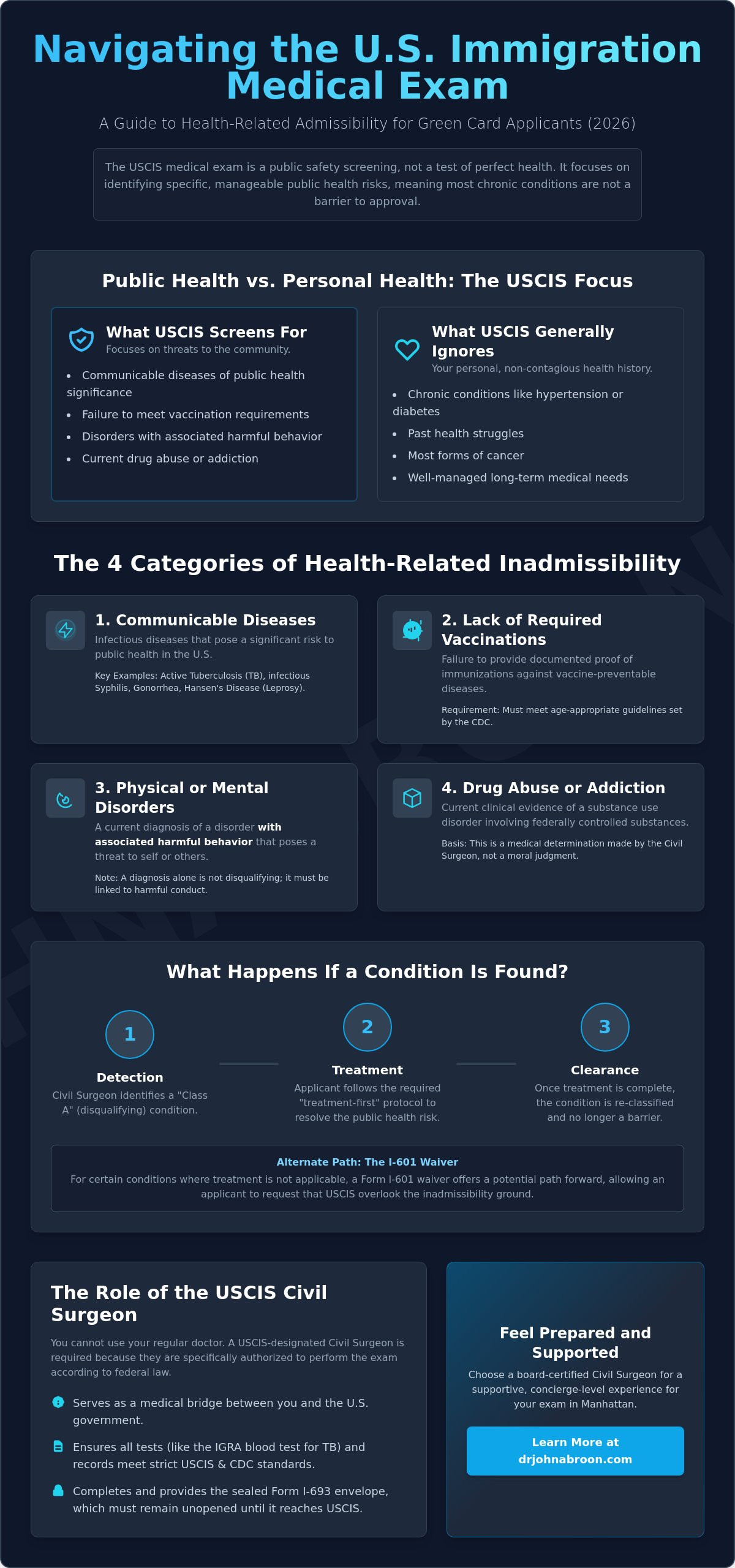
You might wonder why you can’t simply visit your long-term primary care physician for this exam. USCIS requires that a designated Civil Surgeon perform the evaluation because they are specifically authorized to report findings according to federal immigration law. A Civil Surgeon acts as a bridge between the applicant and the government, ensuring that all laboratory tests and vaccination records meet strict USCIS and CDC guidelines. In our Manhattan practice, Dr. Abroon serves as an authorized medical evaluator, providing the precise clinical expertise required for the I-693 while maintaining the warm, personalized care our patients expect in a concierge-style environment.
Public Health vs. Personal Health
It’s vital to distinguish between a diagnostic screening for immigration and a standard annual physical. USCIS isn’t looking for “perfect” health. They’re screening for “communicable diseases of public health significance,” such as active tuberculosis or infectious syphilis. If you have a chronic condition like asthma, high blood pressure, or even most forms of cancer, these are generally not grounds for inadmissibility because they don’t pose a contagious threat to others. Once the exam is complete, the results are placed in a sealed envelope. This document must remain unopened until it reaches a USCIS officer, ensuring the integrity of the medical data provided to the government.
The 4 Categories of Disqualifying Medical Conditions
USCIS organizes medical concerns into four distinct pillars to determine an applicant’s eligibility. These categories are defined in the official Health-Related Grounds for Inadmissibility guidelines. When individuals investigate what diseases disqualify green card status, they often find that the list is more focused than they initially feared. The evaluation isn’t a general search for any health issue; it’s a targeted screening for conditions that could impact the broader American public. The four primary categories include:
- Communicable diseases of public health significance: This includes specific infectious diseases that are easily transmitted.
- Lack of required vaccinations: Failing to provide documentation for age-appropriate immunizations.
- Physical or mental disorders with harmful behavior: Conditions that pose a threat to the safety or property of the applicant or others.
- Drug abuse or addiction: Current clinical evidence of a substance use disorder involving controlled substances.
If you have concerns about how your medical history fits into these categories, scheduling a consultation for an immigration medical exam in Manhattan can provide the clarity and reassurance you need before your formal filing.
Communicable Diseases of Public Health Significance
This category is often the most scrutinized during the I-693 process. Active Tuberculosis (TB) is a primary focus. Unlike a standard skin test, we use the IGRA blood test to detect TB with high precision. If TB is found to be in an active, infectious state, it’s considered a Class A condition that requires treatment before the application can proceed. Similarly, Syphilis and Gonorrhea are screened through blood and urine tests. These must be treated and cleared if they’re in an infectious stage. Hansen’s Disease, commonly known as Leprosy, is also on this list, though it’s exceptionally rare in modern clinical practice. It’s important to remember that most of these conditions are treatable. Once a successful course of treatment is completed, the medical barrier to your Green Card is typically removed.
Mental Health and Harmful Behavior
A common source of anxiety for many applicants is the mental health portion of the exam. It’s vital to understand that a diagnosis of depression, anxiety, or bipolar disorder is not a ground for inadmissibility on its own. USCIS is specifically looking for “harmful behavior.” This is defined as behavior that has posed, or is likely to pose, a threat to the property, safety, or welfare of the applicant or others. During the evaluation, the Civil Surgeon looks for a history of such actions and assesses current stability. If a condition is well-managed and there’s no history of harmful behavior, it typically won’t impact your status. We approach these conversations with the utmost sensitivity, ensuring that your clinical history is presented accurately and fairly to the government.
Common Misconceptions: Conditions That Do NOT Disqualify You
Many applicants approach their medical evaluation with a heavy sense of dread, assuming that any significant health history might lead to a denial. It’s a common source of anxiety, yet the reality is often far more reassuring. When people ask what diseases disqualify green card status, they’re often surprised to learn that the list of Communicable Diseases of Public Health Significance is quite narrow. Most chronic health struggles or past illnesses don’t fall into the categories that USCIS considers grounds for inadmissibility.
A major turning point in immigration health policy occurred on January 4, 2010, when HIV was officially removed from the list of communicable diseases of public health significance. Today, an HIV-positive status is no longer a bar to residency. Similarly, being a cancer survivor or living with heart disease doesn’t impact your eligibility. These conditions aren’t contagious and don’t pose a threat to the community. While physical disabilities might raise questions during other parts of the immigration process, they aren’t medical disqualifiers. It’s vital to distinguish between medical inadmissibility and the “Public Charge” rule, which is a separate legal assessment of financial self-sufficiency rather than a clinical health screen.
Chronic Illness and the Green Card
Living with a managed condition like asthma, diabetes, or high cholesterol won’t prevent you from obtaining a Green Card. These are personal health matters, not public health threats. During your evaluation, the primary requirement is that these conditions are “stable.” This doesn’t mean you must be cured; it means you’re receiving appropriate care and don’t exhibit harmful behaviors associated with the condition. Dr. Abroon takes great care to document your chronic health history with clinical precision, ensuring that USCIS sees a clear picture of a well-managed, stable patient. We focus on providing the government with the necessary context so your personal health journey doesn’t become a hurdle to your residency.
Pregnancy and the Medical Exam
Expectant mothers often worry that their pregnancy might complicate their application. Rest assured, being pregnant is not a disqualifying condition. We prioritize the safety of both mother and baby during the I-693 process. While certain live vaccinations, such as MMR or Varicella, are deferred until after delivery, other requirements are handled with specialized care. For example, if a chest X-ray is required for TB screening, we use double lead shielding to ensure maximum safety, or we may defer the X-ray if the clinical situation allows. Our goal is to complete your requirements thoroughly while honoring the unique needs of your pregnancy.
What Happens If a Condition Is Found? Treatment and Waivers
A positive lab result during your medical evaluation can feel like a setback, but it is rarely a permanent barrier. The clinical framework for the I-693 process is designed with a treatment-first philosophy. This means that for many of the infectious conditions that might initially appear when researching what diseases disqualify green card status, the solution is simply medical intervention. Once an infection is successfully treated and cleared, the Civil Surgeon can sign your paperwork, allowing your application to move forward with confidence.
In cases where a condition cannot be quickly resolved through standard treatment, USCIS provides a legal pathway through Form I-601, the Application for Waiver of Grounds of Inadmissibility. This waiver is a discretionary benefit often available to refugees, asylees, or those with a qualifying relationship to a U.S. citizen or permanent resident. When an applicant files for a waiver due to a communicable disease, the CDC reviews the medical details to ensure the individual will follow a prescribed treatment plan. This collaborative process ensures that public safety is maintained while still providing a viable path for eligible individuals to continue their journey.
Clearing the Exam After Treatment
If a laboratory screen at our practice reveals an infection like Syphilis or Gonorrhea, we don’t immediately finalize your paperwork as inadmissible. Instead, we guide you through the necessary antibiotic protocol. After you complete the treatment, we perform follow-up testing to confirm the infection is gone. At that point, the condition is downgraded from a Class A status to a Class B designation. A Class B finding simply means a medical issue was identified but is no longer a threat to public health, which allows the I-693 to be signed and submitted to USCIS.
The Vaccination Grace Period
Missing immunization records are one of the most common hurdles for applicants, but they’re also the easiest to fix. If you don’t have proof of your mandatory shots, we can help you navigate New York City’s extensive vaccine resources or provide the necessary doses right here in our office. We ensure you meet the requirements for Diphtheria, Tetanus, Polio, and other mandatory immunizations without unnecessary stress. If you have a specific medical reason why you can’t receive a vaccine, we document this as a medical contraindication. A medical contraindication is a specific health condition or circumstance that makes a particular vaccination inadvisable because it may be harmful to the patient’s health.
If you’ve discovered a health concern and need expert guidance to navigate the next steps, schedule your immigration medical exam with our team today to ensure your paperwork is handled with clinical precision and care.
Booking Your Immigration Medical Exam in NYC with Dr. Abroon
Completing your I-693 shouldn’t feel like an interrogation. At the practice of John Abroon M.D., we’ve replaced the sterile, high-volume clinic atmosphere with a sophisticated concierge experience on the Upper East Side. John Abroon M.D. is a board-certified NYC Internist who brings a high level of clinical authority to every evaluation. This specialized expertise is vital for ensuring your paperwork is handled correctly the first time, avoiding the delays that often stem from clerical errors or incomplete medical documentation. While you might have started your journey with anxiety about what diseases disqualify green card status, our mission is to provide the clinical clarity and reassurance you need to move forward.
We pride ourselves on creating a supportive, non-judgmental environment for applicants from all backgrounds. We understand that the immigration process is high-stakes and often stressful. By choosing a private practice that emphasizes personalized care, you ensure that your health history is reviewed with the nuance and attention it deserves. Our team manages the complex requirements of the USCIS medical exam with a steady, reliable rhythm, allowing you to focus on your future in the United States.
Expertise in NYC Immigration Physicals
John Abroon M.D. has served as a USCIS-designated Civil Surgeon for decades, helping thousands of individuals navigate the path to residency. To streamline your experience, we provide in-office diagnostic testing, including blood work and EKGs. This integrated approach saves you from the frustration of visiting multiple laboratories across New York City. We handle the technical details of the screening process so you don’t have to. For more detailed insights into the clinical steps involved, explore our Immigration Medical Exam in NYC: Your Complete Guide to the I-693 Process. This guide serves as a roadmap for your upcoming appointment.
Schedule Your Appointment on the Upper East Side
Preparation is essential for an efficient visit. When you arrive at our Manhattan office, please bring your passport or government-issued ID, any available vaccination records, and a list of your current medications. If you have a history of a treated illness that appeared when you researched what diseases disqualify green card status, bringing those treatment records helps us document your current health stability.
The timeline for receiving your sealed I-693 envelope is typically efficient, depending on the speed of laboratory results. Once the file is ready, we provide you with the sealed document for USCIS and a personal copy for your records. You deserve a medical partner who understands the weight of this process. Schedule your NYC immigration medical exam with John Abroon M.D. today to experience the blend of elite medical expertise and genuine human connection.
Securing Your Future with Confidence and Clinical Clarity
Navigating the path to permanent residency requires focus and the right medical partnership. You’ve learned that most chronic health conditions aren’t barriers to your approval and that even infectious concerns are often resolvable through a treatment-first approach. Understanding what diseases disqualify green card status is the first step toward replacing anxiety with a proactive plan for your I-693 evaluation. The medical exam is simply a public safety screening, not a judgment on your personal health journey.
Our practice provides the sophisticated care you expect from a board-certified NYC internist and USCIS-designated Civil Surgeon. Located in a convenient Upper East Side location, we offer a steady, supportive environment where your total well-being is our priority. Don’t let complex medical requirements or a past diagnosis hold you back from your goals. Book Your USCIS Immigration Medical Exam with Dr. Abroon in NYC today to ensure your paperwork is handled with clinical precision and care. Your journey toward a new life in the United States is a significant milestone, and we’re here to help you cross the finish line with complete peace of mind.
Frequently Asked Questions
Is HIV a disqualifying disease for a Green Card in 2026?
No, HIV is not a disqualifying condition for a Green Card. This policy changed on January 4, 2010, when the Department of Health and Human Services removed HIV from the list of communicable diseases of public health significance. You don’t need to worry about your HIV status impacting your admissibility during the clinical evaluation or laboratory screening process.
What happens if I test positive for Tuberculosis (TB) during the exam?
A positive TB blood test, known as an IGRA, requires further evaluation to determine if the disease is active. We typically order a chest X-ray to check for signs of infection in the lungs. If the TB is active, it’s a Class A condition that requires treatment before we can sign your paperwork. If it’s latent and not infectious, it’s classified as Class B, which doesn’t bar you from residency.
Can I be denied a Green Card for having a mental health condition like depression?
You cannot be denied a Green Card simply for having a diagnosis of depression, anxiety, or other common mental health conditions. USCIS only considers mental health a ground for inadmissibility if the disorder is associated with harmful behavior that poses a threat to yourself, others, or property. Most well-managed conditions don’t interfere with your immigration goals.
Do I need to be fully vaccinated to pass the immigration medical exam?
Yes, you must show proof of age-appropriate vaccinations or receive the required doses during your appointment. This includes protection against Measles, Mumps, Rubella, Polio, and Tetanus among others. If you have a specific medical reason why you can’t receive a shot, the Civil Surgeon can document a medical contraindication to waive that specific requirement safely.
What are the most common reasons people fail the Green Card medical exam?
Most applicants don’t “fail” permanently, but they may face delays due to untreated communicable diseases or missing vaccination records. When people ask what diseases disqualify green card status, the primary concerns are active Tuberculosis, infectious Syphilis, or clinical evidence of drug addiction. These issues must be addressed and treated before the I-693 form can be finalized and sealed.
Can drug use in my past disqualify me from getting a Green Card?
USCIS focuses on current drug abuse or addiction rather than isolated incidents from your distant past. The Civil Surgeon evaluates your history based on clinical standards to determine if there’s a current pattern of substance use that meets the criteria for inadmissibility. We approach these conversations with clinical objectivity and focus on your current health and stability.
How long is the medical exam valid for my USCIS application?
Under current 2026 regulations, a properly completed and signed Form I-693 generally retains its validity indefinitely. This policy was designed to reduce the need for repeat exams during long processing times. It’s still a good idea to coordinate the timing of your exam with your legal representative to ensure it aligns perfectly with your overall filing strategy.
Does having a disability like Down Syndrome or Autism disqualify me?
Having a physical or developmental disability such as Down Syndrome or Autism does not make you inadmissible for a Green Card. These conditions are not communicable diseases and don’t fall under the categories of health-related inadmissibility. We focus on your total well-being and ensure that your health profile is documented with the respect and clinical accuracy you deserve.