


What if your primary care experience felt less like a transaction and more like a dedicated health partnership? Many New Yorkers find themselves waiting weeks for brief appointments, feeling lost within a vast hospital system where direct access to a doctor is nearly impossible during an emergency. This disconnect can make managing your health feel overwhelming rather than empowering. You deserve a medical relationship built on trust, availability, and clinical excellence.
If you’re asking what is retainer medicine, it’s best understood as the financial engine that restores the traditional, deep-rooted doctor-patient bond through modern accessibility. This guide explores how such a model provides unparalleled access to personalized, high-end primary care on the Upper East Side. We’ll examine how this structure facilitates 24/7 physician availability and unhurried, comprehensive consultations. You’ll learn how proactive health management can transform your medical experience from reactive treatments into a steady, life-long wellness strategy tailored specifically to your needs.
Key Takeaways
- Learn what is retainer medicine and how this model prioritizes your time through enhanced access and a significantly smaller patient panel.
- Discover the clinical benefits of unhurried, 60-minute appointments that allow for deep-rooted diagnostic action and total well-being.
- Clarify the distinctions between retainer, concierge, and direct primary care models to select the right level of medical exclusivity for your needs.
- Understand the value of streamlined diagnostic testing and the elimination of waiting rooms in a high-end urban medical environment.
- See how elite internal medicine practitioners on the Upper East Side integrate sophisticated clinical expertise with a dedicated bedside manner.
Understanding Retainer Medicine: A Definition for the Modern Patient
At its core, the answer to what is retainer medicine is simple. It is a healthcare model where you pay a set, recurring fee to keep a physician “on retainer” for your specific medical needs. Unlike the traditional insurance-based system, which often prioritizes the volume of patients seen per day, this model prioritizes the depth of the relationship between you and your doctor. You aren’t just paying for a specific procedure; you are investing in the physician’s availability, time, and clinical expertise.
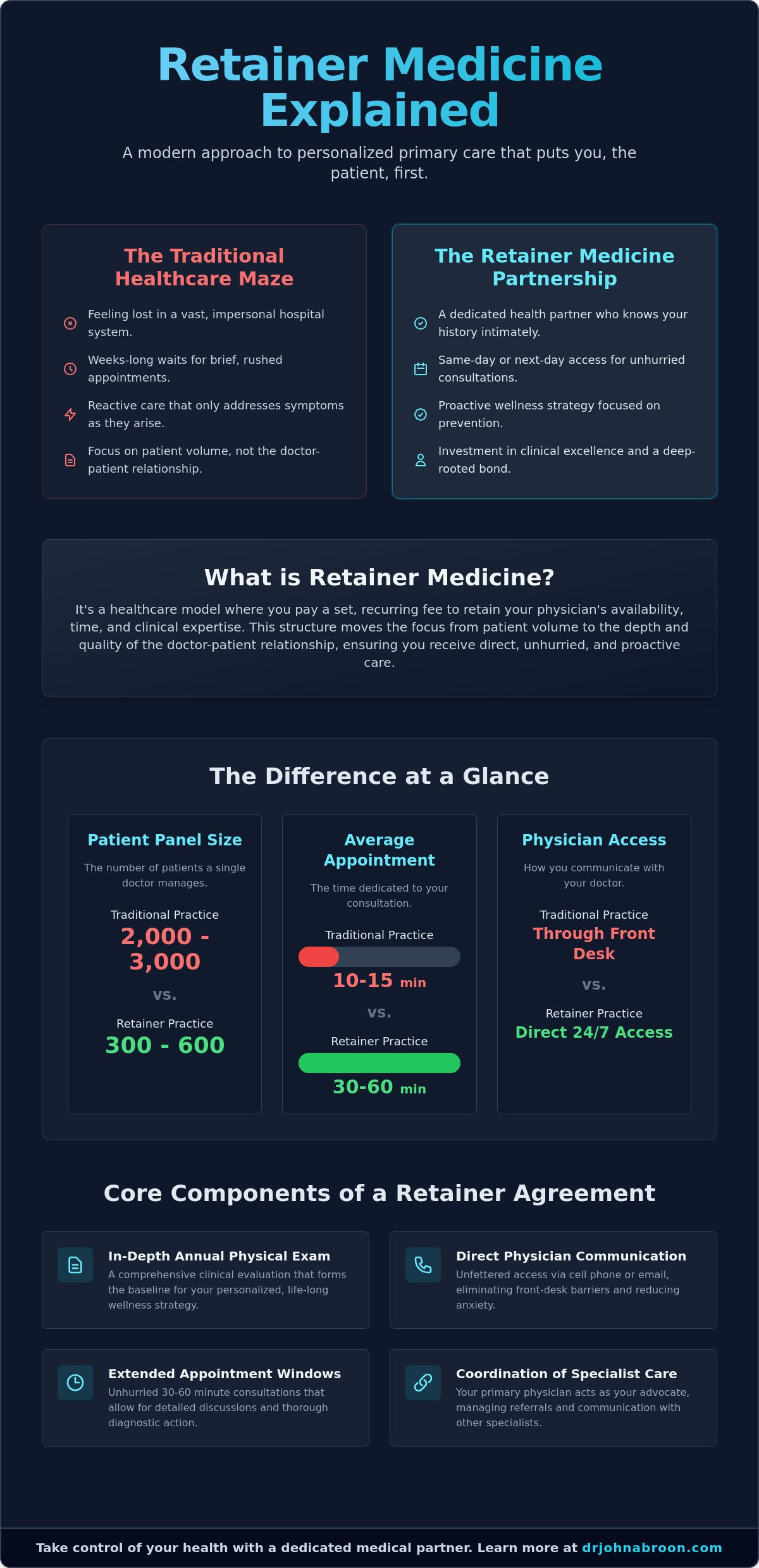
In a standard practice, doctors might manage a panel of 2,000 to 3,000 patients. This creates a “hamster-wheel” effect where appointments are rushed and schedules are overbooked. Retainer practices intentionally limit their patient panels, often to just a few hundred individuals. This reduction allows for a sophisticated level of care that is steady and reliable. When you choose this path, the primary “product” you receive is direct, unhurried access to a trusted healer who knows your medical history intimately.
The Origins of Retainer-Based Practice
The shift toward this model began as a response to the increasing bureaucracy of insurance-only medical systems. Many physicians in high-pressure environments like New York City found that they couldn’t maintain their high quality standards while meeting the demands of large hospital networks. Consequently, Concierge medicine and retainer models emerged to restore the integrity of the diagnostic process. While these services were once seen as elite-only luxuries, they’ve evolved into a broader spectrum of personalized care. Today, individuals from all walks of life utilize these memberships to ensure they don’t get lost in a complex urban medical landscape.
Core Components of the Retainer Agreement
A typical retainer agreement focuses on proactive health rather than just reactive symptom management. While the specific inclusions can vary, they generally center on comprehensive diagnostic action and seamless communication. The cornerstone of this relationship is often the Annual Physical Exam. This isn’t a cursory check-up; it’s an in-depth clinical evaluation that serves as the baseline for your total well-being. Other common components include:
- Direct communication channels for non-emergency inquiries.
- Coordination of care with specialists and diagnostic facilities.
- Longer appointment windows that allow for detailed discussion of complex health concerns.
- A focus on preventative health strategies tailored to your lifestyle.
It’s vital to understand that the retainer fee covers the “access” and “time” provided by the practice. It ensures that when a health need arises, your doctor is ready to act decisively. This structure empowers you to take control of your health journey with a seasoned professional by your side.
How Retainer Medicine Transforms Your Healthcare Experience
Understanding what is retainer medicine is the first step, but experiencing the shift in care is where the true value becomes clear. In a traditional medical setting, the clock is often the doctor’s biggest adversary. Most primary care visits last roughly 10 to 15 minutes, leaving little room for nuanced discussion or complex diagnostic action. In a retainer model, you enjoy the luxury of time. Appointments typically span 30 to 60 minutes. This unhurried pace allows your physician to listen deeply, ask probing questions, and address the subtle details of your total well-being.
This transformation relies on a dramatic reduction in the “patient panel.” While a standard physician might oversee 3,000 individuals, a retainer-based doctor limits their practice to approximately 300 to 600 patients. This shift moves the focus from reactive symptom management to proactive health optimization. Instead of waiting for an illness to occur, your care team focuses on prevention and long-term vitality. The administrative experience also changes, adopting a concierge-like feel where your needs are anticipated rather than just processed by a large, impersonal system.
Enhanced Access and Communication
Direct communication changes everything. When you have access to your internist via email or cell phone, the barriers of traditional front-desk triage disappear. If a health concern arises, same-day or next-day appointments are often available, which significantly reduces patient anxiety and prevents unnecessary urgent care visits. This model also integrates modern solutions like virtual or telehealth options. It’s also helpful to review Medicare coverage for concierge care to understand how these memberships interact with standard benefits. These tools ensure that expert medical advice is always within reach, whether you’re at home in NYC or traveling abroad.
Comprehensive Care Coordination
Your physician acts as the “quarterback” for your entire medical team, ensuring that specialists and diagnostic testing work in harmony. This coordination is essential when you require a pre-operative medical clearance nyc. Your doctor manages the necessary documentation and clinical evaluations to ensure your surgery proceeds safely. Similarly, your annual health plan can easily incorporate travel medicine nyc and vaccinations, preparing you for international journeys with clinical precision. By centralizing these services, you receive a holistic health strategy that covers every aspect of your life. If you’re ready for a more personal approach, exploring concierge medicine can be the first step toward a more reliable healthcare journey.
Retainer vs. Concierge vs. Direct Primary Care: Clearing the Confusion
Choosing the right medical model requires a clear understanding of the terminology used in modern healthcare. While many people use “concierge medicine” and “retainer medicine” interchangeably, there’s a subtle distinction. “Concierge medicine” often serves as the patient-facing brand, evoking images of high-end service and personalized attention. In contrast, when physicians discuss what is retainer medicine, they’re often referring to the professional and financial structure of the practice. Both models focus on providing a premium experience that prioritizes your time and health outcomes.
Direct Primary Care (DPC) is a different model entirely. DPC practices typically bypass the insurance system altogether, charging a monthly fee that covers all primary care services without any insurance billing. In a metropolitan environment like New York City, most retainer practices operate on a hybrid model. This means they accept PPO insurance plans for external costs like diagnostic testing, specialist consultations, and hospitalizations, while the retainer fee covers the enhanced access and coordination provided by your primary physician.
The Insurance Question
You might wonder how your existing coverage fits into this equation. In a hybrid retainer model, your insurance remains a critical tool for managing major medical events. The retainer fee specifically funds the non-covered services that traditional insurance doesn’t prioritize, such as 24/7 direct communication and extended appointment times. As of January 1, 2026, the “One Big Beautiful Bill Act” has simplified the financial aspect for many. This law allows patients to use Health Savings Account (HSA) and Flexible Spending Account (FSA) funds to pay for Direct Primary Care and certain retainer fees. It’s a significant shift that makes high-level care more accessible for those with qualified plans. While the retainer covers the physician’s time, your insurance still handles the billing for blood work, imaging, and prescriptions.
Feature Comparison: Access and Cost
The most striking difference between these models and traditional care is the patient panel size; a traditional doctor may manage 3,000 patients, while a retainer-based physician often limits their practice to 600 or fewer. While concierge models might emphasize office amenities like private lounges or valet parking, retainer medicine focuses heavily on clinical availability and diagnostic precision. This high-access structure is particularly favored on the Upper East Side, where busy executives and families require a doctor who can act decisively without the delays of a traditional waiting room. If you’re seeking a practice that combines elite clinical expertise with a supportive, welcoming narrative, exploring concierge medicine can provide the steady reliability you need. This model ensures that your medical decisions remain manageable through a combination of rigorous science and a dedicated, personal connection.
Evaluating the Value: Is a Retainer Practice Right for You?
A common question arises when patients consider this model: “Why should I pay more if I already have insurance?” It’s a valid concern that deserves a direct answer. The value of a retainer practice isn’t found in replacing your insurance, but in providing the level of care and access that the traditional system often lacks. When you understand what is retainer medicine, you realize you’re investing in a physician’s availability and the clinical expertise required to manage your health proactively.
The most immediate benefit is the quantification of time saved. In a city where every minute counts, avoiding crowded waiting rooms and month-long delays for appointments is invaluable. Patients in this model experience fewer missed work days and more efficient, streamlined testing. This efficiency is particularly evident during executive physicals nyc, where a comprehensive health snapshot is captured in a single, unhurried session. This approach provides a level of peace of mind that is especially critical for those with chronic conditions or complex medical histories.
Who Benefits Most from Retainer Medicine?
While anyone seeking high-level care can benefit, certain groups find this model transformative. Busy professionals require the punctuality and direct communication that a limited patient panel provides. Seniors with complex medication regimens need a doctor who can coordinate every aspect of their care with clinical authority. Families seeking long-term continuity of care also find peace of mind in having a single, trusted healer for every milestone. Additionally, patients who require frequent diagnostic testing nyc value having an internist who acts as a dedicated advocate within the medical system. Those undergoing frequent surgeries also find immense value in having a trusted physician who can manage clearances and post-operative follow-ups with ease.
Questions to Ask a Potential Retainer Physician
Selecting the right partner for your health journey is a significant decision. You should feel empowered to ask direct questions to ensure the practice meets your standards. Consider asking the following during your initial consultation:
- What is your exact patient panel size limit to ensure I receive unhurried care?
- How do you handle after-hours emergencies or health concerns that arise on weekends?
- Which local NYC hospitals and specialists do you maintain the strongest professional relationships with?
These answers will help you determine if the practice offers the steady, reliable support you deserve. If you’re ready to move beyond the limitations of traditional primary care, you can explore the personalized care options available at our Upper East Side facility.
Personalized Medicine on the Upper East Side: The Dr. John Abroon Experience
In the heart of Manhattan’s medical community, Dr. John Abroon provides a standard of care that bridges elite clinical expertise with a deeply personal touch. For those navigating the complexities of the New York healthcare system, understanding what is retainer medicine often leads to a search for a physician who truly listens. Dr. Abroon operates a sophisticated practice on the Upper East Side, where the focus remains on the individual’s total well-being. As a seasoned internist, he specializes in the diagnostic challenges of adult health, ensuring that every patient receives a steady, reliable roadmap for their medical journey. This approach is specifically designed for the competitive urban environment where quality and accessibility are paramount.
The practice is designed to handle a wide spectrum of medical needs with clinical precision. Whether you require a comprehensive annual physical exam nyc or a specialized immigration medical exam, the experience is characterized by unhurried attention and rigorous science. By combining state-of-the-art facility standards with the approachable bedside manner of a dedicated healer, Dr. Abroon ensures that high-stakes medical decisions feel manageable and supported. It’s a boutique environment where technical excellence doesn’t come at the cost of empathy.
A Legacy of Trust in Manhattan
Dr. Abroon is board-certified and brings decades of experience to the NYC medical community. His commitment to personalized primary care means that your relationship with the practice feels like a true partnership rather than a series of transactions. This dedication is backed by significant in-office diagnostic capabilities. Having access to advanced testing within the practice saves you unnecessary trips to outside labs and allows for decisive diagnostic action. It’s a premium experience where high-end expertise meets genuine human connection, ensuring no two patients are treated the same. This clinical authority establishes immediate trust, providing a sense of calm reliability for individuals seeking the best in Manhattan healthcare.
How to Get Started with Dr. Abroon
The journey toward better health begins with a comprehensive initial consultation. During this process, Dr. Abroon takes the time to understand your medical history, lifestyle, and specific health goals. This model allows for the seamless integration of specialized services like weight loss management or travel health into your overall wellness strategy. By treating the patient as a whole person rather than a collection of symptoms, the practice provides a medical experience that is both sophisticated and accessible. If you’re ready to experience a higher standard of primary care, we invite you to contact our office to schedule your evaluation and discover how a dedicated internist can transform your health journey. Taking this next step ensures your care remains steady, personalized, and proactive.
Take the Next Step Toward Elite Primary Care
Choosing a medical partner who prioritizes your well-being over patient volume transforms the way you experience healthcare. You now understand how a reduced patient panel facilitates unhurried consultations and direct communication, ensuring you’re never treated as a mere number in a large system. Understanding what is retainer medicine is the first step toward reclaiming your time and peace of mind. By focusing on elite diagnostic action and comprehensive preventive strategies, you shift from reactive treatments to a proactive wellness partnership.
Dr. John Abroon, a board-certified Internist with over 25 years of experience, provides this sophisticated level of care from a convenient Upper East Side location. His practice offers elite diagnostic and preventive care tailored specifically to your unique lifestyle and needs. It’s about more than just symptom management; it’s about a dedicated relationship that supports every milestone of your health journey. Experience the difference of personalized care with Dr. John Abroon on the Upper East Side. Your path to reliable, high-level medical care begins with a single conversation.
Frequently Asked Questions
Is retainer medicine the same as concierge medicine?
Concierge medicine and retainer medicine are functionally identical terms used to describe a membership-based care model. While “concierge” evokes a sense of high-end service and boutique amenities, “retainer” refers to the professional financial arrangement that keeps your physician available for your specific needs. Both models prioritize a sophisticated level of clinical attention and direct access that traditional practices often struggle to provide.
Does retainer medicine replace my health insurance?
No, this model does not replace your health insurance. You still require a standard insurance policy to cover major medical events, hospitalizations, surgeries, and consultations with specialists. When you ask what is retainer medicine, it’s helpful to view it as a secondary layer of service that funds enhanced access and unhurried time with your primary physician.
Can I use my HSA or FSA to pay for a medical retainer fee?
Yes, you can use these funds for your membership fees as of January 1, 2026. The “One Big Beautiful Bill Act” signed into law in 2025 officially allows Health Savings Account (HSA) and Flexible Spending Account (FSA) funds to be applied toward Direct Primary Care and certain retainer-based fees. This change makes high-level, personalized care much more accessible for individuals with these tax-advantaged accounts.
What happens if I need to see a specialist while under a retainer plan?
Your retainer physician acts as a dedicated coordinator for your entire medical team. If you require a specialist, your doctor manages the referral and ensures that your medical history is communicated clearly to the consultant. While the specialist will typically bill your insurance for their services, your primary doctor remains the central point of contact who integrates their findings into your overall health strategy.
Are diagnostic tests like EKGs included in the retainer fee?
Many basic diagnostic tests are frequently included as part of the membership or the annual physical exam. Services like an EKG or basic pulmonary function tests are often performed in-office to provide immediate clinical insights. For more complex imaging or external lab work, the practice typically coordinates the testing while the facility bills your insurance plan directly.
Why is retainer medicine becoming more popular in New York City?
New Yorkers are increasingly seeking alternatives to the high-volume hospital systems that dominate the local landscape. The ability to avoid long waiting rooms and secure same-day appointments is a significant advantage in a fast-paced urban environment. This model provides a sense of calm and reliability that is often missing in a standard NYC medical consultation where doctors are frequently overbooked.
Is retainer medicine worth it for someone who is generally healthy?
Yes, even healthy individuals benefit from a model that prioritizes preventative health and rapid response. Having a trusted expert who knows your history means you won’t have to navigate an impersonal urgent care center if a sudden illness or injury occurs. It’s an investment in long-term vitality and ensures that what is retainer medicine works for you through proactive health management and decisive diagnostic action.
How many patients does a typical retainer doctor see compared to a traditional doctor?
A typical retainer-based doctor maintains a patient panel of 600 or fewer individuals. In contrast, a traditional primary care physician may be responsible for 2,000 to 3,000 patients. This dramatic reduction is what allows for unhurried, 60-minute appointments and the steady, personalized attention that defines a high-end medical experience on the Upper East Side.