


Why does a premium Manhattan zip code still come with a three-week wait for a ten-minute medical appointment? If you have ever felt like a data point in a high-volume assembly line, you are not alone. The frustration of weighing a concierge doctor vs traditional insurance nyc options often stems from a simple desire for better access. You deserve more than a rushed consultation on the Upper East Side that leaves your most pressing questions unanswered while you struggle to coordinate care with specialists.
We understand that your time is your most valuable asset, and your health shouldn’t be managed in the gaps between a physician’s overbooked schedule. It’s exhausting to feel like a number in a practice that prioritizes volume over value. This guide explores the critical differences between concierge medicine and traditional insurance-based care to help you find a model that aligns with your lifestyle. You’ll discover how shifting from a reactive to a proactive approach provides immediate access to your doctor, unhurried physical exams, and seamless coordination of diagnostic testing. We’ll break down the 2026 landscape so you can choose a healthcare partnership that offers both elite clinical excellence and genuine human connection.
Key Takeaways
- Learn how concierge medicine addresses the Manhattan medical paradox by prioritizing immediate access over the weeks-long wait times common in traditional practices.
- Understand the structural differences between a concierge doctor vs traditional insurance nyc models, focusing on how membership-based care puts your well-being ahead of insurance quotas.
- Discover the clinical value of unhurried, 90-minute physical exams that allow for deeper diagnostic insights and a truly proactive approach to your longevity.
- Identify the “hidden costs” of high-volume insurance models, such as lost time and delayed treatments, and how personalized care mitigates these risks.
- Explore the benefits of having a dedicated board-certified expert coordinate every aspect of your health, from diagnostic testing to specialist referrals.
The Manhattan Medical Paradox: Why Traditional Insurance Models are Strained
New York City boasts some of the most advanced medical facilities on the planet. Yet, for many Manhattanites, actually seeing a doctor has never been more difficult. This is the heart of the debate when comparing a concierge doctor vs traditional insurance nyc models. In an insurance-based system, the financial viability of a practice often depends on volume. To cover the high overhead of a Manhattan office, physicians are frequently forced to see 25 to 30 patients every day. This leaves only a handful of minutes for each consultation, turning what should be a meaningful clinical dialogue into a rushed checklist.
As patients search for alternatives to this assembly-line approach, Concierge medicine has emerged as a solution to this strained environment. By decoupling the physician’s revenue from fluctuating insurance reimbursement rates, doctors can prioritize value over volume. In the traditional model, the administrative burden is staggering. Doctors often spend as much time documenting for insurance billing as they do speaking with the person on the exam table. This systemic pressure leads to reactive medicine, where symptoms are managed only after they become problems, rather than being prevented through careful, unhurried observation.
The Impact of Large Patient Panels
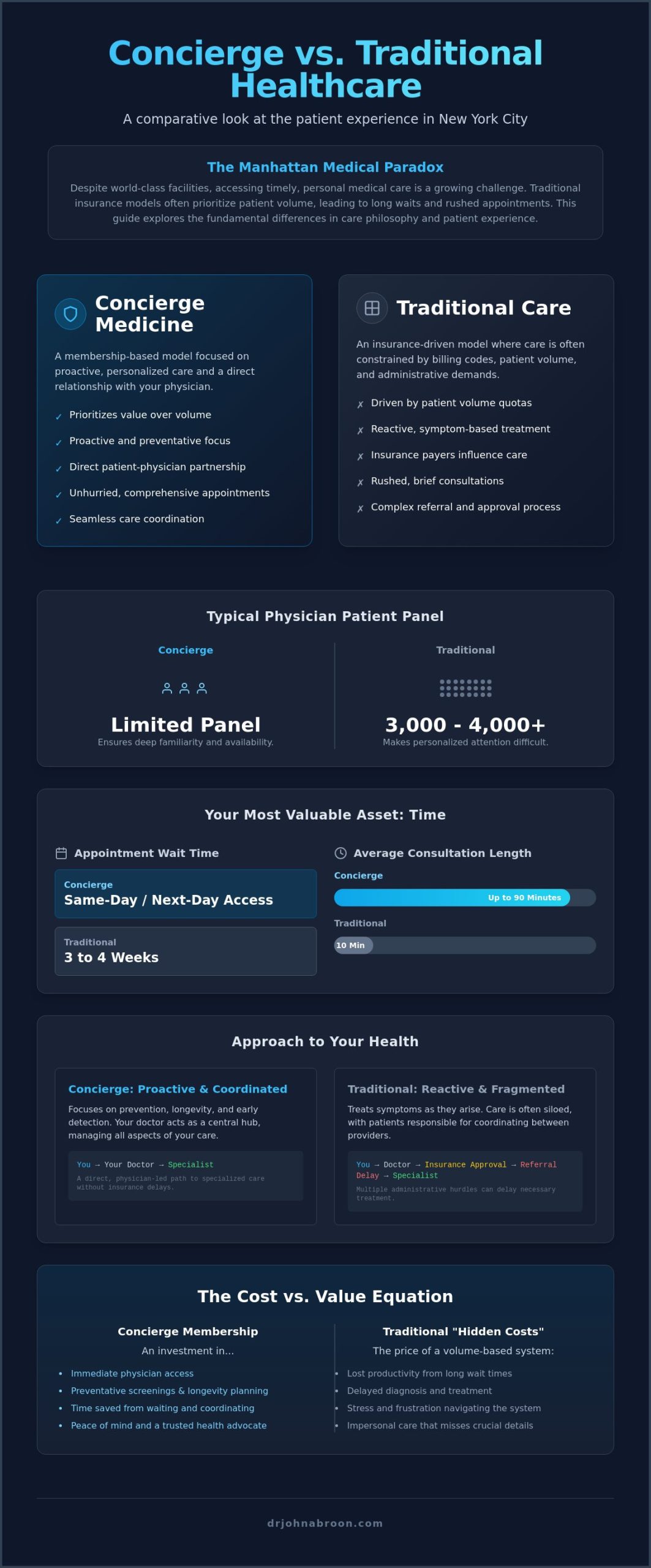
In traditional NYC practices, it’s common for a single primary care physician to manage a panel of 3,000 to 4,000 patients. This massive scale makes “squeezing you in” for a sudden illness nearly impossible. By 2026, wait times for a non-urgent primary care visit in Manhattan have stretched to three or four weeks in many high-volume practices. This creates a heavy psychological toll. Patients feel like a number in an assembly line, while dedicated healers face burnout from the inability to provide the depth of care they were trained to deliver. When a doctor only has ten minutes, the nuance of your health history is easily lost.
Insurance Constraints on Preventative Care
Insurance companies often dictate the scope of your care through the narrow lens of “medical necessity.” If a diagnostic test doesn’t meet a specific insurance code, it might not be covered, even if your doctor believes it’s vital for your longevity. This reactive framework makes proactive, advanced diagnostic testing difficult to access. You may also find yourself trapped in a referral loop. In the traditional system, even minor specialist consultations require paperwork and approvals that delay your path to wellness. A concierge approach removes these barriers, allowing your physician to act as a true advocate who coordinates your care without waiting for an insurance adjuster’s permission.
Defining the Models: Concierge Medicine vs. Traditional Primary Care
Choosing between a concierge doctor vs traditional insurance nyc isn’t just a financial decision. It’s a choice about who sits at the center of your healthcare journey. In a traditional model, the insurance payer often dictates the pace and depth of care. Concierge medicine flips this script. It places the patient-physician relationship back at the forefront by using a membership-based structure. This model allows a board-certified internist to serve as your dedicated health advocate rather than a high-volume provider who is forced to prioritize speed over clinical nuance.
Many Manhattan residents believe they must choose one or the other. In truth, most concierge practices function within a hybrid reality. You’ll still use your PPO or high-end insurance plan for external costs like hospital stays, complex radiology, and major surgeries. The membership fee covers the “uncovered” essentials: the doctor’s time, immediate accessibility, and comprehensive care coordination. Even Medicare’s view on concierge care acknowledges this distinction, noting that while membership fees aren’t covered, the actual medical services provided can often be billed traditionally. This ensures you maintain your existing coverage while adding a layer of elite, personalized attention.
What Your Concierge Fee Actually Covers
The fee is an investment in a seamless medical experience. It removes the friction points that define modern urban healthcare. When you join a personalized practice, you aren’t just paying for an annual exam; you’re paying for a level of presence that insurance doesn’t incentivize. This model typically includes:
- Direct 24/7 access to your physician via phone, text, or email for urgent medical concerns.
- Same-day or next-day appointments with zero time spent in a crowded waiting room.
- Extended consultation periods, often exceeding 60 minutes, to address complex health histories and preventative strategies.
How Traditional Insurance Models Function
Traditional primary care operates on a “gatekeeper” logic. This means your care is often siloed by what is “in-network” or “medically necessary” according to a third-party payer. Because reimbursements are low, these practices must refer out for even simple diagnostic tests to remain solvent. This creates a fragmented experience where you spend more time traveling between various labs than speaking with your healer. If you’re tired of the gatekeeper delays, exploring personalized primary care can restore your sense of agency and clinical focus.
A board-certified internist in a concierge setting acts as your clinical “quarterback.” They don’t just hand you a referral and wish you luck. They communicate directly with specialists, review every diagnostic report in detail, and ensure that no part of your health is managed in a vacuum. This level of advocacy is the primary differentiator in the 2026 NYC medical landscape, offering a steady hand in a complex system.
Side-by-Side Comparison: Accessibility, Diagnostics, and Patient Experience
The gap between these two models becomes starkly apparent when you face a sudden health concern. In the traditional insurance-based system, an urgent issue often results in a three to four-week wait for a primary care appointment or a long afternoon in a crowded urgent care facility. When comparing a concierge doctor vs traditional insurance nyc, the accessibility shift is dramatic. Concierge members typically receive care within three to four hours for urgent needs. This immediate response doesn’t just offer peace of mind. It ensures that acute conditions are managed before they escalate into emergencies.
Time is the most significant clinical tool a physician possesses. Traditional practices are often forced to limit consultations to 10 or 15 minutes to meet insurance quotas. In contrast, a concierge visit typically lasts between 45 and 90 minutes. This extended period allows for a thorough review of your health history and a deeper exploration of your wellness goals. While there are various pros and cons of concierge medicine to consider, the ability to have a meaningful, unhurried conversation with your healer is a primary driver for many Manhattan residents.
The Advantage of In-Office Diagnostic Testing
Efficiency in diagnostics can change the course of a treatment plan. In a traditional model, a doctor might write a script for blood work or an EKG, requiring you to travel to a separate lab and wait days for results. A concierge practice prioritizes on-site capabilities. Having EKGs, pulmonary function tests, and rapid blood work available immediately enhances the accuracy of your annual physical exam in NYC. This integrated approach is also vital for those requiring a pre-operative medical clearance in NYC, as it allows for a fast-tracked, comprehensive evaluation that keeps your surgical schedule on track.
Physician Accessibility and the “UES Experience”
Living on the Upper East Side comes with high expectations for service and expertise. The concierge model meets these demands by providing direct access that insurance-based practices cannot match. You often receive your doctor’s direct cell phone number, ensuring that after-hours emergencies are handled by someone who actually knows your medical history. Beyond the clinical setting, your physician acts as a personal navigator within the local specialist network. Instead of managing your own referrals, your doctor coordinates directly with NYC’s top specialists, ensuring your care remains cohesive and focused. This boutique environment replaces the sterile, high-traffic waiting room with a private space where your total well-being is the only priority.
Is Concierge Medicine Worth the Investment? The Cost vs. Value Debate
Determining the true value of a concierge doctor vs traditional insurance nyc requires looking beyond the annual membership fee. While insurance-based care appears more affordable on paper, it often carries significant hidden costs that impact your quality of life. For a Manhattan professional, taking half a day off to navigate a ten-minute consultation and another morning for off-site diagnostic testing represents a substantial loss of productivity. These inefficiencies, coupled with the potential for delayed treatments, make the traditional model surprisingly expensive when measured in time and opportunity costs.
Personalized care is an investment in your most vital asset: your health. Many patients effectively use tax-advantaged accounts like HSAs or FSAs to manage their membership fees, as these funds can often be applied toward the clinical components of concierge services. By choosing a model that eliminates the friction of the modern medical system, you gain a partner who is incentivized to keep you healthy rather than just treating you when you’re ill. This shift from reactive to proactive care is particularly valuable for busy leaders who rely on nyc concierge medicine to maintain peak performance in a high-stakes environment.
The ROI of Preventative Health
The financial benefits of concierge medicine often manifest in the prevention of long-term chronic conditions. Early detection of cardiovascular or metabolic issues can save thousands of dollars in future medical interventions and medications. Comprehensive executive physicals in NYC provide the deep diagnostic data necessary to identify health risks years before they become symptomatic. Industry data from 2025 indicates that patients in personalized care models experience significantly lower hospital readmission rates due to the consistent monitoring and immediate intervention provided by their dedicated physician.
Insurance and Concierge: A Collaborative Approach
A common misconception is that concierge medicine replaces your health insurance. In reality, the two systems work best when they collaborate. You still need a PPO or high-deductible plan to cover major medical events, such as surgeries, hospitalizations, or specialized oncology care. Your concierge doctor acts as your clinical advocate, working with your insurance provider to ensure that these high-stakes procedures are coordinated seamlessly. This approach ensures you aren’t “double-paying” for the same service; instead, you’re paying for an elite level of access and advocacy that standard insurance plans simply don’t provide. If you are ready to secure a higher standard of care, we invite you to learn more about the benefits of personalized primary care on the Upper East Side.
Personalized Primary Care with Dr. John Abroon on the Upper East Side
Dr. John Abroon believes that elite medicine requires more than just clinical skill; it demands a genuine, unhurried human connection. As a board-certified internist with deep roots in the Manhattan medical community, he has designed his practice to be a sanctuary from the high-volume noise of standard healthcare. When you evaluate a concierge doctor vs traditional insurance nyc, the true difference is found in the depth of the partnership. Dr. Abroon combines rigorous medical expertise with a warm, patient-centered philosophy that treats you as a whole person rather than a collection of symptoms.
This commitment to comprehensive care allows the practice to handle a diverse range of medical needs under one roof with absolute discretion. Whether you require the meticulous detail of immigration medical exams in NYC or the management of complex internal medicine cases, the focus remains on accuracy and patient comfort. Our Upper East Side clinic is the preferred choice for individuals who seek high-level medical evaluations in a private, boutique environment where their time and health are held in the highest regard.
A Comprehensive Suite of Medical Services
A truly personalized medical home must evolve with your specific needs and lifestyle. Our practice offers an expansive range of services, from specialized travel medicine nyc consultations to integrated weight loss management and urgent care. Having a dedicated primary care physician nyc means your annual physicals, diagnostic testing, and preventative screenings are handled by a single, trusted expert. This continuity ensures that your medical history is not just a digital file, but a living narrative that informs every clinical decision and proactive health strategy.
Experience the Difference of Concierge Care
Transitioning from a traditional practice to Dr. Abroon’s personalized care is designed to be effortless and reassuring. During your first consultation at our facility in the Henger building, we prioritize understanding your total well-being and long-term health goals. Our dedicated team manages the complex logistics of medical record transfers and coordinates directly with elite specialists to ensure your care remains seamless. We invite you to experience a model where your health is the only priority and your physician is always within reach. Contact our practice today to discuss how a personalized healthcare plan can support your journey toward optimal wellness and longevity.
Secure Your Future with Personalized Medical Excellence
The decision between a concierge doctor vs traditional insurance nyc ultimately determines how you prioritize your most valuable asset. We’ve discussed how shifting to a membership-based model replaces the stress of a high-volume practice with immediate access and unhurried clinical consultations. This proactive approach ensures that your health is managed with precision, focusing on longevity and early detection rather than mere symptom management. You deserve a medical partnership that respects your time and provides the clinical depth necessary for complex internal medicine.
Dr. John Abroon offers over 25 years of experience as a board-certified Internist, providing elite diagnostic testing directly within his convenient Upper East Side location. By choosing a dedicated health advocate, you gain the peace of mind that comes from steady, reliable care tailored to your unique lifestyle. Don’t settle for being a number in an overstretched system when elite expertise is within reach. Schedule your consultation for concierge medicine with Dr. John Abroon today. We look forward to welcoming you into a practice where your total well-being is our singular focus.
Frequently Asked Questions
Do I still need health insurance if I have a concierge doctor in NYC?
Yes, you should maintain health insurance alongside your concierge membership. While your membership covers the personalized access and extended time with your physician, you still need insurance for major medical events like surgeries, hospital stays, and external specialist visits. Most concierge practices in Manhattan operate on a hybrid model, working with your existing PPO or high-deductible plan to ensure comprehensive coverage for services outside the primary care office.
Is concierge medicine the same as Direct Primary Care (DPC)?
No, concierge medicine and Direct Primary Care have distinct structural differences despite both focusing on enhanced access. DPC practices typically do not bill insurance at all and rely solely on membership fees for all services. Concierge medicine often maintains a relationship with insurance providers, allowing the practice to bill for covered medical services while the membership fee provides for premium benefits like 24/7 access and unhurried consultations.
Can I use my HSA or FSA to pay for a concierge medical membership?
You can often use Health Savings Account (HSA) or Flexible Spending Account (FSA) funds for the medical portions of your concierge membership. Because the membership fee covers clinical services like annual physicals and diagnostic screenings, many tax-advantaged plans recognize these as qualified medical expenses. It’s always advisable to consult with your plan administrator or tax professional to ensure compliance with your specific account’s regulations for 2026.
What happens if I need to see a specialist or go to the hospital?
Your concierge physician acts as your clinical advocate and coordinator for all specialist referrals and hospitalizations. Instead of navigating the complex NYC medical system alone, your doctor communicates directly with specialists and hospital teams to ensure a seamless transition of care. This high-level coordination helps prevent fragmented treatment and ensures that everyone involved in your health journey is fully informed of your medical history and current needs.
Are concierge doctors more expensive than traditional primary care physicians?
The out-of-pocket cost for concierge medicine is higher due to the membership fee, but it often reduces long-term “hidden costs” associated with traditional care. When comparing a concierge doctor vs traditional insurance nyc, you must account for the value of immediate access and the prevention of chronic issues through proactive care. Traditional models may result in higher costs over time due to lost productivity from long wait times and reactive treatments.
How many patients does a concierge doctor typically see compared to a traditional doctor?
Concierge doctors limit their patient panels to between 300 and 600 individuals to ensure personalized attention. In contrast, traditional insurance-based physicians in Manhattan often manage panels of 3,000 to 4,000 patients. This smaller scale is what allows for 60 to 90-minute appointments and same-day availability. It ensures that you never feel like a number in a high-volume assembly line, allowing for a steady and reliable doctor-patient relationship.
Is concierge medicine only for wealthy individuals or is it becoming more common?
Concierge medicine is becoming increasingly common across a diverse range of Manhattan residents who prioritize their health and time. While it was once seen as an exclusive luxury, the model has expanded to include various structures that appeal to busy professionals, families, and seniors. Many New Yorkers now view the membership as a necessary investment in longevity and a way to bypass the growing frustrations and wait times of the traditional healthcare system.
Can Dr. Abroon provide pre-operative clearance if I am a concierge patient?
Dr. Abroon provides comprehensive pre-operative medical clearances for his concierge patients directly within his Upper East Side office. Having your primary physician handle this process ensures that your surgical team receives a thorough evaluation from someone who already understands your complete health history. Because the practice offers elite diagnostic testing on-site, we can fast-track the necessary screenings to keep your surgical schedule on track without the delays typical of insurance-based labs.