

Your adjustment of status medical exam isn’t just a routine checkup — it’s a federal filing that can determine whether your Green Card application moves forward or stalls at the finish line. One missing vaccine record, one improperly sealed envelope, and USCIS can reject months of careful preparation.
That anxiety is completely understandable. The I-693 process sits at an uncomfortable intersection of medical requirements and immigration law, and the rules around validity periods, required vaccinations, and Civil Surgeon protocols genuinely confuse even well-prepared applicants. You’re not overthinking it; the process really is that specific.
This guide cuts through that confusion. You’ll walk away with a clear understanding of every test and vaccination USCIS requires, how the 60-day and two-year validity rules actually work, and what to look for when choosing a Civil Surgeon in New York City who can get it right the first time. Dr. John Abroon, a board-certified internist and USCIS-designated Civil Surgeon on the Upper East Side, brings the clinical precision and regulatory expertise this process demands, so you leave with a correctly completed, properly sealed I-693 and the confidence to submit it.
Key Takeaways
- The adjustment of status medical exam is a federally required health screening — not a standard checkup — and only a USCIS-designated Civil Surgeon can legally complete and sign Form I-693 on your behalf.
- USCIS mandates specific vaccinations and blood tests, including screenings for Tuberculosis, Syphilis, and Gonorrhea, so gathering your complete immunization history before your appointment is essential to avoiding delays.
- The I-693 envelope must remain sealed after your Civil Surgeon completes it — opening it yourself can invalidate your entire submission, regardless of how carefully your exam was conducted.
- Validity windows on Form I-693 are strict, and a missed detail or improperly completed form can force you to restart the process — making your choice of Civil Surgeon one of the most consequential decisions in your Green Card application.
- A well-prepared appointment — with the right documents, records, and an experienced Civil Surgeon — can transform a complex federal requirement into a straightforward, single-visit milestone on your path to permanent residency.
Understanding the Adjustment of Status Medical Exam (Form I-693)
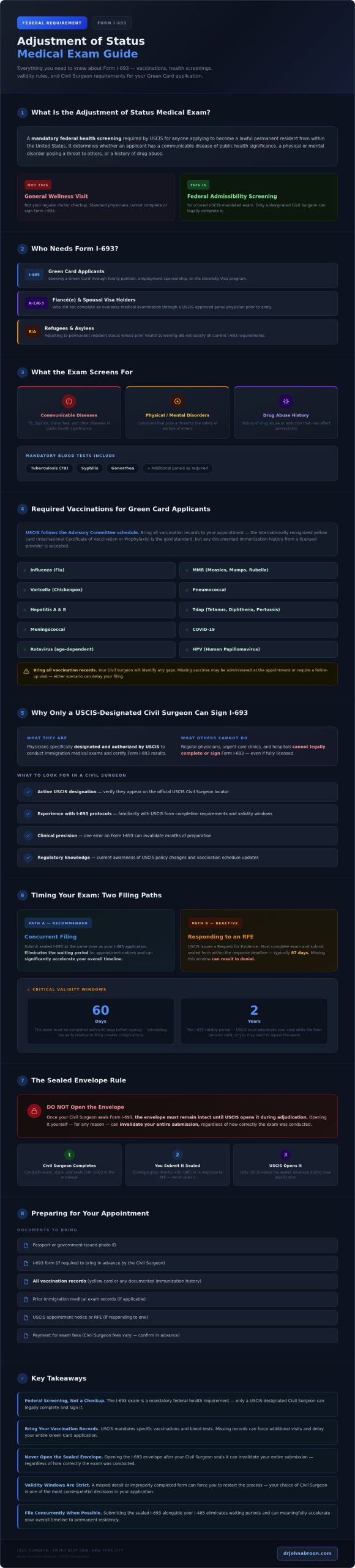
The adjustment of status medical exam is a mandatory federal health screening required by U.S. Citizenship and Immigration Services (USCIS) for anyone applying to become a lawful permanent resident from within the United States. It is not a general wellness visit. Its specific purpose is to determine whether an applicant has a communicable disease of public health significance, a physical or mental disorder that poses a threat to others, or a history of drug abuse. USCIS uses this information to evaluate admissibility under the Immigration and Nationality Act.
The phrase “adjustment of status” refers to the legal process of transitioning from a non-immigrant classification, such as an H-1B or F-1 visa, to permanent resident status without leaving the country. Because this transition grants long-term residency rights, the federal government requires documented proof that the applicant meets specific public health standards before approving that change.
Form I-693 is the official document that captures and certifies those findings. Only a USCIS-designated Civil Surgeon can complete, sign, and seal it. Once sealed, the envelope must remain intact until USCIS opens it during adjudication. The form is not submitted to a public health agency or a hospital. It travels directly to USCIS, either alongside your I-485 application or in response to a specific request.
Who Needs an Immigration Medical Exam?
The requirement applies broadly, but not universally. You’ll generally need a completed I-693 if you fall into one of these categories:
- I-485 applicants seeking a Green Card through a family petition, employment sponsorship, or the Diversity Visa program
- K-1 or K-3 visa holders who did not complete an overseas medical examination through a USCIS-approved panel physician prior to entry
- Refugees and asylees who are adjusting to permanent resident status and whose prior health screening did not satisfy all current I-693 requirements
If you completed a medical exam abroad as part of a consular visa process, check with your immigration attorney before scheduling. Some applicants may have partial or full exemptions depending on when and where that prior exam occurred.
When to Schedule Your Exam
Timing your exam strategically can save significant processing time. Two scenarios typically determine when you’ll need a completed I-693:
Concurrent filing means submitting your sealed I-693 at the same time as your I-485 application. This approach eliminates the waiting period between filing and receiving an appointment notice, which can accelerate your overall timeline considerably.
Responding to an RFE is the alternative path. If USCIS issues a Request for Evidence, you’ll need to complete the exam and submit the sealed form within the response deadline, which is typically 87 days. Missing that window can result in a denial.
The Civil Surgeon’s signature on Form I-693 carries its own validity window. USCIS guidelines specify conditions under which the form remains valid for use, so scheduling your exam too early relative to your filing date can create complications. Your Civil Surgeon should walk you through the current validity rules at the time of your appointment to ensure your form is accepted without issue.
Mandatory Vaccinations and Health Screenings for USCIS
The adjustment of status medical exam covers far more than a standard physical. USCIS requires a structured combination of blood tests, vaccinations, and clinical evaluations, each with specific protocols. Understanding exactly what’s involved before you walk through the door is the single best way to avoid delays, additional appointments, and unnecessary stress.
Before your appointment, gather every vaccination record you have. The internationally recognized yellow card, formally called the International Certificate of Vaccination or Prophylaxis, is the gold standard, but any documented immunization history from a licensed provider will work. Bring what you have. Your Civil Surgeon will identify the gaps.
Required Vaccinations for Green Card Applicants
USCIS follows the Advisory Committee on Immunization Practices (ACIP) schedule when determining which vaccines are required. The core requirements include:
- MMR (Measles, Mumps, Rubella): Two doses required for most applicants born after 1957
- Tdap (Tetanus, Diphtheria, Pertussis): One dose, with Td boosters as applicable
- Polio: Documentation of a complete primary series
- Varicella (Chickenpox): Two doses, or documented proof of prior infection
- Hepatitis B: A three-dose series, required for applicants up to age 59
- Influenza: One dose of the current seasonal formulation, required annually
- COVID-19: As of the time of writing, USCIS continues to require COVID-19 vaccination for applicants. Requirements can shift, so confirm the current mandate directly with your Civil Surgeon before your appointment, as this is one area where federal guidance has evolved.
What if You Are Missing Vaccine Records?
Missing records don’t disqualify you. They just require a clear plan, and there are three practical paths forward.
Titer testing is the first option. A titer is a blood test that measures your existing antibody levels for a specific disease. If your titers confirm sufficient immunity for MMR or Varicella, for example, USCIS will accept that result in place of documented vaccination history. It’s a straightforward blood draw that can resolve significant documentation gaps.
Receiving missing doses on-site is the second option. A well-equipped Civil Surgeon’s office can administer required vaccines directly, consolidating your exam and vaccination needs into a single visit. This is exactly the kind of one-stop experience that makes choosing the right Civil Surgeon so consequential.
Medical waivers apply in specific clinical circumstances. If a vaccine is medically contraindicated, meaning a documented allergy, prior adverse reaction, or a condition that makes vaccination unsafe, your Civil Surgeon can note that contraindication on Form I-693. USCIS reviews these on a case-by-case basis.
Blood Tests and Physical Examination
Beyond vaccinations, USCIS mandates blood screening for Tuberculosis (using the IGRA test, which is a blood-based alternative to the traditional skin test), Syphilis (RPR), and Gonorrhea. Results are documented directly on Form I-693 by your Civil Surgeon.
The physical examination itself is thorough but focused. Your Civil Surgeon will assess general health, respiratory and cardiovascular function, skin condition, and any signs of communicable disease. A mental health evaluation is also part of the process. This isn’t a psychiatric assessment; it’s a clinical review to identify any disorder associated with harmful behavior that USCIS considers relevant to admissibility.
When every component is handled under one roof by a physician who understands both the clinical and regulatory dimensions of this process, the entire exam becomes far more manageable. Schedule your immigration medical exam with Dr. Abroon to complete all required screenings, blood work, and vaccinations in a single, well-coordinated appointment.
Why You Must See a USCIS-Designated Civil Surgeon
Your primary care physician may be exceptional. They may know your health history inside and out. But unless they hold USCIS designation as a Civil Surgeon, they cannot legally complete, sign, or seal Form I-693. Submitting an I-693 signed by an unauthorized physician doesn’t just delay your application; it invalidates it entirely. USCIS will reject the form regardless of how thorough or accurate the underlying examination was.
Civil Surgeon designation isn’t automatic. USCIS vets physicians specifically for their knowledge of immigration health protocols, federal reporting standards, and the precise documentation requirements that govern the adjustment of status medical exam. A designated Civil Surgeon understands that a missing checkmark in the vaccination section, an unsigned field, or an improperly recorded lab result can trigger a Request for Evidence or an outright denial. That level of regulatory fluency simply isn’t part of standard medical training.
Accuracy is the entire point. The I-693 isn’t a form that tolerates approximation. Every field has a purpose, and USCIS adjudicators review these forms against strict compliance standards. Dr. John Abroon has been board-certified in internal medicine since 1997, and his USCIS designation reflects decades of navigating complex medical clearances where clinical precision and regulatory compliance must work together seamlessly.
The Difference Between a Civil Surgeon and a Panel Physician
These two roles are frequently confused, but they serve entirely different functions within the immigration system. Panel Physicians operate at U.S. embassies and consulates abroad, conducting medical exams for applicants going through consular processing outside the United States. Civil Surgeons are designated to work domestically, completing Form I-693 exclusively for individuals adjusting their status from within the country. If you’re living in New York City and applying for a Green Card through the I-485 process, a Civil Surgeon on the Upper East Side is the only physician who can legally handle your case. A panel physician’s exam, conducted overseas, has no standing in this context.
Dr. Abroon’s Professional Approach to Immigration Exams
Immigration medical appointments carry a specific kind of stress. The stakes are high, the paperwork is dense, and the clinical environment itself can elevate anxiety in ways that affect exam results, including blood pressure readings. Dr. Abroon’s practice is designed to counter that. The setting is calm and professional, closer in feel to a concierge medical office than a clinical processing center, which matters when accurate physiological measurements are part of the record.
His approach combines the diagnostic rigor of internal medicine with a precise understanding of what USCIS expects on a completed I-693. That dual expertise means your exam is evaluated through both a clinical and a compliance lens simultaneously. As a primary care physician in NYC with deep roots in the Upper East Side community, Dr. Abroon brings continuity of care to a process that most applicants experience only once, ensuring nothing is overlooked and every component of your form is completed correctly the first time.
Preparing for Your Appointment in New York City
Preparation is what separates a smooth, single-visit adjustment of status medical exam from one that requires a follow-up appointment. The clinical work itself is straightforward when you arrive organized. What slows applicants down is almost always logistical: a missing vaccination record, an untranslated document, or uncertainty about fasting requirements that leads to unnecessary rescheduling.
Here’s what you need to know before you walk through the door.
Checklist: What to Bring to Dr. Abroon’s Office
- Government-issued photo ID: A valid passport is strongly preferred, as it also confirms your nationality and current immigration status. A driver’s license can supplement but typically shouldn’t replace it.
- Vaccination records: Bring every immunization document you have, including records from your home country. If they’re not in English, have them translated by a certified translator before your appointment. Partial records are still useful; your Civil Surgeon will work with what you have and identify the gaps.
- Form I-693: Dr. Abroon’s office maintains the current USCIS-approved version, so you don’t need to source it yourself. That said, if your immigration attorney has already provided one, bring it along.
- A complete medication list: Include dosages and the conditions each medication treats. Chronic health conditions, documented allergies, and prior adverse vaccine reactions are all clinically relevant to how your exam is conducted and recorded.
Fasting and Lab Preparation
Most of the blood work required for the I-693 doesn’t require fasting. The Syphilis (RPR) and TB (IGRA) screenings are standard blood draws with no dietary restrictions beforehand. Confirm with the office when you book, since individual clinical circumstances can occasionally affect this guidance.
What to Expect During Your Appointment
Plan for an appointment that runs roughly one to two hours, depending on how many vaccinations need to be administered on-site. The visit covers your physical examination, blood draws, a review of your vaccination history, and completion of the relevant sections of Form I-693. The environment is calm and unhurried, which matters when accurate measurements like blood pressure are part of the clinical record.
NYC Logistics: Labs and Turnaround Times
Specimen collection for Syphilis and TB testing happens directly in the office, which eliminates the delay of coordinating with an external lab. Results are typically processed within a few business days, after which your completed, sealed I-693 will be ready for pickup. Contact the office when scheduling to get a specific turnaround estimate based on current lab processing times.
The Upper East Side location is well-served by the 4, 5, and 6 subway lines, making it genuinely accessible for applicants coming from Midtown, the Upper West Side, and surrounding neighborhoods. For those in outer boroughs, the commute is straightforward compared to navigating a clinic in a less central part of the city.
Language support is available for patients who need assistance communicating their medical history. If you require a translator, contact the office in advance so accommodations can be arranged before your appointment, not during it.
Arriving organized means leaving with a sealed envelope and a clear next step. Book your immigration medical exam with Dr. Abroon and complete every required component of your I-693 in a single, well-coordinated visit.
Navigating the Final Steps: Results and the Sealed Envelope
You’ve completed your adjustment of status medical exam. The blood work is done, the vaccinations are documented, and Dr. Abroon has reviewed every section of Form I-693. What happens next is straightforward, but one rule in particular carries consequences serious enough to warrant its own explanation.
Do not open the sealed envelope. This isn’t a formality. Once your Civil Surgeon completes, signs, and seals the I-693 packet, that envelope must arrive at USCIS intact. An opened envelope signals a compromised form, regardless of whether anything inside was altered. USCIS will reject it, and you’ll need to restart the process from scratch. The seal is the chain of custody. Breaking it breaks your submission.
What you can review is your personal copy. Dr. Abroon provides each patient with a copy of their completed results for their own records. This gives you full visibility into what was documented, including your vaccination status, lab findings, and any clinical notations, without compromising the sealed official packet. Keep this copy somewhere safe. It’s your reference point if questions arise later.
What Happens If a Test Comes Back Positive
A positive result doesn’t automatically end your Green Card application. Latent tuberculosis is the most common example. Latent TB means the infection is present but not active, and it’s not considered a communicable disease of public health significance under USCIS guidelines. Your Civil Surgeon will document the finding accurately on Form I-693 and may recommend a treatment course. USCIS adjudicators review these cases individually, and many applicants with latent TB findings proceed to approval without issue. Transparency and accurate documentation, not concealment, are what protect your application.
Once the sealed envelope is ready, you have two options: submit it directly alongside your I-485 if you haven’t filed yet, or provide it to your immigration attorney to include with your application package. Either way, don’t delay. Validity windows are real, and a form that sat too long on a desk can create the same problem as one that was never completed.
What to Do If You Receive an RFE
Receiving a Request for Evidence related to your medical exam is more common than most applicants expect, and it’s almost never a signal that something is seriously wrong. The most frequent cause is a simple timing issue: the previously submitted I-693 expired before USCIS adjudicated the case. The form has a defined validity window, and when that window closes, USCIS needs a current one.
If your RFE requests an updated medical exam, the process is essentially the same as your original appointment. In some circumstances, a Civil Surgeon can re-certify a form rather than conduct an entirely new examination, depending on how much time has passed and which components remain current. Dr. Abroon will assess your specific situation and determine the most efficient path forward. For a deeper walkthrough of the full I-693 process and how RFEs fit into it, the Immigration Medical Exam in NYC: Your Complete Guide to the I-693 Process covers the procedural landscape in detail.
Don’t let the RFE deadline pass without acting. The response window is firm, and a missed deadline typically results in denial.
Ensuring Your Green Card Journey Stays on Track
A correctly completed, properly sealed I-693 is one of the most satisfying milestones in the adjustment of status process, because it’s entirely within your control. Choose the right Civil Surgeon, arrive prepared, and the form gets done right the first time. That’s the whole formula.
What comes after is worth thinking about, too. Permanent residency is a fresh start in many respects, and your health deserves the same continuity of care that your immigration status now reflects. Establishing an ongoing relationship with a trusted NYC internist means you have a physician who already knows your history, including everything documented during your immigration exam, ready to support your health in the years ahead. Your Annual Physical Exam in NYC: A Complete Guide for 2026 is a practical resource for understanding what that ongoing preventive care looks like and why it matters at every stage of life.
The sealed envelope is the final step in a process that began with gathering documents and ends with submitting a form that represents your health, your compliance, and your readiness for permanent residency. When every component is handled with precision, that envelope carries confidence, not uncertainty.
Your Green Card Path Starts With the Right Civil Surgeon
The adjustment of status medical exam is one of the few steps in your Green Card application where precision is entirely within your control. Choose a USCIS-designated Civil Surgeon, arrive prepared, and the I-693 gets completed correctly the first time. That’s what protects your timeline and keeps your application moving forward.
Three things make the difference: working with a physician who holds official Civil Surgeon designation, having your vaccinations and records organized before you walk in, and understanding that the sealed envelope is the final, non-negotiable piece of the process. Get those right, and this complex federal requirement becomes a single, manageable appointment.
Dr. Abroon’s Upper East Side practice brings board-certified internal medicine expertise and USCIS Civil Surgeon designation together in a calm, concierge-style setting designed to make this process straightforward rather than stressful. Every required component, from blood work to vaccinations, is handled under one roof.
Book your USCIS medical exam with Dr. Abroon today and take this milestone off your checklist with confidence.
Frequently Asked Questions About the Adjustment of Status Medical Exam
How much does the adjustment of status medical exam cost in NYC?
Immigration medical exam fees vary by provider and depend on which vaccinations you need on the day of your appointment. The base exam fee covers the physical, required blood work, and form completion, but any vaccines administered on-site are typically billed separately. Contact Dr. Abroon’s office directly for current pricing before scheduling, so you can plan for the full cost of your visit based on your specific vaccination history.
Does health insurance cover the I-693 immigration medical exam?
Most standard health insurance plans do not cover the immigration medical exam because it’s a government-required administrative process rather than a medically necessary clinical service. Some plans may cover individual components, such as blood draws or vaccines, if those services are billed independently. Confirm your coverage with your insurer before your appointment, and ask the office whether any components can be billed separately to maximize what your plan reimburses.
How long is the I-693 medical exam valid for USCIS in 2026?
USCIS validity rules for Form I-693 are specific and worth understanding before you schedule. Generally, the form remains valid if USCIS receives it within two years of the Civil Surgeon’s signature date, and the applicant must not have exceeded certain age thresholds for vaccination requirements during that window. Because these guidelines can be updated, confirm the current validity rules with Dr. Abroon’s office at the time you book, since filing with an expired form is one of the most common and avoidable reasons for an RFE.
What happens if I don’t have my childhood vaccination records?
Missing childhood records don’t disqualify you from completing your adjustment of status medical exam. Two practical options exist: titer testing, which is a blood draw that measures your existing immunity for diseases like MMR and Varicella, or simply receiving the missing doses on-site during your appointment. Dr. Abroon’s office can administer required vaccines directly, so gaps in your history can often be resolved in a single visit without the need for a follow-up appointment.
Can I get my immigration medical exam while I am pregnant?
Yes, you can complete the immigration medical exam during pregnancy. Your Civil Surgeon will review your current health status and adjust the clinical approach accordingly. Certain vaccines are contraindicated during pregnancy, including MMR and Varicella, and Dr. Abroon will document any medically appropriate deferrals directly on Form I-693. USCIS reviews these notations on a case-by-case basis, and a properly documented contraindication will not automatically delay your application.
Do I need to fast before my immigration physical with Dr. Abroon?
Fasting is generally not required for the standard blood work included in the I-693 exam. The TB (IGRA) and Syphilis (RPR) screenings are routine blood draws without dietary restrictions. That said, individual health circumstances can occasionally affect this guidance, so confirm fasting requirements when you book your appointment rather than assuming the standard protocol applies to your specific situation.
What should I do if I test positive for Tuberculosis during the exam?
A positive TB result doesn’t automatically jeopardize your Green Card application. Latent TB, meaning the infection is present but inactive, is not classified as a communicable disease of public health significance under USCIS guidelines. Dr. Abroon will document the finding accurately on Form I-693 and may recommend a treatment course. USCIS adjudicators review these cases individually, and many applicants with latent TB findings proceed to approval. Accurate documentation, not concealment, is always the right approach.
Can I open the sealed envelope to check for mistakes before sending it to USCIS?
No. Opening the sealed envelope invalidates your I-693 submission entirely, regardless of your reason for opening it. USCIS treats an opened envelope as a compromised form and will reject it, requiring you to restart the exam process. To give you full visibility into what was documented, Dr. Abroon provides each patient with a personal copy of their completed results. Review that copy for your own records, and submit the sealed official packet untouched.