


What if a simple lab draw felt like the biggest obstacle between you and your future in the United States? For many applicants, the blood test for immigration medical exam carries an unexpected weight, sparking anxiety about needles or the fear of a result that could delay a green card application. It’s perfectly normal to feel overwhelmed by the strict timeline of USCIS filings and the confusion surrounding age-specific laboratory requirements. You aren’t just looking for a diagnostic facility; you’re looking for the peace of mind that your health and your status are in expert hands.
At John Abroon M.D., we believe that medical clarity is the foundation of a stress-free immigration journey. This 2026 guide provides a clear roadmap to the mandatory screenings, helping you understand exactly what to expect and how to prepare for your visit. We will explore the specific laboratory protocols for tuberculosis and syphilis, explain the importance of age-based testing, and demystify the sealed envelope process. By the end of this article, you’ll have the confidence to navigate your medical clearance with ease, ensuring your paperwork is filed correctly and on time in our welcoming Upper East Side office.
Key Takeaways
- Identify the essential screenings required for Form I-693, focusing on the CDC’s requirements for communicable diseases of public health significance.
- Learn why the modern IGRA blood test is now the gold standard for tuberculosis screening, replacing older skin tests for a more accurate and efficient process.
- Understand how your age dictates specific testing protocols, ensuring your blood test for immigration medical exam aligns perfectly with current USCIS regulations.
- Demystify the “sealed envelope” procedure and discover why a positive result for latent conditions is a medical hurdle you can overcome with the right care.
- Explore the benefits of visiting a USCIS-designated Civil Surgeon who offers in-office specimen collection to simplify your Manhattan medical clearance.
Essential Blood Tests for Form I-693: An Overview
The Report of Immigration Medical Examination (Form I-693) is more than a simple health check; it’s a critical public health screening required for residency. Every applicant must undergo specific diagnostic evaluations to ensure they don’t pose a risk to the community. A central requirement of this process is the blood test for immigration medical exam, which targets “communicable diseases of public health significance” as defined by the CDC. This screening process aligns with the historical and legal framework of the Medical exclusion of immigrants, ensuring that those entering or adjusting status meet the necessary health-related grounds for admissibility.
The Role of the USCIS Civil Surgeon
While you might have a primary care doctor you visit for annual checkups, they cannot sign your I-693 form unless they’ve been specifically designated by USCIS. John Abroon M.D. maintains this designation, providing the clinical authority required to validate your results. Choosing a board-certified internist for your exam ensures that your laboratory data is interpreted with the highest level of diagnostic precision. In our Manhattan facility, we manage the entire chain of custody for your specimens. This means your blood work is handled securely from the moment of the draw until the final results are documented in your sealed envelope, preventing any administrative errors that could lead to a rejection.
The Three Primary Screenings
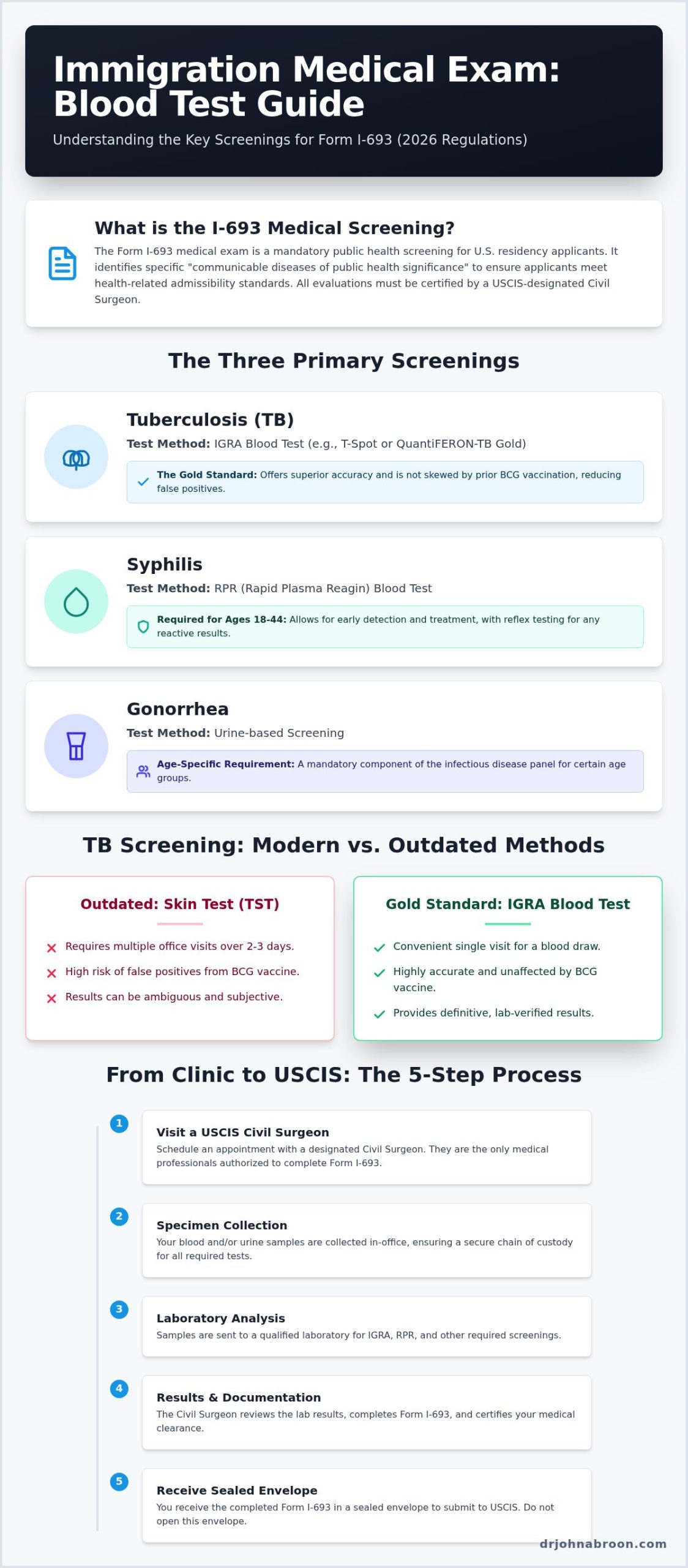
USCIS focuses its laboratory requirements on three specific conditions that have significant public health implications. While these are often grouped under the general term blood test for immigration medical exam, the methods of collection can vary based on current CDC protocols. These tests are standardized for all green card applicants within the required age brackets:
- Tuberculosis (TB): This is now conducted via an IGRA blood test, which offers superior accuracy over older methods.
- Syphilis: A mandatory RPR blood screening identifies this bacterial infection, allowing for early detection and treatment.
- Gonorrhea: Though typically a urine-based screening, it’s a mandatory component of the infectious disease panel for specific age groups.
By conducting these tests in a controlled, professional environment, we ensure that your medical record is both accurate and compliant with the latest federal regulations. We handle these routine screenings with the care and attention to detail that your high-stakes application requires.
Deep Dive: Understanding TB, Syphilis, and Gonorrhea Testing
The landscape of immigration medicine has evolved significantly. Gone are the days of the multi-day tuberculin skin test (TST), which often required multiple office visits and provided ambiguous results. Today, the blood test for immigration medical exam utilizes advanced laboratory science to provide definitive answers with a single draw. This shift toward precision ensures that your Form I-693 is backed by the most reliable clinical data available, reducing the stress of potential delays.
The IGRA Blood Test for Tuberculosis
For tuberculosis screening, USCIS now mandates the Interferon-Gamma Release Assay (IGRA). We primarily utilize the T-Spot or QuantiFERON-TB Gold Plus tests, which are considered the gold standard for diagnostic accuracy. These tests are particularly beneficial for applicants who received the Bacillus Calmette-Guérin (BCG) vaccine in their home countries. Unlike the old skin tests, IGRA results aren’t skewed by the BCG vaccine; this drastically reduces the chance of a false positive. The IGRA test is a highly specific laboratory method that measures the immune system’s response to TB bacteria. By focusing on specific proteins, we can distinguish between a past vaccination and an actual latent or active infection, providing you with a clear and accurate health profile.
Syphilis and Gonorrhea Protocols
Public health screenings also include specific tests for bacterial infections like syphilis and gonorrhea. Per current CDC guidelines, syphilis screening is required for all applicants between the ages of 18 and 44. We perform an RPR (Rapid Plasma Reagin) test to identify antibodies. If an initial screening returns a reactive result, we immediately initiate reflex testing. This secondary, more specific confirmatory test helps us determine if the result is due to a past treated infection or a current one that requires medical attention. Gonorrhea testing is required for applicants aged 15 and older. While we often discuss this alongside your blood test for immigration medical exam, it typically involves a urine sample rather than a blood draw.
Modern diagnostic tools have revolutionized the medical clearance process. These sophisticated methods mean fewer false positives and less anxiety for you. If you have concerns about your medical history or upcoming labs, you can schedule a consultation with John Abroon M.D. to discuss your specific needs in a supportive, professional environment. Our goal is to ensure you feel empowered by your results rather than overwhelmed by the requirements.
Age Requirements and Testing Protocols for 2026
USCIS does not apply a blanket rule to every family member. The specific blood test for immigration medical exam protocols change based on the applicant’s age on the day of the appointment. This nuance is critical. Missing even one age-specific screening can trigger a Request for Evidence (RFE), stalling your green card application for months. We ensure your family’s laboratory panel matches the current CDC Technical Instructions exactly.
Testing Requirements by Age Group
Age thresholds determine which communicable diseases require screening. For children under the age of two, the focus remains on the physical evaluation rather than laboratory draws. Once a child reaches age two, the IGRA blood test for tuberculosis becomes mandatory. Between the ages of 2 and 17, applicants generally don’t require syphilis or gonorrhea testing unless Dr. Abroon identifies a specific clinical need during the exam.
Adults between 18 and 44 undergo the most comprehensive laboratory panel. This includes mandatory screenings for tuberculosis, syphilis, and gonorrhea. For those aged 45 and older, TB screening remains a permanent requirement, while other bacterial screenings are typically omitted per current federal guidelines. By following these precise age-based protocols, we protect your timeline and ensure your I-693 is filed correctly the first time.
Preparing for the Blood Draw
Preparation for your laboratory work is simple, but a few small steps can make a significant difference in your comfort. You don’t need to fast for a blood test for immigration medical exam. We actually recommend eating a balanced meal and drinking plenty of water before your visit. Proper hydration helps our clinical team locate veins more easily, which leads to a faster and more efficient experience for everyone involved.
When you visit our Upper East Side office for your immigration medical exam nyc, remember to bring your passport or government photo ID and any historical vaccination records. If you feel anxious about needles, please let us know. Our practice is designed with a concierge-like feel to reduce patient stress. We use specialized techniques to ensure even the most needle-phobic patients feel calm and supported throughout their visit. This personalized care is why many families trust us with their high-stakes medical filings.
Managing Results: What Happens After Your Blood Work?
Once the laboratory has processed your blood test for immigration medical exam, the results move to the final documentation phase. Dr. Abroon carefully transcribes these findings onto your Form I-693. This lead to the “sealed envelope” stage, where the original form is placed in a secure packet that you must deliver to USCIS unopened. It’s essential that you don’t break this seal, as doing so invalidates the medical clearance. We provide you with a personal copy of the results so you can review the findings for your own records without disturbing the official filing.
Many applicants feel a surge of anxiety while waiting for their lab reports. It’s vital to remember that a positive test result is a manageable medical hurdle, not an automatic barrier to your residency. Our goal is to guide you through the next clinical steps with clarity and compassion, ensuring your health and your application remain on the right track.
Interpreting a Positive TB Result
If your IGRA test returns a positive result, it indicates that your immune system has encountered the TB bacteria. This usually points to a Latent TB Infection (LTBI) rather than active disease. LTBI is not contagious and, with a clear chest X-ray, allows the I-693 to be completed. To rule out active disease, we coordinate a chest X-ray to ensure your lungs are clear. If the X-ray is negative for active symptoms, Dr. Abroon can sign off on your medical clearance. Per NYC health regulations, we’re required to report positive IGRA results to the local health department for public health monitoring, but this doesn’t negatively impact your immigration status.
Treatment and Clearance
Other conditions, such as a reactive syphilis screening, follow a similar path of clinical resolution. If a bacterial infection is detected, it can typically be addressed with a standard course of antibiotics. Once treatment is initiated or completed, depending on the specific CDC protocol, we can move forward with your paperwork. The timeline for re-testing varies, but we work closely with you to ensure every requirement is met as quickly as possible. Dr. Abroon’s role as a USCIS-designated Civil Surgeon is to help you achieve a healthy status so you can move forward with your life in the United States. If you’re ready to start this process with a team that prioritizes your success, schedule your immigration medical exam today.
Why Choose Dr. John Abroon for Your NYC Immigration Exam?
Selecting the right facility for your medical clearance is a pivotal step in your immigration journey. In New York’s competitive landscape, you deserve more than a standard clinic; you need a dedicated partner who understands the weight of your USCIS filing. Dr. John Abroon offers a sophisticated medical experience on the Upper East Side, blending elite clinical authority with a warm, patient-centered environment that feels more like a concierge service than a sterile office. We believe that professional medical care should be steady, personalized, and deeply reassuring.
As a USCIS-designated Civil Surgeon and board-certified internist, Dr. Abroon has provided high-level care to the Manhattan community since 1997. We recognize that the blood test for immigration medical exam is often the most stressful part of the process for many applicants. To mitigate this anxiety, we provide in-office diagnostic and laboratory testing. By centralizing your care, we maintain a strict chain of custody over your specimens and ensure that your results are processed with both accuracy and speed. You won’t have to navigate third-party labs or wait weeks for paperwork to be transferred; everything is handled under one roof.
A Seamless Experience on the Upper East Side
Our private practice setting prioritizes your time and total well-being. Unlike large institutions where you might feel like just another case number, we treat every applicant as an individual with unique needs. You’ll enjoy shorter wait times and more direct access to Dr. Abroon, allowing for a thorough consultation where your health history is respected. Our staff provides meticulous oversight for Form I-693, ensuring that every signature and date is perfectly placed to avoid a Request for Evidence (RFE). This attention to detail is why we are also a trusted primary care physician nyc for many who choose to stay with us for their long-term wellness needs after their status is adjusted.
Booking Your Appointment
We’ve simplified the scheduling process to accommodate the busy lives of families and professionals in Manhattan. During your visit, you can expect a streamlined flow from the initial physical examination to the blood draw. We move logically through the requirements, keeping you informed at every stage so you feel empowered by the information you receive. If you’re facing a tight USCIS deadline, our commitment to efficiency ensures your paperwork is completed correctly and on time. Schedule your immigration medical exam with Dr. Abroon today to take the next step in your health journey with a trusted expert by your side.
Secure Your Path to Residency with Expert Medical Guidance
Navigating the laboratory requirements for your adjustment of status doesn’t have to be a source of stress. By understanding that your blood test for immigration medical exam is a standardized public health screening, you can approach your appointment with clarity and confidence. Each protocol, from the precision of the IGRA tuberculosis test to the age-specific screenings for syphilis and gonorrhea, is designed to ensure a healthy transition to your new life. These results are manageable clinical steps, not barriers, and having an expert to interpret them makes all the difference in your application timeline.
Dr. John Abroon provides the elite credentials of a board-certified internal medicine specialist with the approachable bedside manner you deserve. As a USCIS-designated Civil Surgeon on the Upper East Side of Manhattan, he ensures your I-693 paperwork is handled with meticulous accuracy and care. Our office prioritizes your peace of mind by managing every detail of the diagnostic process in one convenient location, allowing you to focus on the next chapter of your journey.
Book Your USCIS Immigration Medical Exam with Dr. Abroon to experience a seamless, concierge-level medical clearance. Your future in the United States is a significant milestone, and we’re here to support your health and your success every step of the way.
Frequently Asked Questions
Do I need to fast before the blood test for my immigration medical exam?
You don’t need to fast before your blood test for immigration medical exam. These specific screenings for tuberculosis and syphilis don’t require an empty stomach to provide accurate results. We actually recommend eating a balanced meal and staying well hydrated before your visit to our Upper East Side office. Proper hydration makes the blood draw much easier and helps you feel more comfortable during your appointment.
How long does it take to get the blood test results back for Form I-693?
Laboratory results typically return within three to five business days. Once we receive your reports, Dr. Abroon reviews them and transcribes the data onto your Form I-693. If a screening requires reflex testing for confirmation, the timeline might extend slightly. We prioritize both accuracy and efficiency to ensure your medical clearance is finalized in time to meet your USCIS filing deadlines without unnecessary stress.
Will a positive TB blood test result in a green card denial?
A positive IGRA result isn’t an automatic denial of your application. Most positive results indicate a latent infection, which isn’t contagious. If your follow up chest X-ray is clear and you show no symptoms of active disease, Dr. Abroon can complete your medical clearance. While we must report positive results to the NYC health department per local regulations, this is a public health protocol and doesn’t impact your legal eligibility.
Can I use blood test results from my own doctor for the immigration exam?
USCIS regulations generally require the designated Civil Surgeon to oversee the laboratory process to ensure a secure chain of custody. While you should bring any previous records, we typically perform the blood test for immigration medical exam in our facility. This ensures every screening meets the exact CDC Technical Instructions required for 2026 and that the results are documented correctly on the mandatory edition of Form I-693.
What happens if I am pregnant and need a TB test or chest X-ray?
The IGRA blood test for tuberculosis is completely safe to perform during pregnancy. If a positive result makes a chest X-ray necessary, we follow strict safety protocols, including the use of lead shielding to protect the fetus. We tailor our approach to your specific needs, ensuring your health and your baby’s safety remain the top priority while still meeting the legal requirements for your medical clearance.
Is a blood test for HIV still required for the USCIS medical exam?
No, HIV testing is no longer a mandatory part of the immigration medical exam. USCIS removed HIV from the list of communicable diseases of public health significance in 2010. While we focus on mandatory screenings for tuberculosis, syphilis, and gonorrhea, we can perform HIV testing as part of a separate wellness check if you’re interested in a more comprehensive evaluation of your total well being.
How much does the blood work portion of the immigration exam cost in NYC?
Costs for laboratory work in New York City vary depending on the age of the applicant and the specific panels required by the CDC. Some facilities charge separate fees for each lab, while others provide bundled packages that include the exam and all mandatory tests. We recommend contacting your Civil Surgeon’s office directly for a transparent breakdown of their specific process to ensure there are no hidden laboratory fees.
What should I do if I have a history of positive TB tests?
If you have a history of positive TB tests, please bring any previous treatment records or chest X-ray reports to your visit. Even with a known history, USCIS still requires a current IGRA blood test. If that test returns a positive result, we’ll perform a chest X-ray to confirm you don’t have active disease. Providing your medical history helps us document your case accurately and prevents delays in your status adjustment.