


Did you know that nearly 18% of green card denials stem from simple errors or missing information on medical forms? It’s completely natural to feel a wave of anxiety when a USCIS envelope arrives labeled as a deficiency notice. You’ve worked hard on your application, and this unexpected hurdle can feel like a major setback to your plans. Understanding how to respond to i-693 deficiency notice is the most vital step you can take right now to protect your path to residency.
We’re here to help you navigate this process with calm and clinical precision. This 2026 guide will explain exactly what this notice means for your green card and provide the specific steps you need to take with a USCIS civil surgeon to stay on track. We’ll walk through the latest filing requirements, including the mandatory 01/20/25 form edition and current vaccination standards. You’ll learn how to resolve these administrative errors quickly so you can move forward with the confidence that your health documentation is in expert hands.
Key Takeaways
- Understand why a deficiency notice is often a “courtesy letter” designed to keep your application moving rather than a signal of impending denial.
- Learn exactly how to respond to i-693 deficiency notice by timing your medical exam correctly to avoid document expiration or filing errors.
- Distinguish between a standard deficiency notice and a formal Request for Evidence (RFE) so you don’t mail your results to USCIS prematurely.
- Prepare for your appointment by gathering required immunization records and understanding the necessary diagnostic tests for the 2026 filing standards.
- Discover the importance of the “Sealed Envelope” protocol and why choosing an experienced NYC civil surgeon is vital for a successful green card application.
Understanding the I-693 Deficiency Notice: What It Really Means
Receiving a notice from USCIS often triggers a moment of localized panic; however, seeing a “Deficiency Notice” should actually provide a sense of quiet relief. Often referred to as a “Courtesy Letter,” this document is an administrative placeholder rather than a warning of failure. It simply informs you that your Form I-693, Report of Immigration Medical Examination and Vaccination Record, is either missing from your file or contains technical errors that need correction. USCIS issues this notice to ensure you meet the necessary health-related requirements for immigration before they reach a final decision on your residency. At the practice of John Abroon M.D., we see these notices as helpful roadmaps that clarify exactly what the government needs to finalize your status.
The most common reason for receiving this notice in 2026 involves the timing of your initial filing. Since December 2, 2024, USCIS has required that Form I-693 be submitted concurrently with your Form I-485 application. If you filed before this date or inadvertently omitted the medical results during your initial submission, the agency sends this notice to keep your application in the queue. Learning how to respond to i-693 deficiency notice is the first step in converting this administrative hurdle into a successful approval. It represents a psychological shift: your case isn’t being ignored; it’s being actively managed by an officer who wants to see your file completed.
Is an I-693 Deficiency Notice a Denial?
It’s vital to understand that a deficiency notice is not a denial of your green card application. Your status remains active and in good standing throughout this process. This document serves as a non-punitive reminder for missing medical documentation that allows you to prepare for the final stages of your journey without the pressure of an immediate deadline. John Abroon M.D. specializes in providing the clinical precision required to resolve these notices efficiently, ensuring that your medical history is documented correctly for USCIS review.
Why USCIS Sends These Notices in 2026
The landscape of immigration has changed significantly this year. USCIS has shifted toward a streamlined processing model that favors “interview-less” approvals for many adjustment of status applicants. When an officer reviews your file and realizes a decision could be made without an in-person meeting, they need your medical results immediately available. By sending a deficiency notice early, the agency prevents your case from stalling once your priority date becomes current. This proactive approach ensures that once you know how to respond to i-693 deficiency notice, the path to your final approval is clear of medical roadblocks. By partnering with a seasoned expert like John Abroon M.D., you gain the benefit of decades of experience in the New York medical community, making the transition from deficiency to approval as smooth as possible.
Deficiency Notice vs. Request for Evidence (RFE): Key Differences
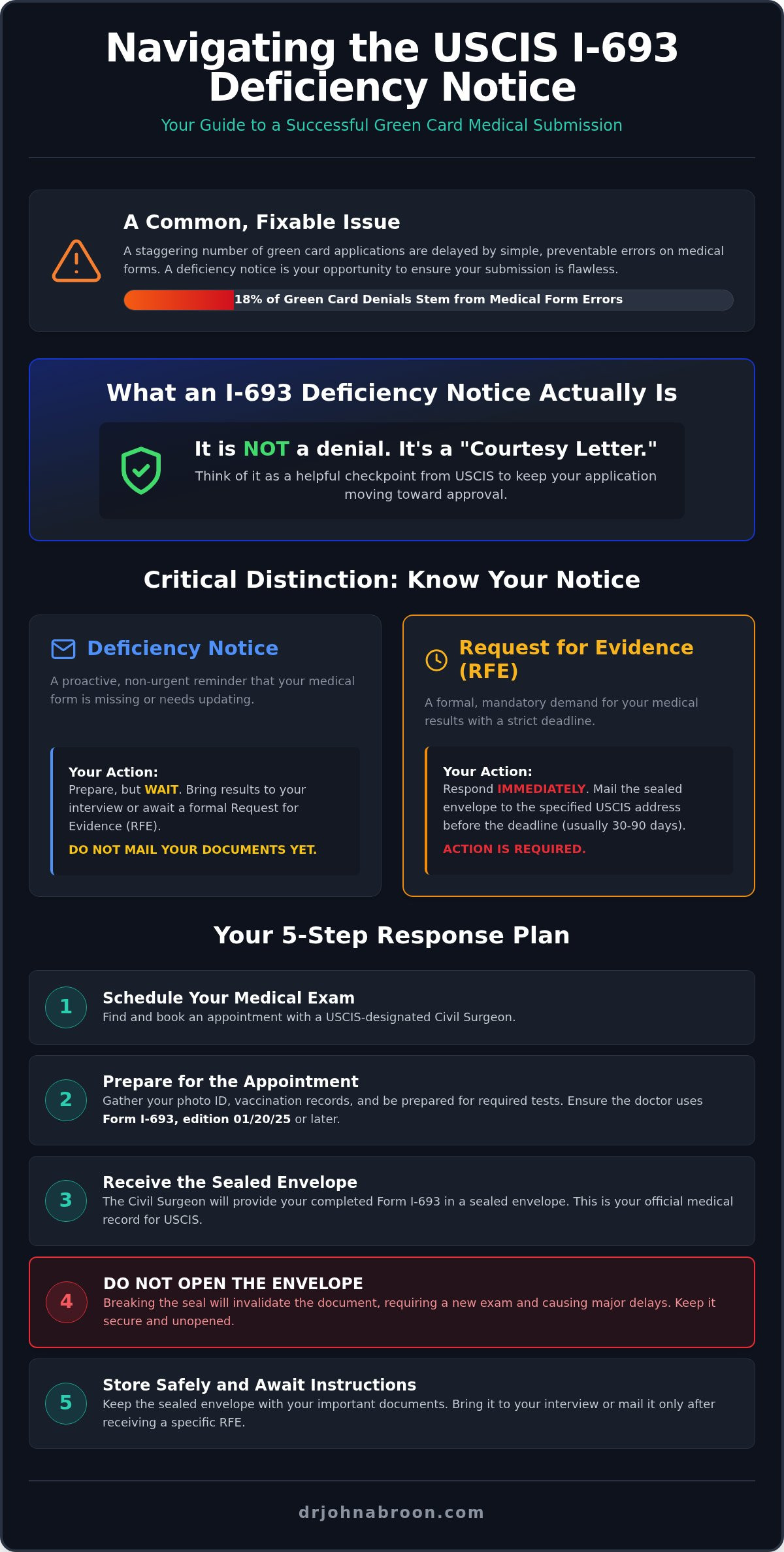
Distinguishing between a Deficiency Notice and a formal Request for Evidence (RFE) is essential for the integrity of your application. While both concern your medical documentation, they trigger entirely different protocols. A Deficiency Notice, often issued on Form I-797, serves as a courtesy reminder. It alerts you that your file is incomplete but explicitly instructs you not to mail the missing documents yet. Wait for the signal. Conversely, an RFE is a mandatory demand with a strict deadline, usually 30 to 90 days. Knowing how to respond to i-693 deficiency notice correctly ensures your green card application stays on its intended timeline and doesn’t get lost in administrative limbo.
The official USCIS policy on Form I-693 outlines how officers handle these distinct communications. If you receive a deficiency notice, the agency doesn’t have an active “call” for your medical results in their mailroom. Sending your sealed envelope now increases the risk of it being lost or separated from your master file. This leads to redundant exams and unnecessary costs. At the Upper East Side practice of John Abroon M.D., we prioritize helping patients understand these nuances so they don’t waste time or resources on premature filings.
The ‘Courtesy’ vs. ‘Mandatory’ Distinction
The most critical difference lies in the “Action Required” section of your notice. A deficiency notice typically advises you to bring your medical results to your interview or wait for a subsequent RFE. It’s a signal that your case is moving, but you don’t need to take immediate mailing action. If your notice includes a specific mailing address and a “Response Due” date, you’re likely holding an RFE. Miscalculating how to respond to i-693 deficiency notice by ignoring a mandatory RFE can result in a denial. Look for the specific headers on your letter; a courtesy notice will clearly state that no immediate action is required via mail.
Potential Risks of Incorrect Responses
Mailing documents without a formal RFE creates a “paperwork ghost.” Without an open request to link your envelope to your digital A-file, your medical results may sit in a processing center for months. This error often forces applicants to repeat the entire medical exam process. It’s much safer to wait for the proper instruction. If you’re feeling overwhelmed by the technical language of your notice, consulting a USCIS-designated civil surgeon at the office of John Abroon M.D. can help you decipher the requirements. Our practice ensures that your Form I-693 is completed with the precision USCIS expects, preventing the very errors that trigger these notices in the first place. We focus on providing a steady, reliable path through the complex health requirements of the immigration process.
Timing Your Response: When to Schedule Your Medical Exam
Timing is everything when managing immigration paperwork. While your first instinct might be to book an appointment immediately after opening the envelope, a strategic approach serves you better. When determining how to respond to i-693 deficiency notice, remember that your goal is a seamless transition from applicant to resident. Traditionally, the “60-Day Rule” required the civil surgeon’s signature to be dated no more than 60 days before you filed your Form I-485. Since you’ve already filed your application and received this notice, that specific window is less of a deadline and more of a baseline for your medical record’s integrity.
The official USCIS policy on Form I-693 clarifies how these records are handled. A significant shift occurred for forms signed on or after November 1, 2023; these documents now remain valid indefinitely while your application is pending. This means that once John Abroon M.D. signs your completed Form I-693, you won’t have to worry about it expiring before your green card is issued, even if the processing takes longer than expected. This policy change allows us to focus on clinical precision and your total well-being rather than racing against a ticking clock.
Avoiding the “Expired Medical” Trap
Even with the benefit of indefinite validity, you should coordinate your exam timing with your legal counsel. If your priority date isn’t yet current, your lawyer might suggest waiting until you’re closer to the front of the line to ensure all your vaccinations meet the very latest CDC requirements for 2026. The Upper East Side practice of John Abroon M.D. specializes in this type of high-stakes coordination. We ensure that every diagnostic test, from TB screenings to blood work, is performed with enough lead time to have your results ready when USCIS sends the final call. This personalized oversight removes the stress of administrative guesswork and ensures you don’t fall into an outdated paperwork trap.
Preparing for an Upcoming Interview in NYC
In the New York City field offices, the gap between receiving a deficiency notice and attending an interview can vary. We generally recommend having your sealed envelope in your possession at least two weeks before your scheduled interview date. This buffer accounts for any unexpected lab processing times and gives you peace of mind. For a deeper look at the entire journey, explore our Immigration Medical Exam in NYC: Your Complete Guide to the I-693 Process. Knowing how to respond to i-693 deficiency notice with a clear timeline ensures you can walk into your interview with one less thing to worry about.
How to Prepare for Your USCIS Medical Exam in New York City
Preparing for an immigration medical exam in a fast paced environment like Manhattan requires organization and a clear understanding of federal requirements. Once you know how to respond to i-693 deficiency notice, your focus must shift to the clinical details that will satisfy a USCIS officer. The process begins with a comprehensive review of your medical history and vaccination status. Dr. John Abroon, a board-certified internist on the Upper East Side, provides a streamlined experience that ensures every diagnostic test and immunization record aligns with the latest 2026 standards.
The first step involves gathering your immunization history. The CDC requires evidence of several vaccinations, including MMR, Tdap, varicella, and hepatitis B. While the COVID-19 vaccination requirement was waived as of January 22, 2025, other seasonal requirements like the influenza vaccine remain mandatory during certain months. Additionally, USCIS requires specific diagnostic screenings for all applicants of a certain age. These include blood tests for syphilis and urine tests for gonorrhea, along with a QuantiFERON-TB Gold Plus blood test to screen for tuberculosis. If you have a history of a positive TB test, bringing previous chest X-ray reports can significantly speed up your clearance.
Required Documentation Checklist
- Valid Photo Identification: Bring a current passport or a government-issued state ID to verify your identity.
- Vaccination Records: Provide official records of all previous immunizations. If these documents aren’t in English, they must be accompanied by a certified translation.
- Medical History: Documentation regarding any chronic conditions or major surgeries helps Dr. Abroon provide a complete clinical picture.
- The Deficiency Notice: Bring the original notice you received from USCIS to ensure the exam addresses the specific concerns raised by the agency.
What Happens During the Physical Exam?
During your visit to our Upper East Side office, Dr. Abroon conducts a professional and thorough assessment. This includes a review of your mental health history and a physical examination of your heart, lungs, and other major systems. Our goal is to ensure you feel supported and informed throughout each step of the assessment. Because we’ve served the NYC community since 1997, we understand the nuances of these exams and how to handle complex medical histories with the care they deserve. If you’re ready to complete your health requirements, you can schedule your immigration medical exam with Dr. Abroon today to ensure your application remains on track.
Completing Your I-693 with Dr. John Abroon on the Upper East Side
Choosing the right medical professional is the final, decisive step in securing your residency. In a dense medical market like Manhattan, the difference between a standard clinic and a dedicated civil surgeon can determine the speed of your approval. Dr. John Abroon has served the NYC community as a board-certified internist and USCIS-designated civil surgeon since 1997. His expertise ensures that your documentation isn’t just finished; it’s perfected. Understanding how to respond to i-693 deficiency notice involves more than just getting a checkup; it requires ensuring your final documentation is beyond reproach and formatted for immediate acceptance by a reviewing officer.
The Benefit of an Internist-Led Immigration Exam
Most immigration clinics operate on a high-volume, impersonal model. Our Upper East Side practice takes a different approach by blending clinical authority with concierge-level care. Because Dr. Abroon is a board-certified internist, he provides a level of diagnostic depth that generic clinics often miss. If your diagnostic tests reveal a health concern, we don’t just hand you a referral and send you away. We address those concerns immediately within the practice, ensuring your health is prioritized alongside your legal compliance. This holistic methodology reduces the stress of receiving a deficiency notice by transforming a bureaucratic requirement into a proactive health journey.
Next Steps After Your Appointment
Once your physical exam and lab results are finalized, we prepare your official Form I-693. The most critical part of this stage is the “Sealed Envelope” protocol. You’ll receive your results in a specialized envelope that has been signed and sealed by Dr. Abroon. You must not open this envelope under any circumstances. If the seal is broken, USCIS will reject the form, and you’ll have to repeat the entire process. We also provide you with a full, unsealed copy of your results for your personal records and for your attorney to review. This ensures you know exactly what is being submitted to the government while maintaining the integrity of the official filing.
When you leave our office, store your sealed envelope in a cool, dry place where it won’t be bent or damaged. Whether you’re heading to an interview at 26 Federal Plaza or responding to a formal RFE through the mail, having your paperwork ready in advance is the best way to stay calm. Knowing how to respond to i-693 deficiency notice means being prepared for the final hand-off. With Dr. Abroon’s expertise and our team’s dedicated follow-up care, you can move toward your residency with the confidence that your medical clearance is complete, accurate, and ready for approval.
Taking the Final Step Toward Your Green Card Approval
A deficiency notice is a clear signal that your case is moving toward its final stages. By understanding the distinction between a courtesy letter and a mandatory RFE, you avoid the common administrative errors that lead to lost documents or processing delays. Successfully managing how to respond to i-693 deficiency notice requires a blend of patient organization and expert medical guidance. It’s a manageable hurdle that simply asks for technical precision in your health documentation.
As a board-certified internal medicine specialist and USCIS-designated civil surgeon on the Upper East Side of Manhattan, Dr. John Abroon provides the precise care needed to finalize your records. We handle every detail, from diagnostic testing to the final sealed envelope, with the concierge-level attention your application deserves. Don’t let a simple notification create unnecessary stress in your immigration journey. Our team is dedicated to ensuring your medical exam is accurate, complete, and fully compliant with the latest federal standards.
Schedule Your USCIS Medical Exam with Dr. Abroon Today to ensure your application remains in excellent standing. We look forward to supporting your transition to residency with clinical excellence and personalized care.
Frequently Asked Questions
What should I do if I receive an I-693 deficiency notice after I already had my medical?
You should first verify if your previously submitted form used the current 01/20/25 edition. If your medical was completed recently but USCIS still issued a notice, there might be a technical error or a missing signature on a specific page. Contact your civil surgeon immediately to review your copy of the filing. They can help determine if a simple correction is needed or if a new examination is required to satisfy the agency’s request.
Can I mail my I-693 form to USCIS as soon as I get the deficiency notice?
You must not mail your medical form immediately if the notice is labeled as a “Courtesy Letter” or “Deficiency Notice.” USCIS specifically instructs applicants to wait until they receive a formal Request for Evidence (RFE) or to bring the sealed envelope to their in-person interview. Mailing documents without a specific request often results in lost paperwork because there is no open administrative task to link your medical results to your digital file.
How long does it take Dr. Abroon to complete the Form I-693 in NYC?
Dr. Abroon prioritizes efficiency for all NYC residents facing tight immigration deadlines. While the physical examination is completed during your visit, the full Form I-693 typically takes a few business days to finalize. This timeline accounts for the processing of mandatory laboratory tests for tuberculosis, syphilis, and gonorrhea. Once all results are verified, we prepare your sealed envelope and personal copy with the clinical precision required for a successful application.
Do I need to get all my vaccinations again if I lost my records?
You don’t necessarily need to repeat every vaccination if your records are missing. Dr. Abroon can perform blood titer tests to verify your existing immunity to diseases like MMR, Varicella, and Hepatitis B. If the titers show you are immune, we can document this on your Form I-693 without additional shots. However, if immunity cannot be proven through laboratory testing, you will need to receive the required doses to meet current CDC standards.
What happens if I bring an opened I-693 envelope to my USCIS interview?
USCIS will reject any Form I-693 if the envelope has been opened or the seal is tampered with in any way. The integrity of the medical results is only guaranteed if the envelope remains sealed by the civil surgeon. If you accidentally open your results, you must return to your civil surgeon to have a new form signed and sealed. This often involves additional administrative steps to ensure the documentation remains valid for your interview.
Is the I-693 deficiency notice a sign that my interview is being waived?
While a deficiency notice isn’t a guarantee of a waiver, it’s a common occurrence in the current 2026 interview-less approval trend. USCIS often sends these notices to ensure your file is complete so an officer can make a final decision without requiring an in-person meeting. Understanding how to respond to i-693 deficiency notice correctly is vital here. If you provide the medical results promptly when requested via RFE, it may facilitate a faster, remote approval of your residency.
Can I use a regular doctor instead of a USCIS civil surgeon to respond to the notice?
You cannot use a regular primary care physician to complete your Form I-693. Only a USCIS-designated civil surgeon has the legal authority to perform immigration medical exams and certify the results. While your regular doctor can provide vaccination records or perform some lab work, the final document must be signed by a designated expert like Dr. Abroon. Using an unauthorized physician will result in an immediate rejection and further delays for your green card application.
How much does an immigration medical exam cost in New York City?
The cost of an immigration medical exam in New York City varies depending on the complexity of your medical history and the number of required vaccinations or lab tests. Market rates in Manhattan reflect the high standard of specialized care provided by experienced civil surgeons. When considering how to respond to i-693 deficiency notice, it’s important to choose a practice that offers transparent, comprehensive service. This ensures all diagnostic tests and administrative requirements are handled correctly the first time.