


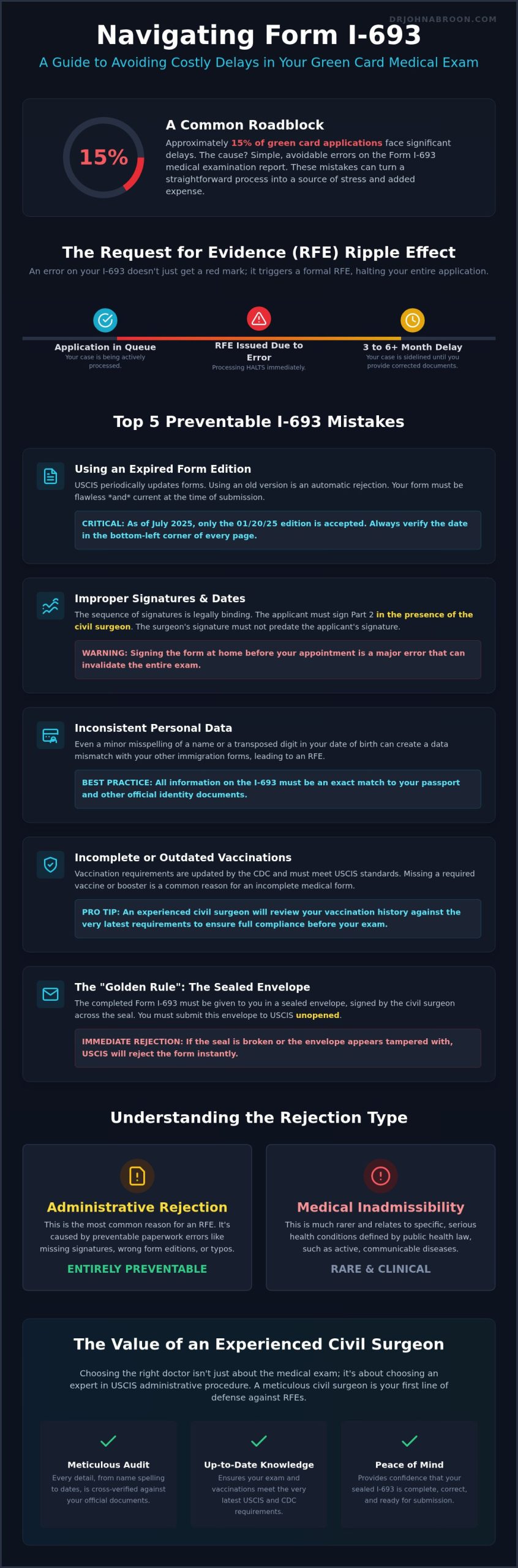
Did you know that approximately 15% of green card applications face significant delays due to simple, avoidable errors on a medical form? These common mistakes on i-693 form submissions often range from missing signatures to outdated vaccinations; they can turn an exciting milestone into a source of deep anxiety. We understand that you can’t afford a setback when you’re so close to the finish line. You’ve worked too hard on your residency application to let a clerical slip-up or a misunderstood medical requirement stall your future in the United States.
This guide provides the clinical authority and clarity you need to navigate your medical exam with total peace of mind. By identifying the most frequent pitfalls, we’ll help you ensure your documentation is flawless before it ever reaches a USCIS officer’s desk. You’ll learn how to verify the mandatory 01/20/25 form edition, navigate the current 2026 vaccination landscape, and discover the exact audit steps to perform before your civil surgeon seals that critical envelope. We’re here to transform a complex requirement into a smooth, manageable step in your journey toward permanent residency.
Key Takeaways
- Learn how minor clerical oversights can trigger a Request for Evidence (RFE), causing unnecessary delays in your green card journey.
- Identify the most common mistakes on i-693 form submissions, such as using an outdated edition or missing required signatures.
- Gain clarity on current vaccination requirements to ensure your medical records meet every USCIS standard before your appointment.
- Master the “Golden Rule” of the sealed envelope to protect the integrity of your results and prevent immediate rejection.
- Understand how a meticulous audit by an experienced NYC civil surgeon provides the personalized care and precision your application deserves.
Understanding the High Stakes of Form I-693 Errors
Form I-693, known officially as the Report of Immigration Medical Examination and Vaccination Record, serves as a critical gateway in your journey toward a green card. It’s not merely a summary of your health; it’s a legal document that proves you meet the rigorous health standards required for residency. USCIS reviews this form to ensure applicants don’t fall under specific Medical grounds for inadmissibility. When the government identifies common mistakes on i-693 form submissions, they view these errors as more than simple oversights. They see them as a failure to provide the necessary legal evidence for your admission to the United States.
The financial and emotional toll of a rejected form is significant. If your I-693 is expired or rejected due to clerical errors, you’re often required to undergo the entire medical examination process again. This means paying for new laboratory tests, diagnostic screenings, and the civil surgeon’s time. For many in the New York City area, these costs can accumulate quickly, adding hundreds of dollars to an already expensive immigration process. We believe that your path to residency should be defined by precision and care, not by the stress of repeating costly exams.
The Request for Evidence (RFE) Ripple Effect
Receiving a Request for Evidence (RFE) is a disheartening experience that immediately halts the adjudication of your green card application. Once an RFE is issued, your case file is moved out of the active processing queue until you provide the corrected documentation. This administrative detour typically adds 3 to 6 months to your overall timeline. In some cases, these delays can be even more damaging; if your priority date is current and the visa bulletin retrogresses while you’re fixing a form error, you might face a wait of several years for another opening. A Request for Evidence (RFE) is the primary administrative consequence of common mistakes on i-693 form filings.
Medical Inadmissibility vs. Administrative Rejection
Distinguishing between medical inadmissibility and administrative rejection is vital for your peace of mind. Medical inadmissibility involves serious health concerns, such as active tuberculosis or other communicable diseases of public health significance. These cases are relatively rare. Conversely, administrative rejections occur when the form is technically deficient. Missing a signature, failing to check a box, or using the wrong form edition are the most frequent culprits. These clerical errors are entirely preventable with a meticulous review process. Remember that a civil surgeon’s signature is a legal attestation of your health status. If that signature is missing or the date is incorrect, the entire legal validity of the medical examination is voided in the eyes of USCIS.
Top Administrative Mistakes: Form Editions, Signatures, and Dates
While the medical portion of your exam requires clinical expertise, the administrative details demand a different kind of precision. USCIS officers frequently reject forms for simple clerical oversights that have nothing to do with your actual health status. Inconsistent personal data, such as a slight misspelling of your middle name or a transposed digit in your date of birth, can lead to a mismatched record. These common mistakes on i-693 form filings are entirely preventable, yet they account for a high percentage of administrative delays. We treat every form with the same diagnostic rigor we apply to our patients, ensuring that every character matches your official identity documents.
The Form Edition Trap
Using an expired version of the form is a mistake that can invalidate your entire medical exam. USCIS updates these documents periodically to reflect new health guidelines or policy changes. As of July 3, 2025, the only acceptable version is the 01/20/25 edition. You should always verify the edition date in the bottom-left corner of every single page. You can find the latest version and instructions on the Official Form I-693 page. Even if your form was current on the day of your physical, a new release before you submit your application could lead to a rejection. This is why we prioritize a swift turnaround for your results to ensure they’re filed while the edition remains valid.
Signature and Date Synchronization
The sequence of dates on your form tells a story of compliance to the USCIS officer. You must sign Part 2 in the presence of the civil surgeon during your appointment. Signing the form at home before you arrive is a significant error that could require a complete redo. Similarly, the civil surgeon cannot sign the final attestation in Part 7 until every laboratory result is received and reviewed. This means the doctor’s signature date must be the same as or later than the dates of your tuberculosis or syphilis tests. Blank fields or back-dated entries suggest the exam wasn’t conducted properly, leading to an immediate RFE. Ensuring this logical flow of information is a hallmark of our personalized immigration medical exams, where we audit every date for perfect synchronization.
Finally, ensure that the civil surgeon’s information is legible and complete. If the doctor’s stamp is faint or their professional address is missing, the form may be flagged. By focusing on these administrative details, you protect yourself from the frustration of a stalled application and keep your residency process moving forward with confidence.
Medical and Vaccination Errors: Navigating 2026 Requirements
Transitioning from administrative paperwork to clinical data requires a shift in focus toward current CDC and USCIS health protocols. Medical oversights are some of the most frequent common mistakes on i-693 form submissions because requirements change regularly based on public health guidance. While your previous medical history is valuable, the civil surgeon must confirm you meet the specific 2026 standards for vaccinations and communicable disease screening. We take a proactive approach to your health history, ensuring every required immunization is documented with clinical precision to avoid the stress of a last-minute rejection. This meticulous attention to detail ensures your medical record is an asset to your application, not a hurdle.
The 2026 Vaccination Compliance Checklist
In 2026, USCIS continues to mandate age-appropriate vaccinations for MMR (Measles, Mumps, Rubella), Varicella (Chickenpox), and Tdap (Tetanus, Diphtheria, and Acellular Pertussis). A common point of confusion involves the 2026 vaccination requirements for seasonal influenza. If your exam occurs during the flu season, which typically runs from October 1 through March 31, the flu shot is mandatory for all applicants. Interestingly, following updated 2025 guidelines, the COVID-19 vaccination is no longer a requirement for your immigration medical exam. If you have a medical contraindication to a specific vaccine, such as an allergy or pregnancy, we can document a clinical exception. For religious or moral objections, you may need to file Form I-601, though these waivers are subject to separate legal adjudication.
Diagnostic Testing Pitfalls
One of the most costly errors occurs when applicants bring laboratory results from non-approved facilities. USCIS requires the designated civil surgeon to oversee all diagnostic draws for Syphilis (RPR), Gonorrhea, and Tuberculosis (TB) to maintain a strict chain of custody. IGRA blood testing is now the mandatory gold standard for TB screening for most applicants; the older skin tests are generally no longer accepted for immigration purposes. Attempting to use outside lab work often results in a rejection because the civil surgeon cannot legally attest to the results. Our Upper East Side office provides in-office diagnostic testing, ensuring your blood draws meet every USCIS evidentiary standard. This internal oversight eliminates the risk of missing laboratory components, such as the specific age-based requirements for Gonorrhea or Syphilis screening, which can vary depending on your profile.
Handling the Results: The Sealed Envelope and Submission Timelines
The completion of your medical exam is a significant milestone, but the final steps require strict adherence to USCIS protocol. Perhaps the most critical instruction we provide is also the simplest: don’t open the sealed envelope. One of the most heartbreaking common mistakes on i-693 form handling occurs when a well-meaning applicant opens the envelope to check the results or make a copy. This action immediately invalidates the document. USCIS requires the medical report to remain in its original, tamper-evident state to ensure the integrity of the clinical findings. We always provide a separate, unsealed copy of your completed form for your personal records; there’s never a need to compromise the official version.
The Sealed Envelope Protocol
Inspecting your packet before you leave the doctor’s office is a vital part of the process. We follow a precise protocol to ensure your documentation is ready for submission. We recommend you take the following steps:
- Inspect the envelope: Look for any physical tears, punctures, or signs of tampering that might have occurred during transport.
- Verify the seal: Confirm the civil surgeon’s signature or official stamp is clearly visible across the back flap’s seal. This signature acts as a security measure.
- Secure the packet: Place the sealed envelope directly into your USCIS filing packet. Avoid bending or folding the envelope excessively, as this can damage the forms inside.
If you notice any damage to the envelope while it’s in your possession, contact our office immediately. In our concierge-style practice, we prioritize your peace of mind. We can assist in re-securing your documents if the seal’s integrity is questioned before you mail your application.
Timing Your Exam for Maximum Validity
Strategic timing is essential for a smooth approval process. Effective June 11, 2025, USCIS policy states that an I-693 signed on or after November 1, 2023, remains valid indefinitely for the specific application it was submitted with. This is a welcome change from previous years when exams expired after two years, often forcing applicants to pay for a second exam. However, since December 2, 2024, you must submit your medical form concurrently with your Form I-485. This means you should coordinate your medical appointment to align closely with your legal filing strategy to avoid any administrative friction. For a deeper look at how to sequence these steps, explore our Immigration Medical Exam in NYC: Your Complete Guide. To ensure your paperwork is handled with the highest level of clinical precision, schedule your appointment with Dr. Abroon today.
Why Choosing an Experienced NYC Civil Surgeon Prevents Costly RFEs
In a high-stakes environment like New York City, your choice of civil surgeon is the most effective safeguard against administrative delays. While many facilities offer basic exams, a practice deeply rooted in the Manhattan medical community understands the specific level of scrutiny USCIS applies to local applications. Dr. Abroon has served as a USCIS-designated civil surgeon since 1997; he combines elite clinical expertise with a concierge-style approach that prioritizes your total well-being. By managing every aspect of the exam in-house, from blood draws to diagnostic testing, we maintain a strict chain of custody that eliminates the common mistakes on i-693 form submissions often caused by fragmented care.
Choosing a seasoned professional means your application benefits from nearly 30 years of institutional knowledge. We don’t just fill out paperwork; we provide a sophisticated medical evaluation that aligns with the latest 2026 federal guidelines. For applicants in a fast-paced urban center, the ability to access comprehensive care in a single location isn’t just a convenience. It’s a strategic advantage that ensures your medical evidence is consistent, accurate, and ready for immediate adjudication.
The Abroon Audit: A Commitment to Accuracy
Every page of your medical report undergoes a rigorous multi-point audit before it’s finalized. Dr. Abroon and his dedicated staff review each data point, ensuring that your personal information, vaccination dates, and laboratory results are perfectly synchronized. This meticulous attention to detail is what sets us apart as a premier Primary Care Physician NYC. We understand that a single missing checkmark or an illegible date can trigger an RFE, so we treat the administrative portion of your exam with the same diagnostic precision we apply to internal medicine. This “concierge” audit process provides a layer of protection that high-volume, generic clinics simply cannot match.
Convenient Upper East Side Medical Evaluations
Located on the Upper East Side, our office provides easy access for residents across Manhattan, Queens, and Brooklyn. We’ve designed our facility to be a one-stop destination for your immigration needs, featuring on-site EKGs and diagnostic tools that streamline the entire process. This integrated model allows us to offer fast-track options for applicants with tight deadlines without sacrificing the personalized care Dr. Abroon is known for. You’ll receive a clear explanation of every test and a supportive narrative that makes high-stakes medical decisions feel manageable. Schedule your I-693 medical exam with Dr. Abroon today.
Secure Your Path to Residency with Clinical Precision
Navigating the path to permanent residency requires more than just good health; it demands an uncompromising eye for detail. By mastering the nuances of current form editions and the strict 2026 vaccination protocols, you effectively eliminate the administrative hurdles that stall so many applications. Remember that avoiding common mistakes on i-693 form submissions is often the difference between a seamless approval and a stressful multi-month delay. Your medical report is a legal attestation of your admissibility, and its accuracy is the foundation of your future in the United States.
Dr. John Abroon has served as a USCIS-designated civil surgeon since 1997, providing the sophisticated care and meticulous oversight necessary for success. From our Upper East Side Manhattan location, we offer comprehensive in-office lab testing to ensure every diagnostic requirement is met under one roof. We’re here to guide you through this high-stakes process with the calm reliability of a seasoned medical partner. Book your error-free immigration medical exam with Dr. Abroon and take the final step toward your green card with total confidence. Your journey deserves the highest standard of clinical excellence.
Frequently Asked Questions
What happens if I accidentally open the sealed I-693 envelope?
If you open the sealed envelope, USCIS will immediately reject the form. The seal’s integrity is a legal requirement to ensure the clinical findings haven’t been altered after the civil surgeon signed them. You’ll need to return to your civil surgeon to have a new form printed, signed, and resealed. While some practices may charge an administrative fee for this service, it’s a necessary step to avoid a certain Request for Evidence (RFE).
How long is the Form I-693 valid for USCIS in 2026?
In 2026, any Form I-693 signed by a civil surgeon on or after November 1, 2023, remains valid indefinitely for the specific application it was filed with. This policy change provides significant relief for applicants who previously faced expiring medical results during long processing times. However, it’s vital to remember that you must submit the medical report concurrently with your Form I-485 to meet the current USCIS filing standards and ensure your application remains in good standing.
Do I need to get the COVID-19 vaccine for my immigration medical exam?
You’re no longer required to provide proof of COVID-19 vaccination for your immigration medical exam. This requirement was officially removed in January 2025. While we encourage all patients to maintain their health through preventive care, your green card approval is no longer contingent on this specific immunization. We’ll focus on other mandatory 2026 requirements instead, such as the seasonal flu shot if your appointment falls between October 1 and March 31.
Can I bring my own lab results from my primary care doctor?
You cannot bring outside lab results for required screenings like Syphilis, Gonorrhea, or Tuberculosis. USCIS requires the civil surgeon to oversee the diagnostic draws directly to maintain a strict chain of custody. Using results from a non-designated facility is one of the common mistakes on i-693 form submissions that leads to automatic rejection. Our Upper East Side office provides comprehensive in-office testing to ensure every sample meets federal evidentiary standards with clinical precision.
What if I don’t have my childhood vaccination records?
If you don’t have childhood vaccination records, we can perform blood titer tests to check for existing immunity. These tests verify if you have sufficient antibodies for diseases like MMR or Varicella. If the titers show you aren’t immune, we’ll provide the necessary age-appropriate vaccinations during your visit. This personalized approach ensures you meet all legal requirements while only receiving the medical care you actually need for a successful residency application.
How much does it cost to fix a mistake on a completed I-693 form?
The cost to fix a mistake on a completed form varies depending on the clinic’s specific policies and the nature of the error. Some facilities charge for a full re-examination if the mistake was due to missing information you provided. We prioritize accuracy through a rigorous audit process to prevent these issues from occurring in the first place. It’s always best to choose a seasoned professional who minimizes the risk of costly administrative re-dos.
Does the civil surgeon provide a copy of the form for my records?
Yes, our practice always provides you with a complete, unsealed copy of your Form I-693 for your personal records. It’s essential to keep this copy so you know exactly what was submitted to USCIS and can verify your vaccination history in the future. We believe in transparency and want you to feel fully informed about every aspect of your medical evaluation. Always keep this copy in a safe place alongside your other immigration documents.
Is a TB skin test (PPD) still accepted by USCIS?
The TB skin test (PPD) is no longer accepted for most immigration medical exams. USCIS now mandates the IGRA blood test, such as QuantiFERON or T-SPOT, as the primary screening method for tuberculosis. This blood test is more accurate and isn’t affected by previous BCG vaccinations. If your IGRA test returns a positive result, we’ll guide you through the next steps, which typically involve a chest X-ray to confirm your health and admissibility.