


What happens after pre-op clearance, and does it mean you’re definitely ready for surgery? Completing your evaluation is an important step, but it doesn’t guarantee that the procedure will go ahead or replace instructions from your surgical team. It starts a handoff: your internist’s assessment and relevant test results help the surgeon and anesthesia team plan around your health needs.
It’s understandable to wonder whether your clearance reached the right people, who will explain medication changes and fasting, or what to do if you feel unwell before surgery. Your pre-op evaluation helps inform those decisions, while your surgeon and anesthesia team provide instructions for your specific procedure. If your health changes, let your surgical team know promptly.
This guide explains what clearance does and doesn’t mean, how information reaches your care team, and how to follow up if you’re unsure what comes next. You’ll also learn how to organize your records and follow your individualized instructions as surgery approaches.
Key Takeaways
- Pre-op clearance records a clinician’s assessment of your health for a planned procedure, but the surgeon and anesthesia team make their own decisions.
- After your evaluation, organize your records and follow the surgical office’s process for submitting them.
- Confirm that requested documents arrived and know which office to contact with questions.
- Get medication, fasting, arrival, and transportation instructions from your surgical team, since directions vary by procedure and patient.
- An internist can assess your health and test results as part of pre-operative evaluation, helping inform your care team’s planning.
What does pre-op clearance mean after your medical evaluation?
Pre-op clearance documents a clinician’s assessment of your medical readiness for a planned procedure. The evaluation considers your health in the context of the surgery, helping identify relevant risks and information the surgical team may need for planning. As an overview of the process, Preoperative care includes reviewing a patient’s health and assessing needs before surgery.
Medical clearance is an assessment of your health for surgery, not final approval to proceed. The surgeon and anesthesia team consider this information alongside the planned procedure and their own clinical judgment. Clearance doesn’t guarantee surgery, promise a risk-free outcome, or replace decisions made by the people responsible for your surgical care.
The evaluation is individualized. Your medical history, current health, planned procedure, and clinical findings help determine whether testing or additional review may be appropriate. A clinician may request diagnostic testing, such as an EKG or laboratory work, when it’s relevant to your situation. There isn’t a single set of tests that every patient needs.
What information does a clearance communicate?
The assessment may summarize your relevant medical history, examination findings, and results from tests completed as part of your evaluation. It gives the surgical team context about your health and factors that may affect perioperative planning. The records are tailored to the patient and procedure, so the information shared can vary.
If the evaluation identifies a need for follow-up or a recommendation, that information may accompany the assessment. For example, the clinician may note that a finding needs further review or that additional information would help the team plan. This doesn’t automatically mean surgery cannot proceed; it helps the appropriate clinicians coordinate next steps.
Who makes the final decision about surgery?
An internist contributes a medical assessment but doesn’t make the surgeon’s procedural decision. The surgeon considers the planned operation and overall clinical picture when deciding whether to proceed. The anesthesia team may also review the evaluation and test results to understand your health needs and determine whether it has additional questions.
Additional review is part of careful coordination, not automatically a sign that something is wrong. If the team requests clarification or further evaluation, follow the instructions from the appropriate office. Understanding these roles can make what happens after pre-op clearance easier to navigate: the assessment informs planning, while the surgical team determines the next step for your procedure.
After Pre-Op Clearance: Handoff to Your Surgery Team
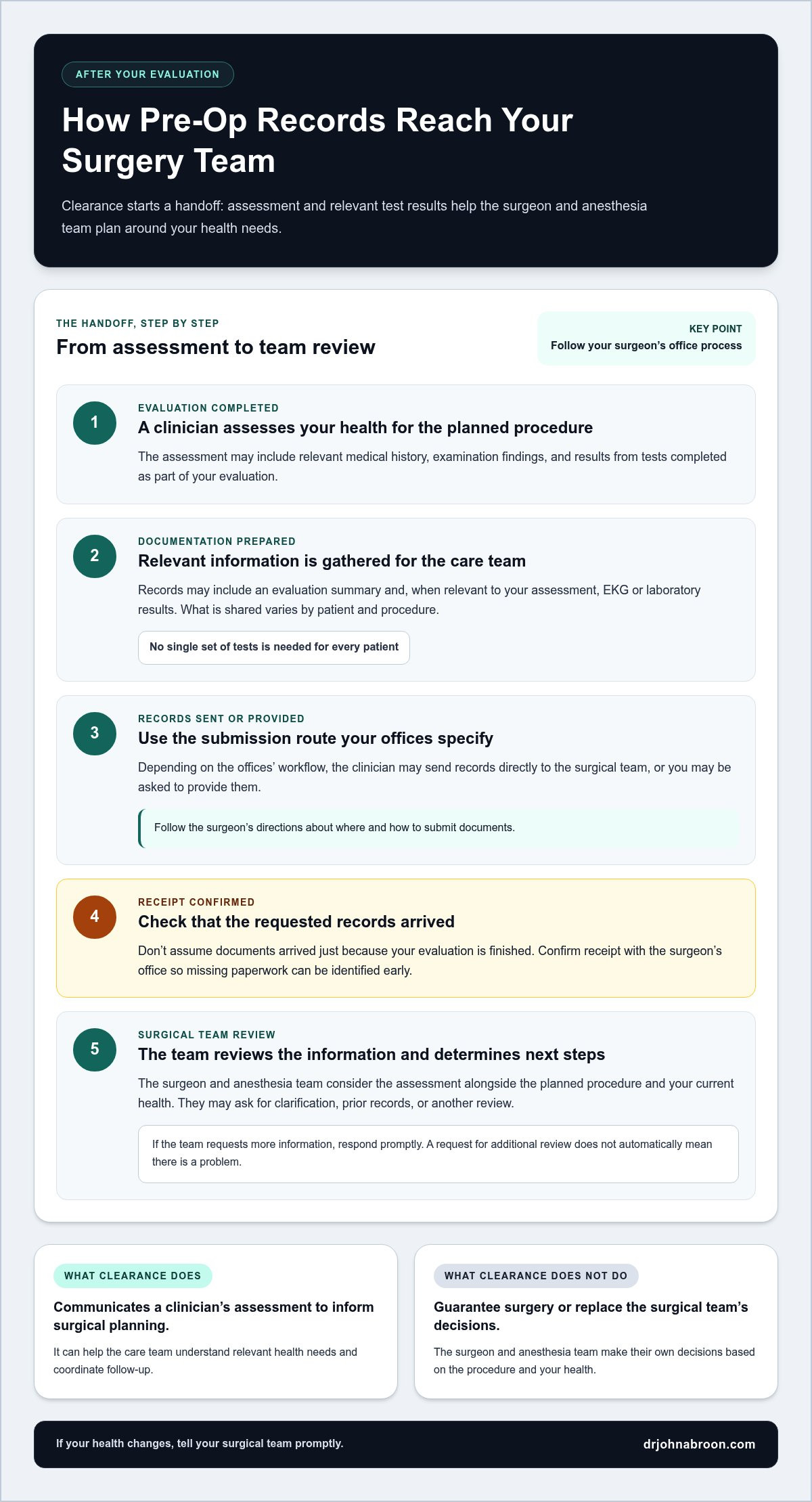
Once your evaluation is complete, the next step is to get relevant information to the surgical team. The process generally follows a sequence: the clinician completes the assessment, prepares the documentation, shares or provides the records, and the surgical team reviews them. The workflow can vary by office, so follow the surgeon’s instructions for submitting your records.
The surgical team must receive and review the required records before it can determine the next steps for your procedure. Don’t assume the documents have arrived simply because your evaluation is finished. Confirming receipt with the surgeon’s office can help you catch missing paperwork early.
How do clearance notes and test results reach the surgeon?
Depending on the offices’ workflow, the clinician may send records directly to the surgical team, or you may be asked to provide them. These may include an evaluation summary and, when relevant to your assessment, EKG or laboratory results. Follow the surgeon’s directions about where and how to submit documents, then confirm receipt with the office. This helps you identify missing paperwork before it holds up the handoff.
What if the surgeon or anesthesia team requests more information?
The team may need clarification about a finding, prior medical records, or another review before confirming the plan. Requests vary with your health and planned procedure; they don’t automatically mean there’s a problem. Respond promptly and direct questions about procedure-specific instructions to your surgeon or anesthesia team.
For more background on the evaluation itself, read this pre-operative medical clearance guide. In New York City, Dr. John Abroon, a board-certified internist and primary care physician on the Upper East Side, provides pre-operative medical clearances and diagnostic testing. To complete the handoff, follow the submission steps your offices provide, confirm the records reached the surgical team, and direct outstanding questions to the appropriate team member.
Does Pre-Op Clearance Mean Surgery Is Guaranteed?
No. Pre-op clearance isn’t a guarantee that surgery will happen, a promise that the procedure is risk-free, or a fixed approval that overrides later decisions. It records a clinician’s assessment based on the information available at the time of evaluation. Your surgeon and anesthesia team consider that assessment alongside the planned procedure and your current health.
That distinction matters because your health can change between the evaluation and surgery. If you develop a new symptom, notice a worsening condition, or receive new health information, tell your surgeon or the relevant clinician promptly. Don’t assume a change is too minor to mention, and don’t change medication or care plans on your own. Your team can decide whether it affects your preparation or needs another assessment.
Can new symptoms or health changes affect the plan?
They can prompt the care team to review your situation, but only your clinicians can determine what the change means for your procedure. For example, report a new cough, fever, or flare-up of a chronic condition to the surgical team. Share when it began and how it has changed, then follow the guidance you receive rather than trying to judge its significance yourself.
Why might the team ask for another review?
A new finding, incomplete medical record, or question specific to the procedure may lead the team to request clarification or further review. That request is not, by itself, a decision to cancel or postpone surgery. It’s a step toward understanding the full clinical picture before deciding how to proceed.
If someone asks you to provide more information, find out which clinician or office is coordinating the next step and when to follow up. This helps keep questions from getting lost between teams and makes it clear who to contact if your health changes again. The process may involve your internist, surgeon, or anesthesia team, depending on what needs review.
So, what happens after pre-op clearance can depend on your health and the details of your procedure. The team may proceed with its plan, ask for additional information, or recommend reassessment. These are individualized clinical decisions, not outcomes you can determine from the word “clearance” alone. Stay in communication with your care team and follow its specific instructions as surgery approaches.
What should you do between clearance and surgery?
After your evaluation, keep instructions, records, and questions organized. Your surgical team’s guidance should lead. General advice online can’t account for your procedure, health history, or the specific plan your clinicians have made.
A short checklist can help you stay on top of the details:
- Confirm which office or clinician to contact with questions.
- Check that the surgical team has received every record it requested.
- Keep copies of your clearance paperwork and relevant test results together.
- Write down questions and note any changes in your health so you can report them.
Which instructions should you follow before surgery?
Get instructions about medication, fasting, arrival time, and transportation directly from your surgical team. These directions vary by procedure and patient, so don’t rely on general online guidance or another person’s experience. Don’t start, stop, or change medication based on assumptions. If instructions conflict or aren’t clear, contact the responsible care team for guidance before acting.
Keep the latest instructions somewhere easy to find and review them again as your procedure approaches. If your care team updates its guidance, follow the most current individualized instructions rather than an earlier version.
What should you have ready for follow-up?
Keep your clearance paperwork, requested results, and the surgical office’s contact details in one place. You may not need extra testing or another appointment, but having relevant records available makes it easier to respond if the team asks for information. Note questions as they come up, including who should answer them and how the office prefers you to get in touch.
Report relevant health changes promptly through the team’s preferred channel. Include what changed and when, and let your clinicians decide whether it affects your preparation. This practical approach helps you handle what happens after pre-op clearance without trying to interpret medical instructions on your own.
Dr. John Abroon provides pre-operative medical clearances and diagnostic testing in New York City.
How to Get Help With Pre-Op Clearance in New York City
After your evaluation, continue following your surgeon’s instructions, confirm that requested records have arrived, and report relevant changes in your health. If you’re unsure who should answer a question, identify the right contact. Knowing what happens after pre-op clearance includes knowing where to direct concerns, not trying to make clinical decisions on your own.
When should you contact your medical office?
Contact the appropriate office if records appear to be missing, instructions are unclear or conflicting, or your health changes before surgery. For arrival logistics, medication directions, and decisions about the procedure, contact your surgeon’s office. If symptoms are urgent or severe, seek appropriate urgent or emergency medical care rather than waiting for a routine response.
Share clear, practical details when you reach out: what changed, when it began, and which instructions or records you’re asking about. The care team can then direct your question to the clinician responsible for the next step.
What can a New York City internist contribute?
An internist can review your medical history, assess current findings, and conduct an individualized pre-operative medical evaluation. The clinician’s assessment helps inform the surgical team’s planning, but it doesn’t replace the surgeon’s or anesthesia team’s decisions about proceeding. Any testing or follow-up depends on your health and the planned procedure.
Dr. John Abroon is a board-certified internist and primary care physician who provides pre-operative medical clearances and diagnostic testing at his Upper East Side practice in New York City. The evaluation focuses on your medical context rather than a one-size-fits-all checklist, and may include tests such as an EKG or laboratory work when clinically relevant.
If you’re preparing for a procedure, follow your surgical team’s instructions and keep communication open if something changes. Learn more about pre-operative medical clearance in NYC, or explore Dr. Abroon’s pre-operative clearance services.
Move Forward With Clear, Personalized Guidance
Understanding what happens after pre-op clearance can make the days before surgery feel more manageable. The evaluation documents your health at that point in time, but it doesn’t guarantee surgery or replace decisions by your surgeon and anesthesia team. Confirm that requested records have arrived, follow your surgical team’s latest instructions, and report any health changes promptly.
An internist can review your medical history and findings as part of an individualized pre-operative evaluation. Dr. John Abroon is a board-certified internist and primary care physician who provides pre-operative medical clearance and diagnostic testing at his Upper East Side practice in New York City. This assessment supports communication with your surgical team; it doesn’t promise a particular decision about your procedure.
If you need pre-operative medical clearance in New York City, explore pre-operative medical clearance with Dr. Abroon. Follow your care team’s instructions and keep them informed of changes as your surgery date approaches.
Frequently Asked Questions
What happens immediately after pre-op clearance?
After your evaluation, the clinician prepares the relevant documentation and any test results, which then need to reach the surgical team through its specified process. The surgeon and anesthesia team review the information and may request clarification or further assessment. To understand what happens after pre-op clearance in your case, follow the surgical office’s directions for submitting records and confirm that required documents arrived rather than assuming the handoff is complete.
Does pre-op clearance mean my surgery is approved?
No. Pre-op clearance is a medical assessment, not a guarantee that surgery will proceed. The surgeon and anesthesia team consider your health, the planned procedure, and information available closer to the surgery date. They may request further review or adjust the plan if circumstances warrant it. Ask the surgical team what remains outstanding and who will let you know when the plan is confirmed.
Can surgery be postponed after medical clearance?
Yes, the care team may reconsider timing based on the circumstances and your clinical assessment. New symptoms, a change in health, incomplete records, or a concern related to the procedure may prompt further review. A request for information doesn’t automatically mean surgery will be postponed. Tell the surgeon’s office promptly about changes, then follow its guidance instead of trying to decide on your own whether you’re ready.
Who receives my pre-op clearance paperwork?
The receiving office and submission method depend on your surgical team’s process. Records may be transferred between offices or given to you to deliver. Ask the surgeon’s office which documents it needs and how to submit them. If you’re unsure whether the records arrived, follow up directly with that office. Completing the evaluation appointment doesn’t necessarily mean every required document has reached the surgical team.
Do I need to follow special instructions after pre-op clearance?
Yes. Follow the individualized instructions provided by your surgical team, which may cover medication, fasting, arrival time, and other preparation. Directions vary by procedure and patient, so general online guidance can’t replace instructions from your own care team. If directions are missing, unclear, or seem inconsistent, contact the responsible office for clarification. Don’t start, stop, or change medication based only on general information.
What should I do if I get sick before surgery?
Tell your surgeon or designated clinical team promptly about new or worsening symptoms. The clinicians can decide whether your condition affects preparation or calls for reassessment. Don’t hide symptoms or assume your earlier evaluation addresses a new health concern. If symptoms are severe or urgent, seek appropriate urgent or emergency medical care rather than waiting for a routine callback from the surgical office.
Can my primary care doctor answer questions about surgery-day instructions?
Your primary care clinician can explain the medical evaluation they performed, but questions about procedure-specific instructions should go to your surgeon or anesthesia team. This includes fasting, medication directions, arrival time, and what to expect on the day. For questions about clearance paperwork, contact the office that completed the evaluation. In New York City, an internist such as Dr. John Abroon can assess your health as part of pre-operative medical clearance.