


If you’re searching for physician supervised weight loss nyc care, you may want clear answers about medical evaluation, nutrition, medication, and follow-up. Conflicting advice can make it hard to know where to start. A conversation with a physician can put your questions in context and help you understand which next steps may be relevant to your health and goals.
You don’t need to reach a particular weight before raising a concern. A physician can review your health history, current needs, and priorities with you. The purpose is to discuss your circumstances, not to assume that everyone needs the same plan or that one approach will guarantee a particular result.
This guide explains what physician-supervised weight management may involve and what to consider when comparing options in New York City. It also covers practical ways to prepare for a visit and discuss nutrition, medication, follow-up, and goals with a doctor.
Key Takeaways
- Physician supervised weight loss nyc care starts with a clinician’s assessment of your health context, not a one-size-fits-all plan.
- Learn how goals, health history, and relevant findings can help shape a discussion about next steps, with BMI considered as one screening measure rather than a full picture of health.
- Compare care by looking for individualized goals, thoughtful nutrition conversations, clear follow-up, and open communication instead of relying on marketing promises.
- Prepare for an appointment by gathering your medication list, health history, past approaches, routines, challenges, and questions. A perfect food diary isn’t necessary.
- Explore how Dr. John Abroon’s background in internal medicine and primary care informs Weight Loss Management at his Upper East Side practice.
What Physician-Supervised Weight Loss in NYC Means for Your Health
When diet advice conflicts and quick fixes compete for attention, it can be difficult to decide what applies to you. Physician-supervised weight management starts with a discussion of your health, concerns, and goals. Instead of assuming that everyone needs the same approach, a clinician can help frame your questions and consider your circumstances before discussing possible next steps.
Physician-supervised weight loss is weight-management care informed by a clinician’s assessment of a person’s health history, current concerns, and individual goals. Unlike generic diet advice, it considers weight-related decisions in the context of overall health. The broad field of Understanding Weight Management includes a range of approaches. Medical supervision can help identify which questions and options are relevant to an individual discussion. It doesn’t guarantee a particular result or mean that medication, testing, or a specific intervention is necessary.
What does physician supervision add to weight management?
A clinician can consider information that a general meal plan can’t account for, including your health history, current concerns, and relevant examination findings. That context may help shape a discussion about possible next steps. The purpose of supervision is to support informed decisions, not to promise that the same approach will work for everyone.
Your goals are important, too. You may want to discuss changes in weight, how previous approaches fit your routine, or how weight concerns relate to other health priorities. Explaining what feels manageable and what hasn’t been sustainable can make the conversation more specific. Different people may have different considerations, so no single intervention should be assumed in advance.
When might a medical conversation be useful?
A particular threshold isn’t required to raise a concern. A conversation may be useful if weight-related questions persist, your health needs have changed, or past efforts have been difficult to maintain. These are reasons to discuss your experience, not diagnostic criteria or proof that you need a specific treatment. A physician can help put the concern in context and talk through what, if anything, may be worth exploring.
Weight questions may also come up during a broader review of health and preventive care. An annual physical exam offers an opportunity to discuss health concerns with a primary care physician as part of an overall wellness conversation. If you’re researching physician supervised weight loss nyc, look for care that makes space for your history and questions rather than relying on promises or a preset plan. A thoughtful discussion is a practical way to start understanding your options.
How a Physician Can Assess Weight-Loss Needs and Nutrition in NYC
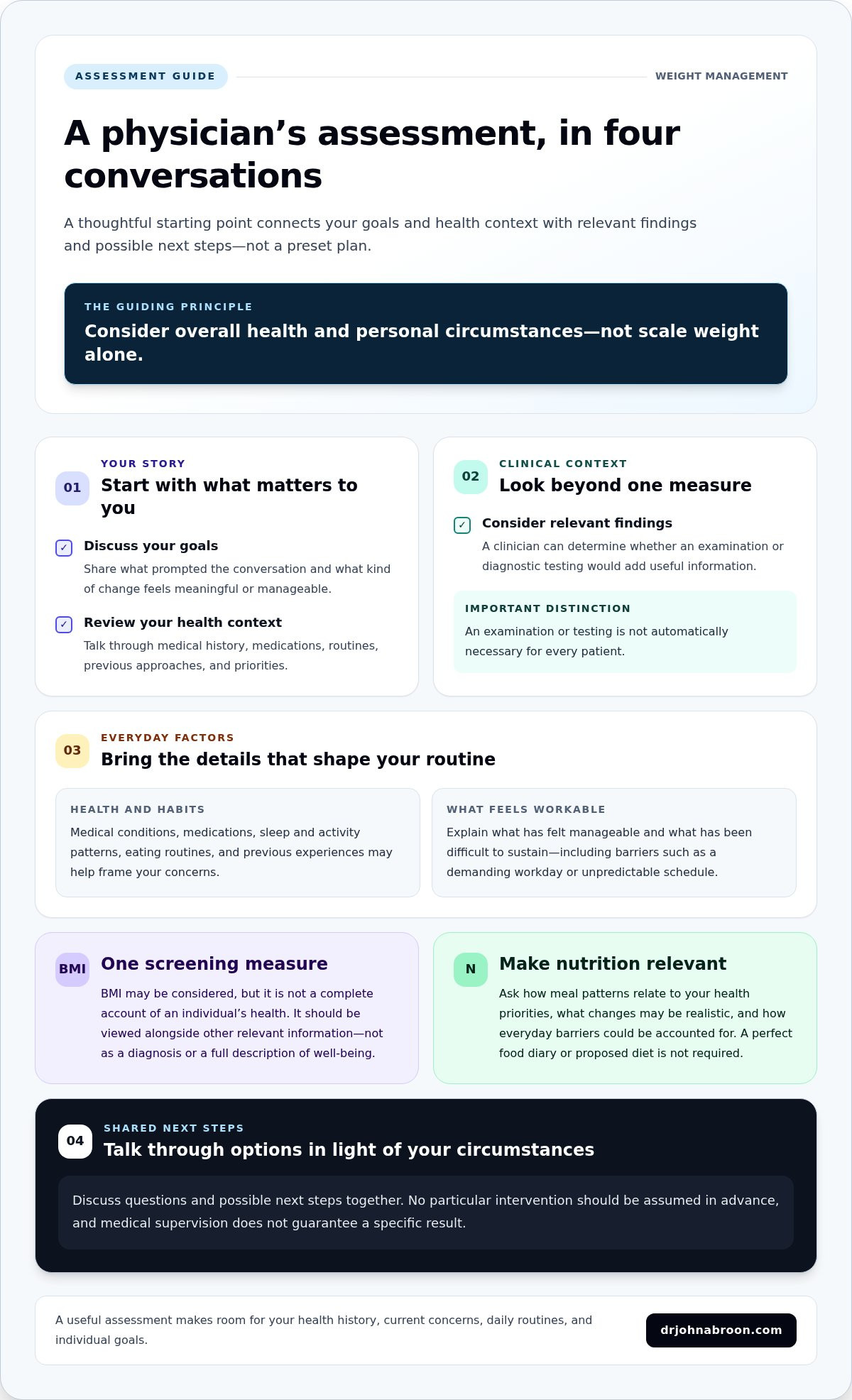
A useful assessment puts weight-related concerns in context. Rather than beginning with a fixed diet or intervention, a physician can clarify what you hope to address, review relevant health information, consider any findings, and discuss possible next steps with you. This sequence allows the conversation to account for your health needs and daily routines, not just a number on a scale.
- Discuss your goals. Explain what prompted the conversation and what kind of change feels meaningful or manageable to you.
- Review your health context. Share your medical history, medications, routines, previous approaches, and priorities.
- Consider relevant findings. Your clinician can determine whether an examination or diagnostic testing is appropriate.
- Talk through next steps. Discuss options and questions in light of your circumstances, without assuming that everyone needs the same intervention.
What health information may be relevant to the conversation?
Consider more than your weight history. Medical conditions, medications, sleep and activity patterns, eating routines, and previous experiences may help frame your concerns. Your priorities matter as well. You might want to discuss a change in your health, a routine that’s hard to sustain, or how weight relates to another health goal. A clinician can decide whether an examination or diagnostic testing would add useful information. Neither is automatically necessary for every patient.
Weight-related decisions should consider your overall health and personal circumstances, not scale weight alone. Body mass index (BMI) is one screening measure a clinician may consider, but it doesn’t provide a complete account of an individual’s health. It should be considered alongside other relevant information, not treated as a diagnosis or a full description of someone’s well-being. The NIDDK Information on Weight Management offers further background on factors and approaches involved in weight management.
How can nutrition guidance support a medical plan?
Nutrition is a useful topic to raise as part of a broader health discussion. Eating patterns that fit your needs and everyday life may be easier to sustain than rigid rules, but what’s appropriate is individual. Ask how your meal patterns relate to your health priorities, what changes may be realistic, and how to account for barriers such as a demanding workday or unpredictable schedule. You don’t need to arrive with a perfect food diary or a proposed diet.
Be open about what has felt manageable in the past and what hasn’t. A clinician can discuss nutrition in context rather than defaulting to a calorie target, restrictive plan, or supplement regimen without considering your circumstances. If you’re exploring physician supervised weight loss nyc, an internal-medicine conversation can help connect weight concerns with broader health needs. Learn more about Weight Loss Management with Dr. John Abroon.
How to Compare Physician-Supervised Weight-Loss Care in NYC
Weight-management options in New York City can differ in how they explain medical decisions and approach ongoing care. Compare the substance of the clinical conversation, not just polished claims. Does it make room for your health context? Are choices explained clearly? Are your goals treated as individual? These questions can help you assess whether the approach feels grounded and collaborative.
Use these points to guide your comparison. They aren’t a scorecard or a promise of results:
Medical context: A thoughtful discussion considers relevant health history and current concerns before drawing conclusions. Notice whether the clinician explains how that context informs the conversation.
Individualized goals: Goals should reflect your priorities and circumstances. If an approach is presented as identical for every patient, ask how individual needs are considered.
Nutrition discussion: Nutrition should be open to discussion in relation to your health, preferences, and everyday routine, rather than reduced to rigid rules or blame.
Follow-up: Ask how future decisions and progress are discussed. Follow-up should have a clear purpose, such as revisiting questions or considering whether next steps remain appropriate, rather than relying on an unexplained timeline.
Communication: You should be able to understand the options being discussed, their potential benefits and limitations, and what remains uncertain. Clear explanations matter more than sweeping claims.
What should a patient look for in the care approach?
Look for a clinician who interprets your health context and discusses options with you. A useful conversation gives you time to raise priorities, ask what a recommendation is intended to address, and understand how decisions may be revisited. Physician involvement doesn’t guarantee a particular outcome, and careful care avoids implying otherwise.
Be cautious about guarantees, effortless-result claims, fixed timelines presented as universal, or promises that one approach works for everyone. Weight management is individual, and a responsible discussion distinguishes what is known from what depends on your circumstances. If a claim sounds absolute, ask for a plain-language explanation of the reasoning and limitations. The point isn’t to distrust every confident statement, but to understand what supports it and how your health factors into the decision.
How should nutrition counseling fit into the comparison?
Nutrition is most useful as a practical conversation, not a test of willpower. Consider whether the discussion can account for your routines, food preferences, health context, and barriers that make change difficult. Advice that leaves room for realistic adjustments may be more relevant to daily life than instructions that demand perfection. You can raise questions about meal patterns or small changes without bringing a complete food log.
For a broader view of how internal medicine relates to ongoing health needs, the primary care physician guide for NYC offers useful context. When comparing physician supervised weight loss nyc options, look for a clinician who explains decisions, listens carefully, and treats nutrition, goals, and follow-up as connected parts of the discussion.
How to Prepare for a Weight-Loss Appointment on the Upper East Side
A little preparation can make a weight-management appointment more focused, but you don’t need to document every detail. A short list of your concerns, current medications, past approaches, and questions can help the physician understand what matters to you. Note your usual routines and any obstacles you’ve encountered, too. These everyday details can be more useful than trying to reconstruct a flawless food diary.
What should you bring and write down before the visit?
Gather information that helps describe your health and what you’re considering. Bring relevant records you already have, and jot down anything you’re unsure about so you remember to raise it during the conversation.
- Health history: Note relevant conditions, past health concerns, and changes you want to discuss.
- Medication information: Bring a current list of prescription medications and other medicines or supplements you take, including doses if you know them.
- Previous approaches: Summarize diets, activity changes, or other strategies you’ve tried, what felt sustainable, and what proved difficult.
- Daily routines: Consider meal patterns, work or family demands, sleep, activity, and situations that affect your choices. Brief notes are enough.
- Personal goals: Write down what you hope might change and any questions about nutrition or health considerations.
This preparation isn’t a test. If you don’t have every record or can’t recall an exact detail, share what you do know. A clear account of your experience can help the physician decide what information is relevant and what questions to address during the visit.
What questions can help clarify the next steps?
Use your appointment to understand how your health context informs the conversation and how you’ll make decisions together. You might ask:
- How might my health history and current concerns shape the options we discuss?
- What are the potential benefits and limitations of any recommendation you’re considering?
- How can nutrition advice fit my routine, preferences, and health needs?
- How will we discuss my goals and progress, and what might lead us to adjust recommendations?
- What changes or symptoms should prompt me to follow up with you?
There’s no need to settle every decision in one visit. If something isn’t clear, ask the physician to explain it in plain language or help identify the next question. For people exploring physician supervised weight loss nyc, preparation can turn a broad concern into a specific, collaborative conversation about goals and appropriate care.
Dr. John Abroon is a board-certified internist and primary care physician with a practice on Manhattan’s Upper East Side. Explore personalized medical care and bring your questions to a conversation grounded in your individual health context.
Discuss Physician-Supervised Weight Management with Dr. John Abroon in NYC
Weight concerns can be easier to discuss when your physician understands your broader health picture. Dr. John Abroon is a board-certified internist and primary care physician with a practice on Manhattan’s Upper East Side. His practice offers Weight Loss Management, with an individualized approach rather than a promise that one plan will suit everyone.
For people exploring physician supervised weight loss nyc, an internal-medicine perspective can connect weight-related questions with other health priorities. Dr. Abroon’s practice combines traditional medicine with modern diagnostic tools, while keeping decisions rooted in each patient’s circumstances. This context can support a thoughtful conversation about goals and possible next steps, without presuming that a particular test, medication, or intervention is right for every person.
What makes an internal-medicine perspective relevant?
Internal medicine considers health concerns as part of a patient’s broader medical picture. In a weight-management conversation, this perspective makes room for relevant health history, current concerns, and personal priorities, rather than treating weight as an isolated number. It can also help frame questions about how a concern relates to overall well-being. This is a foundation for discussion, not a guarantee of a specific outcome or recommendation.
A personalized conversation leaves room for what matters to you. You might want to discuss a goal, a change in your health, or why an earlier approach didn’t fit your routine. The physician can consider those details in context and explain what questions or options may be appropriate to explore. Your goals and concerns belong in the conversation. Ask for clarification whenever a medical term or recommendation feels unclear.
How can you begin a conversation about weight management?
Begin by sharing what prompted you to seek guidance and what you hope to address. You don’t need to arrive with a finished plan or perfectly defined goal. A few notes about your health concerns, routines, and past experiences can help you explain what feels important. Nutrition, medical considerations, and how decisions are made are all appropriate topics to raise.
It may help to explain what you’re uncertain about, too. For example, you could say that you’ve encountered conflicting diet advice, want to understand whether a medical perspective would be useful, or aren’t sure which questions to ask first. A measured discussion can bring those concerns into focus without rushing toward a predetermined solution. The purpose is to understand your situation and consider potential next steps together.
Dr. Abroon’s private medical practice has served patients since 1997 on Manhattan’s Upper East Side. If you’re ready to discuss weight management in the context of your health and goals, learn about the practice.
Take a Thoughtful Next Step Toward Your Health Goals
You don’t need to have every answer before starting a conversation about weight management. A useful first step is to name what concerns you, what you hope to change, and what you’d like to understand. From there, you and your physician can explore the questions that matter to your health and consider next steps without relying on quick promises.
If you’re considering physician supervised weight loss nyc, let your personal priorities guide the conversation. It’s reasonable to ask about nutrition, medical considerations, and how future decisions will be discussed. Your concerns deserve careful attention, and your goals can be part of a practical, individualized discussion.
Discuss Weight Loss Management with Dr. Abroon and take a considered step toward care that reflects your health and priorities. You can begin with questions, uncertainty, or a goal you’re still shaping.
Frequently Asked Questions
Is physician-supervised weight loss different from following a diet on your own?
Yes. Physician-supervised care brings a clinician’s perspective to weight-related decisions. For example, general advice to skip meals may not fit your health concerns or daily routine, so it can be useful to discuss your circumstances before making changes. A medical conversation doesn’t mean you’ll need medication or testing. It helps you understand which options may be relevant and what their limitations are for your individual situation.
What happens during a physician-supervised weight-loss appointment?
An appointment may begin with a discussion of what you’d like help with and what you’ve tried before. The clinician may ask about your health history, medications, or routines, and determine whether an examination or further evaluation is appropriate. Bring your questions and ask the physician to explain the reasoning behind possible next steps. The focus can vary depending on your concerns and health context.
Do I need medication for physician-supervised weight loss?
No, medication isn’t required for everyone. It may be one option to discuss, but whether it’s appropriate depends on your health factors, preferences, and a clinician’s assessment of potential benefits and risks. If you already take medication, don’t stop, start, or change it based on general online advice. Bring your questions and current medication information to a physician so you can discuss your circumstances directly.
Can nutrition counseling be part of physician-supervised weight management?
Yes, nutrition is appropriate to discuss as part of weight management. You might explain that your work schedule makes regular meals difficult, or that family meals shape what’s practical at home. Those details can make the conversation more relevant than a generic menu. Ask what adjustments may fit your health needs and preferences. A clinician can discuss your situation without assuming that one restrictive eating plan suits everyone.
How long does physician-supervised weight loss take?
There isn’t one timeline that applies to everyone. Instead of measuring your progress against another person’s experience or a promised deadline, ask how your goals and health will be reviewed over time. The clinician can discuss what measures are meaningful for your situation and whether recommendations should be revisited. Follow-up decisions depend on your needs and the clinical conversation, so a fixed schedule or guaranteed result shouldn’t be assumed.
Can I discuss weight management with my primary care physician?
Yes, a primary care physician can discuss weight concerns as part of your broader health care. In New York City, you can raise the topic during a conversation about a new health concern, a change in routine, or questions about nutrition. Share what you hope to address and ask whether further evaluation or follow-up may be relevant. If you’re searching for physician supervised weight loss nyc, primary care can be a helpful place to begin.