


What if the safest pre-surgery plan isn’t simply to stop a blood thinner, but to coordinate carefully before making any medication decision? If you’re searching for “pre-op clearance for patients on blood thinners nyc,” it’s understandable to feel caught between bleeding concerns and the risk of a stroke or clot. Never stop, skip, or change a blood thinner unless your treating clinicians instruct you to.
A pre-operative evaluation helps your care team review your health history, medications, reasons for taking them, and planned procedure. Your surgeon, the clinician who prescribes your blood thinner, and the clinician providing your pre-op evaluation may all have important roles in planning and communicating next steps.
This guide explains how an internist assesses medical readiness for surgery, what medication and health details to bring, and how the surgical and anesthesia teams can use the evaluation. At Dr. John Abroon’s Upper East Side practice in New York City, a board-certified internist provides personalized pre-operative medical clearances, with in-office EKGs or laboratory testing when clinically appropriate. The goal is to clarify your medical picture and support coordinated planning, not to promise surgical approval or a one-size-fits-all medication plan.
Key Takeaways
- Pre-op clearance is an individualized medical assessment, not a guarantee that surgery will proceed.
- For pre-op clearance for patients on blood thinners nyc, medication decisions should be coordinated by the treating clinicians, never made independently.
- Bring the planned procedure details, a complete medication and supplement list, the names of prescribing clinicians, and relevant medical history.
- Follow the surgical team’s requested clearance window and gather records and instructions before your evaluation.
- A personalized pre-operative evaluation can help clarify your medical history and testing needs for the surgical and anesthesia teams.
Pre-Op Clearance on Blood Thinners in NYC: What the Evaluation Actually Means
Pre-op clearance is a medical assessment of readiness for a planned procedure, not a guarantee that surgery will proceed. For pre-op clearance for patients on blood thinners nyc, the evaluation helps organize relevant health information and communicate findings to the surgical team. It does not, by itself, decide whether a blood thinner should be continued or changed.
Blood-thinning medicines raise two concerns clinicians must weigh: bleeding during or after a procedure, and the risk of interrupting medicine prescribed to prevent a clot, stroke, or other serious complication. The balance depends on the patient and the operation. The clinicians involved in the patient’s care need to coordinate any medication plan rather than rely on a general rule.
What does a pre-operative medical clearance assess?
An internist reviews your medical history, current conditions, medications, and planned procedure. The goal is to identify health factors that may affect anesthesia or recovery and share relevant findings with the surgical team. A general overview of this process appears in Preanesthetic Assessment.
Testing depends on your clinical history and the surgical team’s requirements, so it is not identical for every patient. When appropriate, an evaluation may include diagnostic testing such as an EKG or laboratory work. The internist can communicate relevant results and concerns to help the surgical and anesthesia teams plan.
Why do blood thinners need an individualized review?
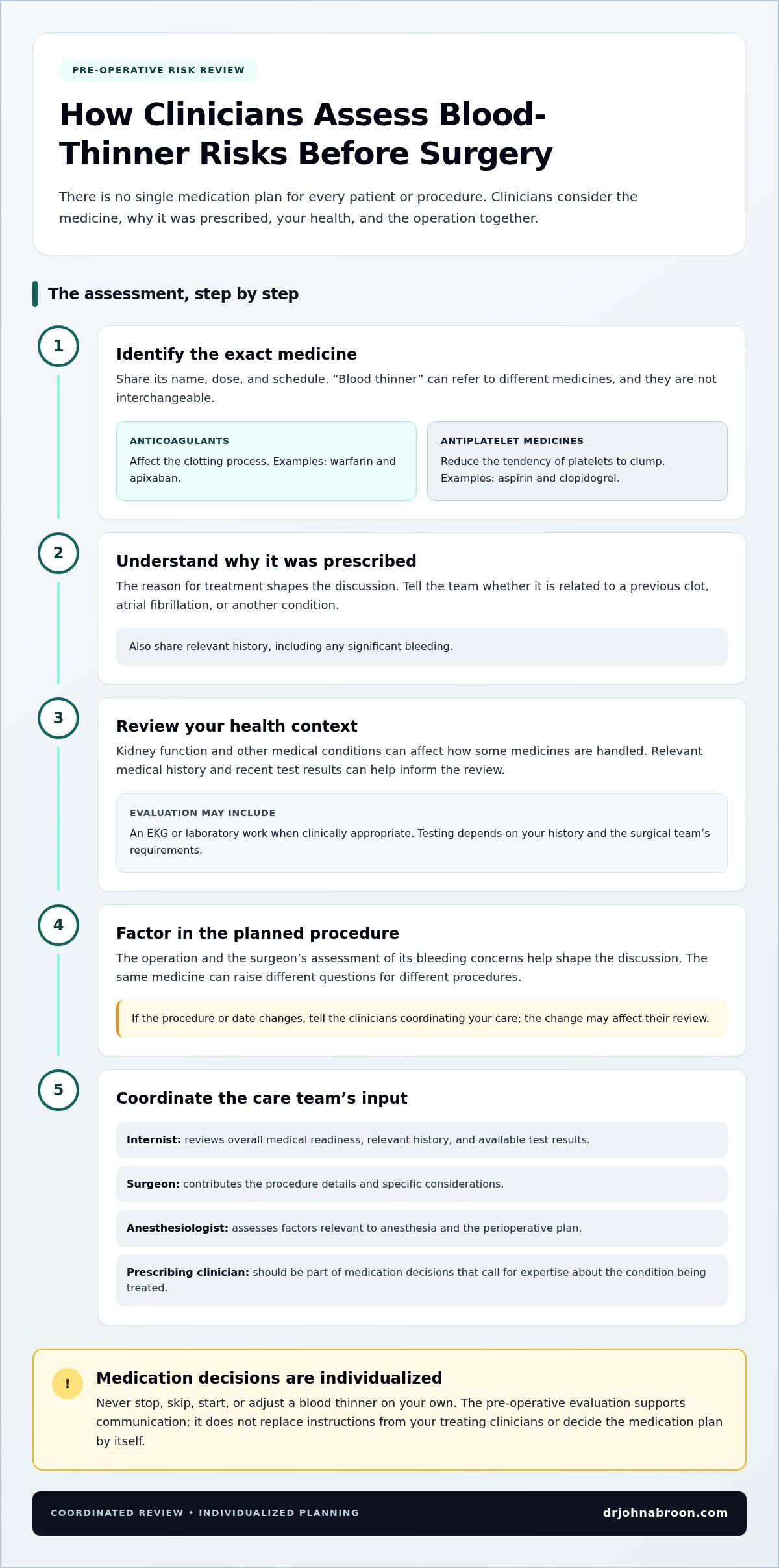
“Blood thinner” can refer to different types of medicine. Anticoagulants, such as warfarin or apixaban, affect the clotting process, while antiplatelet medicines, such as aspirin or clopidogrel, reduce the tendency of platelets to clump. These medicines aren’t interchangeable, so share the name, dose, and reason each was prescribed.
The reason for treatment matters. A medicine may be prescribed because of a history of a clot, an irregular heart rhythm, or another condition. Clinicians consider that history alongside the planned procedure and its bleeding concerns. A plan for one patient or procedure may not suit another, so decisions need to account for the full clinical picture.
Never stop, skip, start, or adjust a blood thinner on your own. Changing treatment without instructions from your treating clinicians can expose you to avoidable risk. If you’re unsure what to do before surgery, contact the clinicians coordinating your care and follow their guidance. The pre-operative evaluation helps clarify relevant risks and support communication. It does not replace individualized instructions from your treating team.
How Clinicians Assess Blood Thinner Risks Before Surgery
There isn’t one medication plan that fits every patient or procedure. To assess bleeding and clotting concerns, clinicians consider the exact medicine, why it was prescribed, the planned operation, and your overall health. The same medicine may raise different questions for different procedures, and bleeding concerns vary with the procedure. The treating team weighs these factors together rather than relying on the medication name alone.
This is a coordinated clinical judgment. For pre-op clearance for patients on blood thinners nyc, sharing a complete, accurate history helps the care team identify what needs discussion and who should be involved. Recommendations need to reflect your circumstances. Don’t use general online instructions to make a medication change.
Which details can change the assessment?
Bring the exact medication name, dose, schedule, and reason it was prescribed. The clinician also needs relevant history, such as atrial fibrillation, a previous clot, or significant bleeding. Kidney function and other medical conditions can affect how some medicines are handled by the body, so recent test results or information about ongoing conditions may help inform the review.
Procedure details matter, too. The planned operation and the surgeon’s assessment of its bleeding concerns help shape the discussion. If the date or procedure changes, tell the clinicians coordinating your care, since the change may affect their review.
Who helps make the perioperative medication plan?
The internist reviews your overall medical readiness, relevant health history, and available test results, then communicates findings that may help the surgical and anesthesia teams plan care. The surgeon contributes details about the procedure and its specific considerations. The anesthesiologist assesses factors relevant to anesthesia and the perioperative plan.
When a medication decision calls for expertise about the condition being treated, the prescribing clinician should be part of the conversation. This may be the clinician managing atrial fibrillation or another reason for anticoagulant treatment. Clear communication helps the team align recommendations, avoid conflicting instructions, and identify who will provide guidance for the medication plan.
At Dr. John Abroon’s NYC practice, a board-certified internist provides individualized pre-operative medical evaluations and communicates relevant findings to support coordination with the surgical team. If you’re preparing for surgery, pre-operative medical clearance can help bring your health history and planned procedure into a focused review. Your treating clinicians must direct any medication changes.
What Patients on Blood Thinners Should Clarify Before Surgery
A focused review is easier when the care team has a clear picture of your medicines, medical history, and planned procedure. For pre-op clearance for patients on blood thinners nyc, preparing ahead also helps establish who will give medication instructions and how those instructions will reach you.
No universal medication timeline applies to every patient or procedure. Don’t assume you should stop or continue a medicine based on someone else’s experience or a general schedule. Your treating clinicians need to give instructions that fit your circumstances.
What information should you bring to a clearance visit?
Gather the medicine containers or an up-to-date medication list, including each name, dose, and schedule, as well as the name of the clinician who prescribes it. Bring the procedure name and planned date, the surgeon’s instructions, and any pre-op forms or relevant records you have. Include a history of clots, bleeding, heart rhythm conditions, and prior procedures, along with any changes to your health or medicines.
Planned procedure and date
Why it helps: The procedure’s details and timing inform the team’s review. Who can clarify: Your surgeon or surgical office.
Complete medication list
Why it helps: Names, doses, schedules, and recent changes help clinicians understand your treatment. Include prescriptions, over-the-counter medicines, and supplements. Who can clarify: You and the clinicians who prescribe your medicines.
Reason for blood-thinning medicine and prescriber
Why it helps: The reason for treatment and the clinician managing it are relevant to planning. Who can clarify: The prescribing clinician.
Relevant medical and procedure history
Why it helps: Prior clots, bleeding, heart rhythm conditions, and previous procedures provide context for assessing your individual risks. Who can clarify: You, your internist, and clinicians familiar with your history.
Written instructions and pre-op forms
Why it helps: Reviewing the actual documents helps the team address procedure-specific requirements and avoid relying on memory alone. Who can clarify: The clinician or surgical office that provided them.
Which questions help clarify the plan?
Before the visit ends, make sure you understand how the team will communicate. Ask which clinician will provide blood-thinner instructions, how those instructions will be shared with the rest of your care team, and whom to contact if something changes.
- Who is responsible for giving me the medication instructions?
- How will the surgeon, anesthesiologist, internist, and prescribing clinician coordinate the plan?
- If I receive instructions that seem inconsistent, whom should I contact before acting?
- Whom should I notify if my procedure date or medication list changes?
If instructions appear to conflict, don’t try to resolve the difference by changing your medication yourself. Contact the clinicians involved so they can clarify a coordinated plan for your specific procedure.
Preparing for Pre-Op Clearance in New York City
Good preparation makes a pre-operative evaluation more focused and gives the care team information to review your health and planned procedure. Schedule your evaluation within the clearance window requested by your surgical team. Requirements vary, so follow the instructions for your procedure rather than assuming a standard deadline. This NYC pre-operative clearance guide offers additional context on what the process may involve.
Organize your records and instructions
Before the visit, gather available records and write down questions you want answered. This preparation can help you explain your situation clearly, especially when several clinicians are involved in your care.
- Gather relevant records. Collect available recent test results, information about relevant medical conditions, and details for specialists involved in your care. Include the name of the clinician who prescribes your blood thinner.
- Make a current medication list. Record each medicine’s name, dose, and schedule, including supplements and over-the-counter medicines. Note recent changes so the clinician can review an accurate picture.
- Collect surgery instructions. Bring the procedure name and planned date, the surgeon’s forms, and any instructions for testing or consultations. If the surgical office has given you a specific clearance window, include that information.
- Attend the evaluation with questions ready. Ask which clinician will provide the medication plan and how it will be communicated to the rest of your care team. Keep the instructions you receive so you can refer to them later.
Testing isn’t automatically the same for everyone. An EKG or laboratory testing may be considered when clinically appropriate, based on your health history and the surgical team’s requirements. Your clinician can review the available information and determine whether additional testing is relevant to your evaluation.
What happens if the plan or surgery date changes?
Tell the clinicians coordinating your care promptly if the procedure date, planned procedure, or medication list changes. Timing can affect how the team interprets earlier instructions, so don’t assume an older medication direction still applies after a significant change. Don’t make a change on your own. Ask the responsible clinicians to clarify the current plan.
For ongoing care that helps keep your medical history organized across visits, Dr. John Abroon’s NYC primary care physician guide describes his primary care practice. If you’re preparing for surgery, you can arrange a personalized pre-operative evaluation with Dr. Abroon, a board-certified internist. The evaluation can clarify relevant findings for communication with your surgical and anesthesia teams, without guaranteeing surgical approval or a particular medication plan.
Arrange Personalized Pre-Op Clearance with Dr. John Abroon in NYC
Preparing for surgery while taking a blood thinner can bring up difficult questions. A personalized medical evaluation can help organize relevant information and communicate findings to your surgical team. Dr. John Abroon is a board-certified internist and primary care physician in New York City who provides pre-operative medical clearances. His Upper East Side practice reviews each patient’s health history and planned procedure individually, without assuming every patient needs the same testing or medication plan.
For pre-op clearance for patients on blood thinners nyc, the evaluation is one part of coordinated surgical planning. It assesses relevant medical readiness and helps clarify findings for the surgical and anesthesia teams. It does not guarantee that surgery will proceed, and medication decisions remain with the clinicians responsible for your care.
What to expect from an individualized evaluation
Your visit focuses on details that may matter to your procedure and overall health. The internist reviews your medical history, current medicines, and planned operation, including instructions or forms from the surgeon. Sharing why you take a blood thinner and which clinician prescribes it helps put your medication list in context.
Testing is selected according to clinical need and surgical requirements, not added automatically. If appropriate to your evaluation, diagnostic testing may include an in-office EKG or laboratory testing. The internist can document relevant findings and communicate them to support the surgical team’s planning. The evaluation provides medical information; your treating clinicians guide decisions about the operation and medication management.
Take the next step with a clear coordination plan
Arrange your evaluation according to the timing requested by your surgical team. Before the visit, gather the planned procedure and date, the surgeon’s instructions, and a complete list of medicines with names, doses, and schedules. Include the names of clinicians who prescribe or manage those medicines. Having these details ready helps focus the visit and supports clear communication across your care team.
If your procedure date or medication list changes, update the clinicians coordinating your care. Don’t rely on earlier medication instructions after a significant change, and don’t stop, skip, start, or adjust a blood thinner on your own. Contact the clinicians responsible for your plan so they can clarify what applies to your circumstances.
A calm, organized evaluation can make a complex pre-surgery process feel more manageable. To arrange a pre-operative medical clearance with Dr. Abroon, bring your procedure details and medication information so your health history can be reviewed in context. Your care team can use the findings to support coordinated planning, while decisions about surgical approval and medication remain individualized.
Move Toward Surgery with a Clear, Coordinated Plan
Before your procedure, make sure you know who will provide your blood thinner instructions and how to reach that clinician if something changes. If the guidance you receive is unclear or seems inconsistent, pause and ask your care team to clarify it. Don’t make medication changes on your own. A coordinated plan can help you approach the next steps with greater confidence.
If you’re arranging pre-op clearance for patients on blood thinners nyc, Dr. John Abroon’s practice provides a personalized medical evaluation to clarify relevant information for your surgical team. Dr. Abroon is a board-certified internist and primary care physician, and his Upper East Side practice provides pre-operative medical clearances and diagnostic testing when clinically appropriate.
Bring your medication list and procedure details, and arrange your evaluation within the timing requested by your surgical team. Schedule a personalized pre-operative medical clearance in NYC to take a considered next step toward a well-coordinated procedure. You deserve clear communication and care shaped around your individual health needs.
Frequently Asked Questions
Can I have surgery while taking a blood thinner?
Some procedures may proceed while a patient takes a blood thinner, while others require a clinician-directed plan. The decision depends on the specific medicine, why it was prescribed, the procedure, and personal health factors. For pre-op clearance for patients on blood thinners nyc, the internist, surgeon, anesthesiologist, and prescribing clinician may coordinate instructions. Don’t stop or adjust your medicine yourself, even if someone else had a different plan for a similar procedure.
Should I stop taking my blood thinner before surgery?
Don’t stop, skip, or change a dose unless the clinicians managing your procedure and prescription give you specific instructions. Stopping a medicine can create risks, while continuing it may also need consideration for certain procedures. If instructions from different clinicians seem inconsistent, or you’re unsure which direction applies, contact the responsible clinical team before making any change. Keep the instructions you receive accessible so you can refer to the exact plan.
What happens if I forget to mention a blood thinner at my pre-op visit?
Tell the pre-op clinician and surgical team as soon as you realize the medicine wasn’t included. Share its name, dose, schedule, and reason for use, along with the prescribing clinician’s name. Don’t independently change your next dose to compensate for the omission. The team can determine whether the information needs further review or whether the prescribing clinician should be included in communication before your procedure.
Does everyone taking warfarin need an INR test before surgery?
No, clinicians don’t use one testing schedule for every patient or procedure. Whether an INR test is appropriate depends on your treatment, health history, and the surgical team’s requirements. Follow the testing instructions given for your evaluation, and bring recent results if the team requests them. Don’t use an older result to make medication decisions without clinical guidance, especially if your health or treatment has changed since it was taken.
Can I take aspirin or clopidogrel before an operation?
Aspirin and clopidogrel are antiplatelet medicines, and instructions depend on why you take them and the procedure planned. Don’t stop either medicine on your own, even before a dental or outpatient procedure. Include both in the medication list you share with the clinicians coordinating your care. If you’re unsure whether a product contains aspirin or another antiplatelet medicine, bring its packaging or write down the active ingredient for review.
Who decides whether my blood thinner should be paused or continued?
The medication plan is individualized and may involve the clinician who prescribed the medicine, the surgeon, the anesthesiologist, and the internist reviewing medical readiness. Each contributes information about the treatment’s purpose, the procedure, and relevant health risks. Follow instructions from the responsible clinical team rather than choosing independently or applying a general online schedule. If you don’t know who will provide the final directions, ask your care team to identify the point person.
When should I schedule pre-op clearance if I take blood thinners?
Arrange the evaluation according to the timeframe requested by your surgeon or procedural team, and provide the procedure date when scheduling. Allow time for the clinicians involved to review your information and communicate as needed, rather than waiting until the last moment. If the surgery date changes or you haven’t received medication instructions, notify the team coordinating your care promptly so they can advise you on next steps.