


Finding pre-op testing near me is only the first step toward preparing for surgery. Your tests and paperwork need to match your surgeon’s instructions, and it can be hard to know what to arrange or bring. A clinician-led evaluation can help connect those instructions with your health history and the next steps in your care.
Before a procedure, your surgical team may request a medical review and specific tests based on your health and planned surgery. Dr. John Abroon, a board-certified internist and primary care physician on Manhattan’s Upper East Side, provides pre-operative medical clearances and diagnostic services, including in-office EKGs, pulmonary function tests, and laboratory specimen collection and processing.
This guide explains how to work from your surgeon’s testing request, prepare for a pre-op visit, and keep relevant records together. You’ll also learn what may happen during an evaluation and how a clinician can consider your medical history and test results in relation to your planned procedure. A practical plan can help you approach each step with greater clarity.
Key Takeaways
- Pre-op testing is guided by your health, planned procedure, and surgical team’s instructions, not necessarily a standard set of tests.
- When searching for pre-op testing near me, consider whether care includes a medical review as well as diagnostic testing.
- Organize your surgeon’s order, medication information, health history, and available medical records to support a more informed evaluation.
- Dr. John Abroon is a board-certified internist on Manhattan’s Upper East Side who provides pre-operative medical clearances and diagnostic services.
- Keep testing and records aligned with your surgical team’s requirements as you plan your next steps.
Pre-Op Testing in NYC: What to Look for Before Surgery
A scheduled procedure can come with a busy checklist: surgeon’s instructions, medical forms, test orders, and timing requirements. Start by distinguishing two related parts of preparation: the medical evaluation and any diagnostic testing requested or considered as part of it.
Pre-op testing refers to tests used during a pre-operative medical evaluation to help assess a patient’s health in relation to a planned procedure. The evaluation is individualized. A clinician considers your health history, current medications, type of surgery, and surgeon’s instructions to determine what information is relevant. One patient may be asked to have an EKG or laboratory work, while another may receive different instructions. Testing isn’t automatically the same for everyone.
Pre-op testing supports a clinician’s assessment; it does not guarantee surgical approval. A medical clearance is the clinician’s assessment of your health for the planned procedure, while test results are one possible part of that assessment. The surgeon and surgical facility make decisions about proceeding with surgery. For a broader overview of how evaluation and testing fit into preparation, see Understanding Preoperative Care.
Why the surgeon’s instructions should guide your search
Use your surgeon’s order or written instructions as the starting point when searching for pre-op testing near me. Requested tests can vary with the procedure and your health, so another patient’s testing list may not apply to you. Bring the instructions to your medical visit and note anything that’s unclear, such as which tests are required or where completed forms should go. The clinician can review the request in the context of your health and discuss relevant next steps.
What “near me” should mean for pre-op care in NYC
In Manhattan, a convenient location can make it easier to coordinate appointments around a procedure. Proximity is only one consideration, though. Look for care that connects requested testing with a clinician’s review and the documentation your surgical team needs. A test-only visit may provide a result without considering your broader medical context. An individualized evaluation considers relevant results alongside your history and the surgeon’s instructions.
Dr. John Abroon, a board-certified internist and primary care physician, provides pre-operative medical clearances at his Upper East Side practice. Diagnostic services include in-office EKGs, pulmonary function tests, and laboratory specimen collection and processing. This clinician-led approach brings medical review and relevant diagnostic services into the same care setting, with the evaluation focused on the individual rather than a fixed testing panel. For more detail on preparing for this process in the city, explore the NYC pre-operative medical clearance guide.
Pre-Op Testing: Medical Reviews and Diagnostic Tests
A pre-operative visit isn’t simply a checklist of tests. It’s an individualized medical assessment shaped by your health history, the procedure you’re preparing for, your current medications, and the surgeon’s instructions. One patient may need a particular diagnostic test, while another may not. The clinician reviews the available information and determines what evaluation is appropriate for the patient’s circumstances.
A pre-operative evaluation is a clinician’s review of your health and planned procedure, informed by relevant test results. Tests can contribute useful information, but they don’t replace the medical review. MedlinePlus describes common steps in preparation for surgery in its guide to Common Pre-Surgical Tests and Visits. Your evaluation should follow your surgeon’s instructions and clinical assessment, rather than assuming every test in a general guide applies to you.
How medical history shapes the evaluation
Existing health conditions, past procedures, and prior test results can give the clinician important context. Share an accurate account of your health, including recent changes, and bring relevant records if you have them. Provide a complete list of prescription medicines, over-the-counter drugs, vitamins, and supplements. This information helps the clinician understand your current care and review the surgical team’s request. A health condition doesn’t automatically determine whether surgery can proceed; the assessment considers your individual situation.
When EKG, pulmonary function testing, or lab work may be relevant
These tests aren’t a standard package for every patient. Whether they are used depends on the requested evaluation, your health information, and the planned procedure. Ask the clinician to explain why a test is part of your assessment and how it relates to the surgeon’s instructions.
- EKG: An electrocardiogram records the heart’s electrical activity. It may be part of an evaluation when relevant to the patient’s circumstances or requested by the surgical team.
- Pulmonary function testing: This assesses aspects of breathing-related function. Whether it’s appropriate depends on the individual clinical review.
- Laboratory work: Blood or other laboratory testing may be requested as part of the evaluation. Dr. John Abroon’s practice provides laboratory specimen collection and processing, alongside diagnostic services.
If you’re searching for pre-op testing near me, look for a process that connects requested tests with a clinician’s review, rather than treating test completion alone as the full evaluation. Bring your surgeon’s instructions and raise anything you don’t understand. For a clinician-led pre-operative medical clearance in Manhattan, learn about Dr. John Abroon’s pre-operative care and the diagnostic services available through his practice.
Comparing Pre-Op Testing Options in New York City
Searching for pre-op testing near me can bring up services that sound similar but involve different kinds of care. A test-only encounter focuses on completing a specific diagnostic test. A pre-operative evaluation adds clinical review, considering your health information and surgical instructions alongside relevant results. Don’t assume that different visits include the same tests or paperwork.
Use the comparison below to identify the parts of care that matter for your situation. It’s a framework for understanding the difference, not a substitute for your surgeon’s order or a clinician’s judgment.
| Care attribute | Testing-only encounter | Clinician-led evaluation | Dr. John Abroon’s practice |
|---|---|---|---|
| Instruction fit | Focuses on the test requested for that visit. | Reviews the surgical instructions as part of the assessment. | Provides pre-operative medical clearances. |
| Clinician review | May center on performing a test rather than reviewing broader medical context. | Considers relevant health history and the planned procedure. | Led by Dr. Abroon, a board-certified internist and primary care physician. |
| Testing | Limited to the test or tests arranged for the encounter. | Testing is guided by the evaluation and individual circumstances. | Diagnostic services include in-office EKGs, pulmonary function tests, and laboratory specimen collection and processing. |
| Records | May focus on producing a test result. | Can place relevant results in the context of the medical review. | Bring the surgeon’s forms and instructions so the evaluation can address the requested documentation. |
| Location | Varies by service and test. | Varies by clinician and practice. | Located on Manhattan’s Upper East Side. |
Does the service address the tests your surgeon requested?
Match the visit to your surgeon’s written order rather than assuming a standard bundle. An EKG, laboratory work, or another assessment may be relevant in one case and not another. The clinician may also identify other considerations based on your circumstances. The goal is to have the surgical team’s request considered during the evaluation, not to collect tests without a clear purpose.
Does the visit include a clinician’s review and clear next steps?
Results are more useful when considered alongside relevant health history and the planned procedure. A clinician-led visit can clarify what has been reviewed and whether follow-up is needed, without implying a particular surgical outcome. Dr. Abroon’s internist-led practice offers an individualized NYC option, bringing pre-operative medical clearance and diagnostic services together in a clinical setting. As you compare care, consider whether the approach addresses your instructions, medical context, and documentation needs, not just location.
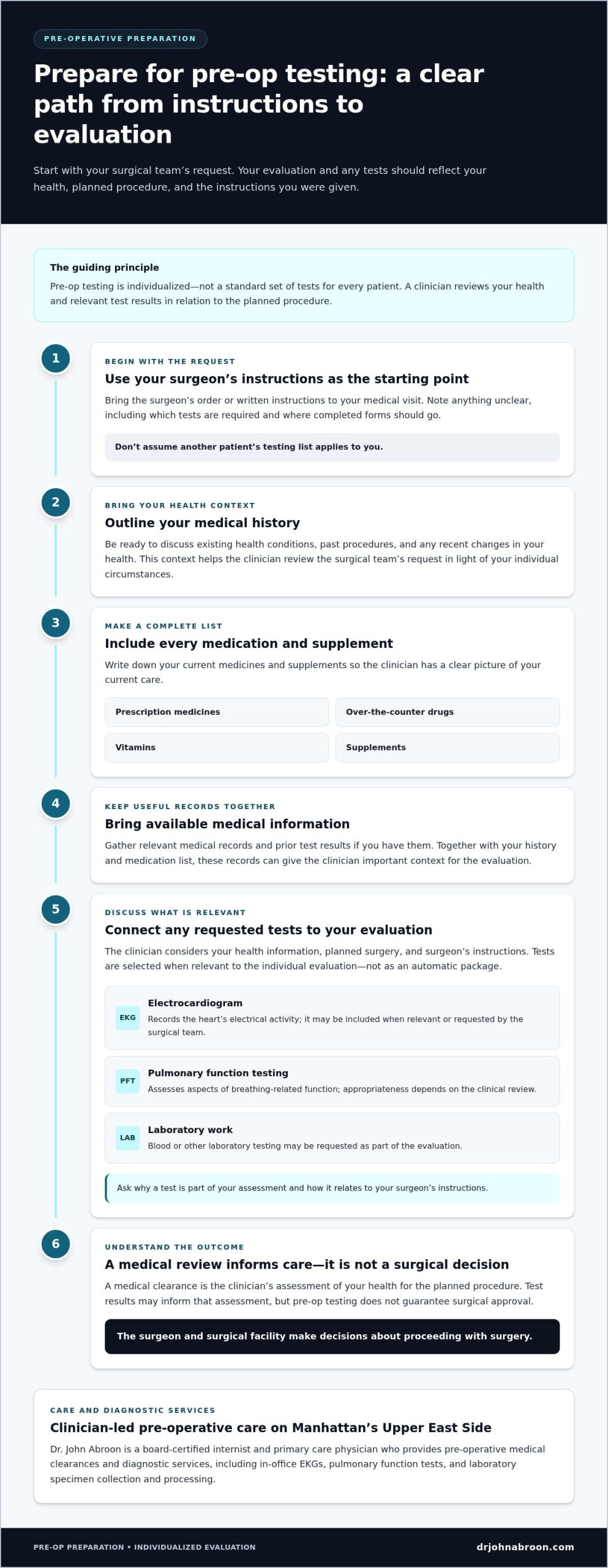
How to Prepare for Pre-Op Testing Near You
A little organization can make a pre-operative visit more focused. If you’re searching for pre-op testing near me, begin with the surgical team’s instructions, then gather the information that will help the evaluating clinician understand your health and planned procedure. Don’t rely on a generic checklist to decide which tests you need or how to prepare.
- Start with the surgeon’s order. Bring the written testing request, instructions, planned procedure details, and relevant contact information for the surgical team. Note any forms they’ve asked you to complete and any timing directions they’ve provided.
- Prepare your medication information. Write down your current prescriptions, over-the-counter medicines, vitamins, and supplements. Include the dose if you know it, and note any recent changes.
- Gather health history and records. Summarize relevant medical conditions, prior procedures, and recent health changes. Bring previous test results or medical records when available and relevant to the evaluation.
- Pack the practical essentials. Bring photo identification and any forms supplied by the surgical team or medical practice. Keeping paperwork together makes it easier to review the request during your visit.
Gather the documents and health details that support your visit
Clear, accurate information helps the clinician assess your circumstances rather than rely on assumptions. If you’re unsure whether a past result or record matters, bring it if it’s readily available and let the clinician decide whether it informs the review. Include relevant contact details for your surgeon so the instructions and documentation can be considered in context. An ongoing relationship with a primary care physician can also help keep your broader health information organized. Dr. Abroon’s NYC primary care and internal medicine guide explains the practice’s approach to continuing care.
Coordinate timing and follow-up with your surgical team
Follow the timing instructions from your surgeon and the clinician conducting the evaluation. Requirements can be specific to your procedure and care plan, so don’t assume a general timeline applies. Follow clinician instructions about fasting or changing medications, too. Don’t fast or stop, start, or adjust a medicine based on generic online advice. If instructions are unclear, ask your care team before making a change.
Additional review or testing may affect what happens next. Keep track of any follow-up requested during the visit, and share evaluation updates or records with the surgical team as directed. This helps the clinicians involved work from the same information without assuming that testing alone completes the process.
For individualized pre-operative medical clearance and diagnostic services in Manhattan, learn about Dr. Abroon’s practice and plan your next steps with the relevant instructions and records in hand.
Pre-Op Testing on the Upper East Side with Dr. John Abroon, M.D.
For patients preparing for surgery in Manhattan, a local physician’s review can help organize the pre-operative requirements. Dr. John Abroon is a board-certified internist and primary care physician whose New York City practice provides pre-operative medical clearances and diagnostic services. The evaluation considers the individual, not simply a checklist of tests. Your surgeon’s instructions, medical history, planned procedure, and current health inform the clinician’s review.
Diagnostic services at the practice include in-office EKGs, pulmonary function tests, and laboratory specimen collection and processing. These are examples of available services, not a standard panel for every patient. The clinician considers what is relevant to your circumstances and the surgical team’s request. A medical clearance reflects a clinical assessment; it doesn’t guarantee that surgery will be approved or proceed. Decisions about surgery remain with the surgical team and facility.
A local internist for individualized pre-operative evaluation
Dr. Abroon’s practice is on Manhattan’s Upper East Side, offering a local option for patients seeking pre-operative evaluation in the city. Established in 1997, the practice brings an internist’s perspective to reviewing health information in the context of planned care. Clear communication can help you understand what the evaluation addresses and what questions may need follow-up. Bring your surgeon’s instructions and relevant records so the clinician can consider them during the assessment.
Patients can have different health histories and surgical requirements, so the tests one person needs may not be appropriate for another. The clinician reviews the request and determines what is relevant to the assessment rather than assuming a particular test is required. This keeps the focus on your medical context and the information your surgical team has requested.
Take the next step for your pre-op evaluation
If you’re looking for pre-op testing near me on the Upper East Side, have your surgeon’s order or instructions ready when arranging care. Include details about the planned procedure and any forms or specific testing requests the surgical team provided. This gives the practice a clear starting point for assessing your pre-operative needs and considering relevant diagnostic testing as part of the medical review.
Preparing for surgery can involve several moving parts, but you don’t have to sort through the medical instructions alone. Dr. Abroon’s practice provides pre-operative medical clearances within a primary care setting, with an evaluation shaped around the patient’s circumstances. To discuss a pre-operative evaluation in Manhattan, contact Dr. John Abroon’s office with your surgeon’s instructions ready.
Take Your Next Step with Clarity
As your procedure approaches, turn the instructions you’ve received into a clear plan. Keep your surgeon’s paperwork together, note questions that still need answers, and make a simple record of who needs each form or update. A focused conversation about your individual needs can help clarify what to do next.
If you’re still searching for pre-op testing near me, look beyond proximity and consider how the evaluation will fit your surgical team’s instructions and your health information. Arriving prepared can make it easier to discuss concerns, understand follow-up steps, and keep your care organized.
Contact Dr. John Abroon’s office to discuss your pre-operative evaluation and take a thoughtful next step toward surgery. Bring your questions and relevant instructions to help make the conversation specific to your needs.
Frequently Asked Questions
Is pre-op testing the same as medical clearance for surgery?
No. Pre-op testing refers to diagnostic procedures, while medical clearance involves a clinician’s broader assessment of your health in relation to the planned surgery. For example, an EKG result may inform the review, but it isn’t the entire evaluation. The surgical team makes decisions about proceeding, so completing a test or receiving a medical assessment doesn’t guarantee that surgery will go ahead.
Can I get pre-op testing from an internist in NYC?
Yes. An internist can provide a pre-operative medical evaluation and consider testing in the context of your health and the surgeon’s request. If you’re looking for pre-op testing near me in New York City, Dr. John Abroon’s practice provides pre-operative clearances and diagnostic services, including in-office EKGs, pulmonary function tests, and laboratory specimen collection and processing. The clinician determines what’s appropriate for your evaluation.
What should I bring to a pre-op testing appointment?
Bring the surgical team’s order, any forms they supplied, photo identification, and a current list of medications and supplements. Include relevant health information, such as recent changes or prior procedures, and bring previous test results if available. If your surgeon’s paperwork names a specific test, having that document at the visit can help the clinician understand what was requested and discuss any questions with you.
How much time should I allow for pre-op testing and follow-up?
There isn’t one timeframe that applies to every patient. The visit, any requested testing, and possible follow-up can depend on your evaluation and the surgical team’s schedule. Follow the timing instructions you’ve received and allow for the possibility that the clinician may need to review additional information. If your procedure date is approaching, share it with the care team so they understand the timing involved.
What happens if my pre-op test results need additional review?
If a result or part of your medical history needs closer attention, the clinician may review relevant records, ask for more information, or discuss whether further evaluation is appropriate. This doesn’t automatically determine whether surgery can proceed. Keep your surgeon informed about follow-up as directed, and respond to requests for records or clarification so the clinicians involved have the information needed for your care.
Does every patient need an EKG or blood work before surgery?
No. Testing is based on the patient’s health, planned procedure, and surgical team’s instructions, so an EKG or blood work isn’t automatically needed for everyone. A test ordered for one person may not apply to another. Bring your specific instructions to the evaluation rather than relying on another patient’s checklist or assuming a general list of tests is required for your surgery.
Can I keep taking my medications before pre-op testing?
Follow the instructions from your clinician or surgical team, because medication guidance can depend on the medicine, the evaluation, and the planned procedure. Don’t stop, skip, or change a prescription based on general online advice. Bring an up-to-date medication list, including nonprescription medicines and supplements. If instructions about a dose or fasting are unclear, get direction from your care team before making a change.