


What makes a boutique medical practice more than polished amenities? For many people, it is a physician who considers their health history, current concerns, and preventive needs together. If you’re looking for a boutique medical practice upper east side, it helps to compare the care itself, the services offered, and how the practice is structured.
“Boutique” is a broad description, not a specific type of membership. It does not, by itself, explain how visits are arranged or what a practice includes. Focus instead on practical details: how the physician evaluates your concerns, whether the practice offers relevant services, and how recommendations connect to your health needs.
Dr. John Abroon’s Upper East Side internal medicine practice offers annual physical exams, diagnostic testing, and other primary care services. Dr. Abroon is a board-certified internist and primary care physician, and his New York City practice was established in 1997. In-office testing includes EKGs, pulmonary function tests, and laboratory specimen collection. These details give you a concrete starting point for assessing whether the practice’s clinical approach fits your needs.
Key Takeaways
- Compare boutique, concierge, and large-system care by practice structure and clinical approach, not by label alone.
- Consider how a primary care visit connects your health history and examination with preventive planning and diagnostic evaluation.
- Use practical questions to understand how a physician personalizes care and how the practice is arranged.
- Explore how a boutique medical practice upper east side can support different needs through internal medicine and preventive care.
- Learn about Dr. John Abroon’s services, including immigration medical exams, pre-operative clearances, and travel medicine.
What Does a Boutique Medical Practice on the Upper East Side Mean?
Does “boutique” describe a style of care, a membership, or both? The answer depends on how a practice uses the term. For someone searching for a boutique medical practice upper east side, the label may suggest individualized attention, but it does not explain how visits are arranged, which services are offered, or how care is paid for.
A boutique medical practice emphasizes personalized attention and care shaped around each patient’s health needs; the term does not define one universal practice or payment model. The clinical relationship is central: a physician considers your health history, concerns, and goals rather than treating every visit as interchangeable. To judge whether that approach suits you, look at how the practice evaluates concerns and discusses next steps.
Personalized care can be offered in different settings, including an independent primary care practice, a membership-based arrangement, or a larger organization. “Boutique” alone does not establish appointment length, access, or a membership requirement. Those are separate features of a practice’s structure.
Boutique care versus concierge medicine: what the terms mean
“Boutique” is a broad description of an individualized practice experience. “Concierge medicine” commonly refers to a membership-based arrangement, though specific terms vary. Some references use the terms in overlapping ways; the overview of Concierge medicine, also known as boutique medicine reflects that association. The label still does not explain the details of a particular practice, so compare its care and stated arrangements directly.
A practical distinction is that boutique describes an emphasis on personalized care, while concierge often describes how care is organized. The terms can overlap, but they are not interchangeable in every context. If membership is important to your decision, review what the arrangement includes and how it relates to the services you need.
Why Upper East Side patients may seek a more personal approach
A local search often starts with a practical need: finding a physician who can consider the broader picture of your health. Individual attention can help focus conversations about prevention, new symptoms, and personal or family history. That context helps a physician evaluate concerns and discuss appropriate next steps instead of treating each question in isolation.
- Prevention: Discuss health priorities and preventive care in light of your individual history.
- Symptoms: Describe when a concern began, how it has changed, and what else may be relevant.
- Continuity: Build a clearer picture of your health over time through ongoing primary care.
For Upper East Side residents, location matters, but proximity alone does not define quality or fit. Consider how a physician approaches evaluation and whether the practice’s services support the care you are seeking. Dr. John Abroon is a board-certified internist and primary care physician whose New York City practice was established in 1997. His practice brings personalized primary care together with preventive exams and diagnostic testing, making clinical attention, rather than amenities alone, a useful way to assess the approach.
How Personalized Internal Medicine Connects Prevention, Evaluation, and Testing
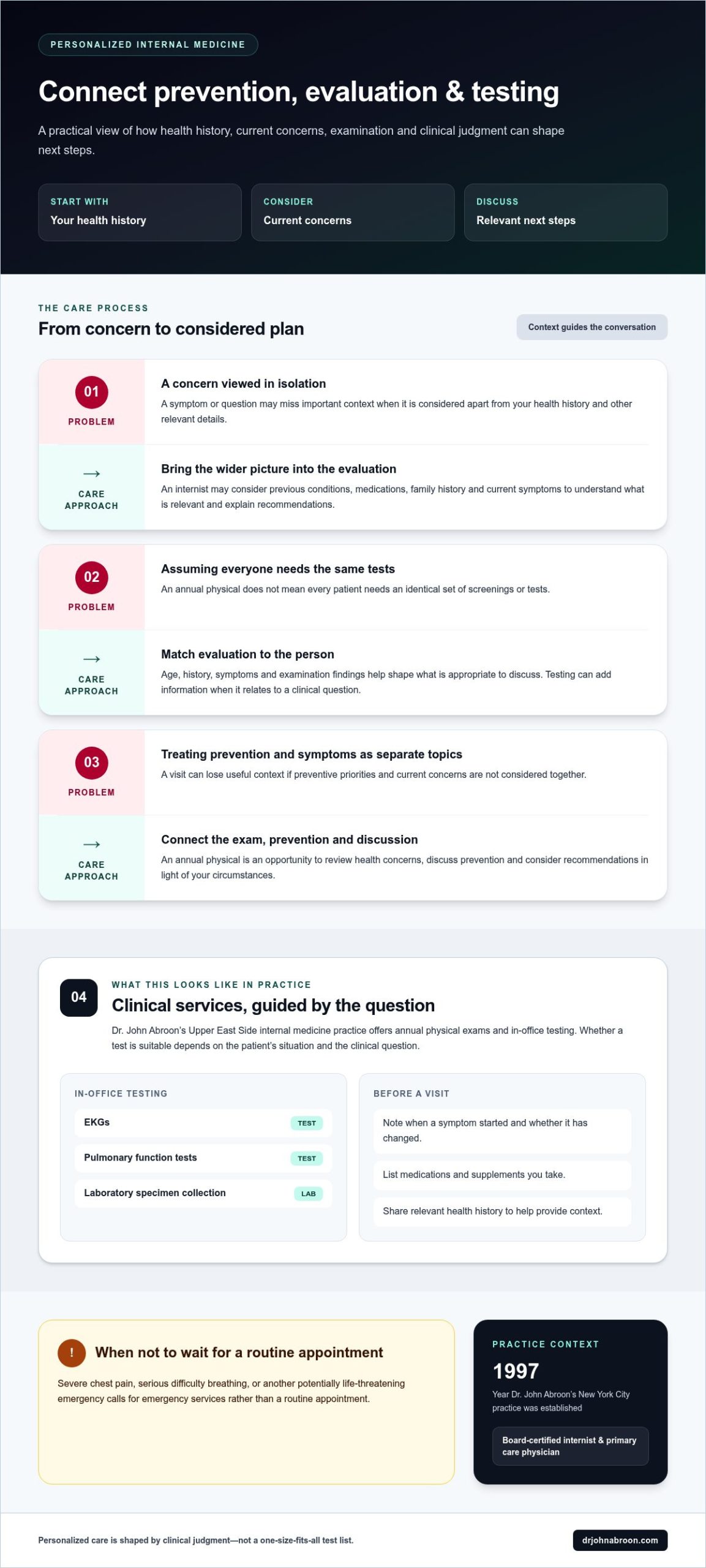
Personalized internal medicine is a clinical process, not a checklist of tests. A physician learns about your health history and current concerns, performs an examination as appropriate, assesses the information, and discusses a plan shaped around your needs. This connects prevention with evaluation: your circumstances help guide what to discuss and recommend.
For someone considering a boutique medical practice upper east side, this process offers a practical way to assess care. Does the physician consider your history alongside your symptoms? Are recommendations explained clearly? Individualized care means the conversation and clinical judgment guide next steps, rather than assuming every patient needs the same screening or test.
How an internist uses your health history and current concerns
Previous conditions, medications, family history, and current symptoms can all help an internist understand what may be relevant to an evaluation. Before a visit, note when a symptom started, whether it has changed, and which medications or supplements you take. That information gives the physician context to assess your concerns, explain recommendations, and tailor next steps to your situation.
Some symptoms need immediate attention. If you experience severe chest pain, serious difficulty breathing, or another potentially life-threatening emergency, call emergency services rather than waiting for a routine appointment.
Where physical exams and diagnostic testing fit
An annual physical exam is an opportunity to review health concerns, discuss prevention, and consider recommendations in light of your circumstances. It does not mean every patient needs an identical set of tests. Your age, history, symptoms, and examination findings help shape what is appropriate to discuss.
Diagnostic testing can add useful information when it relates to a clinical question. Dr. John Abroon’s Upper East Side practice offers in-office EKGs, pulmonary function tests, and laboratory specimen collection. The physician considers whether a test is suitable for your situation and interprets its findings alongside your history and examination.
Testing should help answer a clinical question; it should inform, not replace, a physician’s judgment. A test may be considered to evaluate a symptom or add information to an assessment, but the decision depends on the individual clinical picture. Testing is not automatically a routine bundle, and results should be understood in context rather than on their own.
- Before a visit: Note your current concerns, medications, and relevant health history.
- During the discussion: Ask what a recommendation is intended to assess and how it relates to your health.
- After testing: Discuss what the results mean in the context of your overall evaluation.
Dr. Abroon is a board-certified internist and primary care physician. To learn more about his approach to personalized primary care, explore how preventive visits and diagnostic evaluation fit within the practice.
Boutique, Concierge, or Large-System Care: Compare the Approach, Not the Label
These terms describe different aspects of healthcare. “Boutique” generally describes an emphasis on individualized attention. “Concierge” commonly refers to a membership arrangement. “Large-system care” describes an organizational setting. The categories can overlap, so a label alone will not tell you what a physician’s care includes or how the practice works.
Compare the clinical approach, practice structure, and setting separately. The table is a starting point, not a guarantee that every practice within a category works the same way.
| Care model | Care focus | Practice structure | Service setting | What to clarify |
|---|---|---|---|---|
| Independent practice | May emphasize an ongoing relationship with a physician and individualized primary care. | Operates separately from a large health system; arrangements vary. | Care is provided through the practice, with diagnostic services varying by office. | Which services are available, how care is arranged, and how insurance and billing work. |
| Concierge membership | May combine primary care with membership-based services or access arrangements. | Patients pay a membership fee; what it covers differs by practice. | May be offered through an independent practice or a larger organization. | What the fee includes, what is billed separately, and how insurance applies. |
| Large-system care | May connect primary care with a broader organization’s specialties and resources. | Care is organized within a health system, with processes that vary across systems. | May involve multiple departments or locations. | How primary care, testing, referrals, and other services are coordinated. |
What the boutique label can, and cannot, tell you
The word “boutique” alone does not establish a fee, insurance arrangement, appointment schedule, or set of included services. It also does not guarantee faster appointments or better health outcomes. Focus instead on whether the physician’s approach suits your needs, how preventive and diagnostic care are considered, and which services are relevant to you.
If you’re seeking preventive care, look for an approach that considers your health history and concerns rather than assuming a standard set of tests. If you need diagnostic evaluation, consider how testing fits into the physician’s assessment. These clinical details are more useful than the label alone.
How an independent Upper East Side practice differs in feel
Dr. John Abroon’s physician-owned and operated private practice brings internal medicine and primary care together with annual physical exams and diagnostic services. In-office testing includes EKGs, pulmonary function tests, and laboratory specimen collection. These services show the practice’s clinical scope without implying a particular appointment length, access schedule, or membership term.
When comparing a boutique medical practice upper east side with a concierge program or a large health system, focus on whether the physician’s evaluation, available services, and practice arrangements align with the care you’re seeking.
How to Decide Whether a Boutique Medical Practice Fits Your Needs
Start with your health priorities, not the word “boutique.” Consider the primary care you need, how you want to work with a physician, which services matter to you, and how the practice is arranged. This four-step reflection can help you assess whether a boutique medical practice upper east side fits your needs without letting amenities or marketing language overshadow clinical fit.
- Identify your current health needs. Are you looking for routine preventive care, help evaluating a specific concern, or ongoing primary care? Think about your medical history, current symptoms, and the questions you want to address.
- Consider the physician relationship you prefer. Do you value a physician who considers your concerns in context and explains the reasoning behind recommendations? Think about how you want conversations about prevention, symptoms, and next steps to feel.
- Review relevant services. Match your needs to the practice’s clinical scope. Consider whether annual physical exams, diagnostic testing, or other internal medicine services are relevant to the care you’re seeking.
- Understand the practice arrangement. Membership, payment, and insurance arrangements differ among practices. Review the practice’s stated terms rather than assuming the boutique label signals a particular arrangement.
Keep clinical fit distinct from convenience and presentation. A welcoming setting may matter, but it does not explain how a physician evaluates a concern or tailors preventive recommendations. Useful questions include: How does the physician account for my history when discussing prevention? How are diagnostic tests selected for an individual concern? How will the reasoning behind recommendations be explained?
Match your health priorities to the practice’s services
For routine prevention, annual physical exams offer an opportunity for individualized evaluation. For a diagnostic concern, Dr. John Abroon’s practice provides EKGs, pulmonary function tests, and laboratory specimen collection in the office. The practice also offers urgent care, travel medicine, and specialized medical evaluations, including immigration medical exams and pre-operative clearances. The physician’s assessment helps determine what is relevant to your situation.
Understand the practice arrangement before making a decision
Before choosing a practice, understand its stated membership, payment, and insurance arrangements. These differ among medical practices, and “boutique” does not define the terms. If you’re considering a membership-based model, the guide to personalized concierge medicine in NYC offers more context on that distinct approach.
For a closer look at Dr. Abroon’s primary care, explore Dr. Abroon’s primary care approach. Compare the practice’s services and individualized internal medicine with the health priorities you identified.
Meet Dr. John Abroon: Personalized Medical Care on the Upper East Side
For people looking for a boutique medical practice upper east side, Dr. John Abroon’s practice offers physician-led internal medicine and primary care in New York City. Dr. Abroon is a board-certified internist and primary care physician, and his practice was established in 1997. Care centers on individualized medical evaluation, with recommendations shaped by a patient’s health needs.
A physician-led practice with broad internal medicine services
An internist provides primary care and evaluates health concerns in the context of a patient’s overall medical history. That perspective can inform preventive care, physical exams, and decisions about diagnostic testing. Dr. Abroon’s practice offers annual physical exams and in-office diagnostic services, including EKGs, pulmonary function tests, and laboratory specimen collection. The physician determines which evaluation or test is appropriate for the individual situation.
The practice also provides services for specific needs, including immigration medical exams, pre-operative medical clearances, and travel medicine. These services sit alongside primary and preventive care within a broader internal medicine practice. They reflect the range of evaluations available while leaving each patient’s care tailored to the reason for the visit and their health context.
Personalization comes through careful assessment and recommendations tailored to the person being seen. It does not mean assuming every patient needs the same examination or test, and it does not guarantee a particular clinical outcome or appointment schedule. A grounded approach means having your concerns considered and understanding how recommendations relate to your care.
Take the next step toward a more personal care relationship
If preventive care is a priority, an annual exam is an opportunity to discuss your health history and current concerns. The complete guide to annual physical exams in NYC offers further context on this type of visit. You can also review the practice’s primary care information to see how its internal medicine services relate to your needs.
A thoughtful decision starts with understanding the physician’s clinical approach and the services relevant to you. To learn more about Dr. Abroon’s practice or request an appointment through the website, learn about Dr. John Abroon’s practice.
Choose Care That Supports Your Next Step
A good primary care relationship should help you feel heard, informed, and able to take an active role in decisions about your health. As you consider a boutique medical practice upper east side, look beyond the label: would you feel comfortable raising questions, discussing changes in your health, and understanding the reasoning behind a care plan?
To prepare for a first conversation, note the health priorities you want to discuss and the questions you’d like answered. Consider what matters to you in preventive care, how you prefer a physician to explain recommendations, and which services are relevant to your needs. Bringing those priorities into the conversation can help you assess whether the practice’s approach fits.
Dr. John Abroon’s practice brings a clinically grounded, personalized approach to primary care and internal medicine. Learn about Dr. John Abroon’s personalized medical care and take the next step toward discussing your health priorities with the practice.
Frequently Asked Questions
What should I bring to my first appointment with an internist?
Bring a current medication list, relevant medical records, allergy information, and a brief summary of your health concerns. Include the names of other clinicians involved in your care and recent test results if you have them. For example, note when a symptom began and what changes you’ve noticed. These details help the physician understand your history and focus the visit.
How often should adults schedule a physical exam?
There isn’t one schedule that suits every adult. Your physician can recommend timing based on your age, medical history, risk factors, and current health needs. A preventive exam is different from an appointment for a new symptom. Don’t wait for a routine physical to discuss a concern that is changing or needs attention sooner. In New York, your primary care physician can help plan preventive visits around your individual circumstances.
Can diagnostic testing happen during a primary care visit?
It may, if the physician considers a test clinically appropriate and it is available for the visit. Dr. Abroon’s practice offers EKGs, pulmonary function tests, and laboratory specimen collection. A patient reporting palpitations, for example, may need an evaluation that differs from someone discussing a respiratory concern. Testing isn’t needed at every appointment, and results should be interpreted alongside your symptoms and medical history, not treated as a diagnosis on their own.
Is a boutique medical practice appropriate if I have several health concerns?
It may suit you if you want to discuss multiple concerns in the context of your overall health. Before a visit, make a short list of priorities and note which issue is most pressing. Dr. Abroon’s New York internal medicine practice includes preventive exams, diagnostic testing, and specialized evaluations. The term “boutique” does not guarantee a particular outcome; consider whether the physician’s approach and services fit the questions you want to address.
What does a board-certified internist treat?
An internist specializes in adult medicine, including prevention, evaluation, and management of a range of health concerns. Board certification indicates that a physician has met specialty certification requirements, but it cannot guarantee a particular result for an individual patient. Dr. John Abroon is a board-certified internist and primary care physician in New York City. Before a visit, make a list of concerns so the physician can understand what you’d like to discuss.
When should I seek urgent care instead of scheduling routine primary care?
A new or worsening concern may call for prompt attention rather than waiting for a preventive appointment. For severe symptoms or a possible medical emergency, call 911 or go to an emergency department. For a non-emergency issue, the appropriate care setting depends on the symptoms and circumstances. Don’t rely on an online article to diagnose a problem or delay needed care. If you’re unsure how serious symptoms are, seek professional medical guidance promptly.