


The traditional rule to never touch your immigration medical results has officially changed for many applicants in 2026. While you might feel a surge of concern at the thought of breaking that official seal, the answer to “Can I open sealed I-693 envelope USCIS” now depends entirely on your specific filing method. We recognize the weight this single envelope carries in your journey. It represents your dedication and a vital step toward your future, so it’s natural to want to ensure every detail is perfect before it reaches a reviewer’s desk.
We understand the anxiety that stems from the fear of a rejected application or the confusion over conflicting instructions. This guide provides the clinical clarity you need to manage your I-693 documentation with absolute certainty. We’ll explain the latest USCIS exceptions for online filers, clarify how you can review your medical findings through proper channels, and outline the precise steps to take if a seal is accidentally compromised. Our goal is to make this high-stakes process feel manageable through expert guidance and clear, actionable information.
Key Takeaways
- Learn the specific 2026 filing criteria that determine when you can open sealed I-693 envelope USCIS without invalidating your medical results.
- Understand the digital submission requirements that mandate breaking the seal for scanning if you choose to file your Form I-485 online.
- Discover the correct professional protocol to follow if your envelope is accidentally opened, ensuring you avoid common mistakes like using tape or glue.
- Exercise your right to view your medical records by requesting a dedicated patient copy from your civil surgeon before the official version is finalized.
- Benefit from the expertise of a seasoned Upper East Side internist who specializes in navigating the complexities of immigration medical exams.
The USCIS Sealed Envelope Policy: Why It Must Stay Closed
The I-693 envelope is a specialized, tamper-evident document that serves as the official record of your immigration medical exam. It isn’t just a collection of papers; it’s a secure vessel containing sensitive medical data and the civil surgeon’s formal certification. This document acts as the direct, verified communication between your physician and the United States government. Because of its weight in the application process, the envelope must remain exactly as the doctor prepared it.
Maintaining the integrity of this seal is the only way USCIS can guarantee the results haven’t been altered. If you’re wondering, “Can I open sealed I-693 envelope USCIS?” the answer for traditional paper filings is a firm no. USCIS will reject any medical report that shows even the slightest sign of tampering, such as being taped, glued, or resealed. These strict protocols exist because medical results are used to determine if an applicant meets the public health grounds for inadmissibility. A broken seal suggests a breach in the chain of custody, which can lead to immediate application delays or denials.
Identifying a Properly Sealed I-693 Envelope
When you receive your completed documents from a clinic in NYC, you should verify the envelope’s condition before leaving the office. A properly prepared I-693 will typically be in a heavy-duty white or manila envelope. You should notice specific visual cues that confirm its validity:
- The Surgeon’s Signature: The civil surgeon must sign their name across the back flap of the envelope.
- The Official Stamp: A clinic stamp or seal should overlap the flap and the main body of the envelope.
- Physical Integrity: The edges should be crisp, with no signs of being steamed open or manually peeled.
Checking these details ensures your package is ready for submission. If the signature is missing or the stamp is faint, it’s best to address it with the office staff immediately to avoid future issues with your filing.
The Role of the Civil Surgeon in Document Security
Only a USCIS-designated civil surgeon like John Abroon M.D. possesses the authority to sign and seal Form I-693. This isn’t a task for a standard primary care physician. When a designated doctor seals that envelope, they’re taking legal responsibility for the accuracy of the findings. They’re certifying that the vaccinations, blood tests, and physical assessments were performed according to strict federal guidelines.
Inside the seal, the doctor follows standardized procedures for document organization. This includes ensuring all pages are present, dated, and signed in the correct sequence. By the time the envelope is closed, the medical professional has verified that your health profile aligns with current immigration requirements. This professional oversight is what gives the sealed envelope its clinical authority and legal standing in the eyes of immigration officers.
Exceptions to the Rule: When Opening Your I-693 is Required
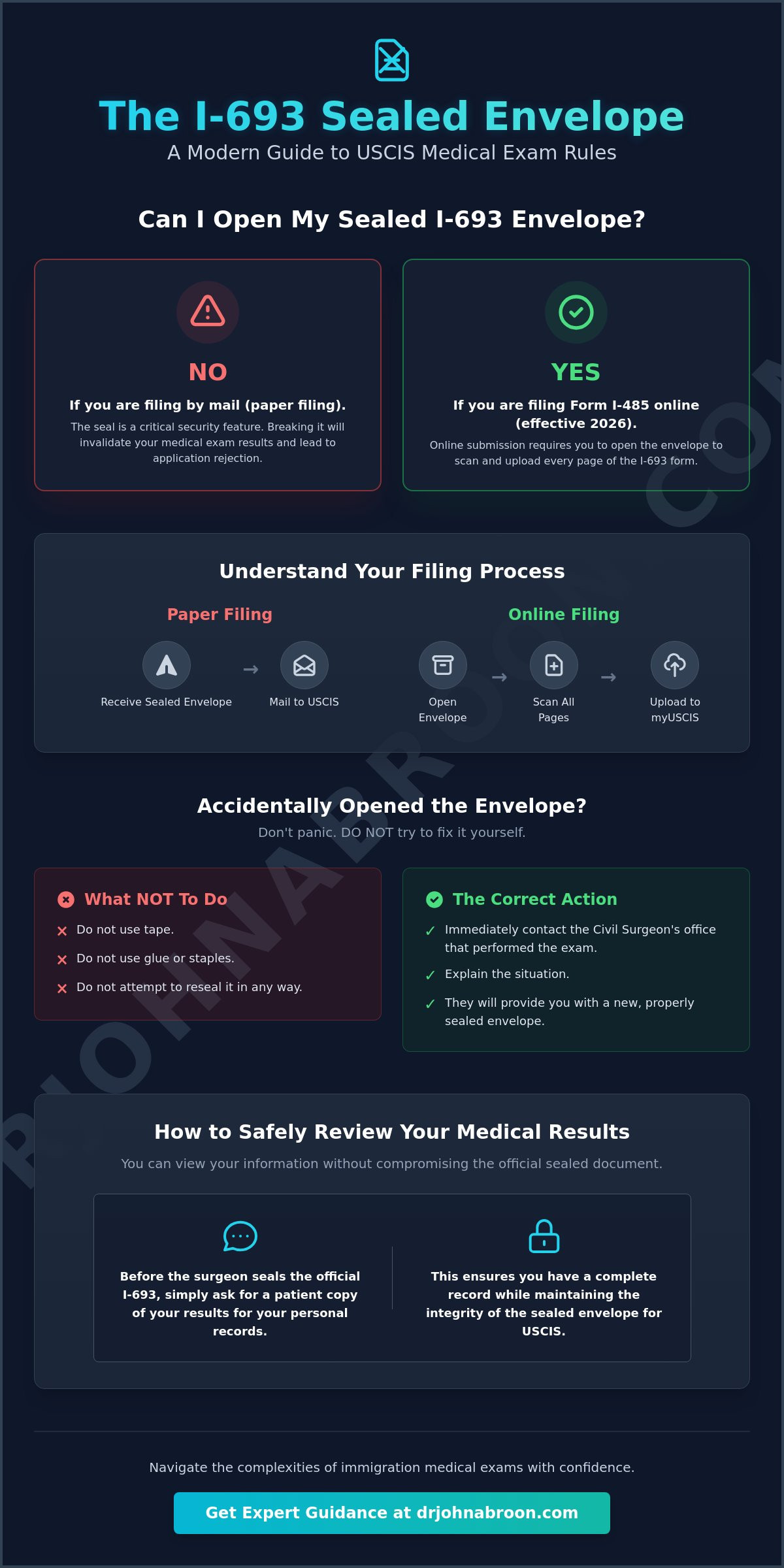
For decades, the sealed envelope was an untouchable relic of the immigration process. However, as of June 2026, the landscape has shifted to accommodate digital efficiency. If you’re an employment-based applicant filing your Form I-485 online, the strict prohibition against opening your medical results no longer applies in the same way. In fact, if you choose the digital route, you’re required to break the seal to facilitate the transition to a paperless system. This is a significant departure from traditional mail-in protocols where the envelope must remain closed to be valid. Many patients now ask, “Can I open sealed I-693 envelope USCIS?” and the answer is a definitive yes, provided you’re utilizing the myUSCIS online portal.
The core of this exception lies in the need for a high-quality digital record. When you file online, you must scan every page of your medical report. This process naturally requires you to open the physical envelope. It’s vital to remember that while the seal is broken, the document’s legal weight remains. USCIS may reject a Form I-485 application that doesn’t include a completed Form I-693, as per the policy change effective December 2, 2024. Ensuring you follow the correct protocol for your specific filing type is the best way to maintain the momentum of your application. If you have questions about which path is right for your health history, our team provides personalized guidance during Immigration Medical Exams to ensure your paperwork is flawless.
Filing Your I-693 Online via myUSCIS
When you open your envelope for an online filing, precision is your best ally. You’ll need to produce a high-resolution, multi-page PDF that captures every detail, including the civil surgeon’s signature and the clinic’s official stamps. USCIS officers must be able to verify these security markers digitally. Once the upload is complete, do not discard the physical documents. You must retain the original opened envelope and all its contents in a safe place. USCIS often requests the physical “tampered” original during your final interview to cross-reference it with the digital version you provided months earlier.
USCIS Rejections and Returned Envelopes
Sometimes, an envelope arrives back at your home already opened. This typically happens if USCIS rejects your entire application package for a clerical reason, such as a missing signature on a different form or an incorrect fee. If the immigration officer opened your medical results before realizing the package was incomplete, they will return the opened I-693 to you. In this specific scenario, you can often refile the same opened document. You must include the official USCIS rejection notice in your new submission package. This notice acts as your legal “hall pass,” explaining to the next reviewer why the medical seal was already broken by the government’s own hands.
Accidentally Opened Your I-693? Immediate Next Steps
Discovering that you’ve broken the seal on your medical results can feel like a major setback. You might worry that your entire application is now in jeopardy. Take a breath; it’s a fixable error. While the seal is a strict requirement for paper filings, accidentally opening it doesn’t mean your green card will be denied. It simply means you have a bit more administrative work to do. If you’ve been asking yourself, “Can I open sealed I-693 envelope USCIS?” after already peeling back the flap, the immediate answer is to stop what you’re doing and set the documents aside.
The most important rule in this situation is to avoid any DIY repairs. You should never attempt to glue, tape, or staple the envelope back together. USCIS officers are trained to spot even the most subtle signs of tampering. A resealed envelope that looks “homemade” acts as a red flag for fraud and will lead to an automatic rejection of the form. Instead, consult the official USCIS Form I-693 Information to confirm that the document must be submitted in the original, doctor-sealed envelope. Your next move is to contact the medical office that performed your exam to arrange for a formal replacement.
The Re-Sealing Process with Your Civil Surgeon
Returning to your original civil surgeon is the most efficient way to resolve a broken seal. In our Upper East Side office, John Abroon M.D. and his team handle these requests with the same clinical precision as the initial exam. We verify that the medical data in your file hasn’t changed since your visit. If everything is current, we can reprint the form and provide a fresh, signed, and sealed envelope. While there’s typically a nominal administrative fee for re-issuing and re-sealing the report, this small investment protects the integrity of your application. In Manhattan, this process is usually streamlined to ensure you don’t face significant delays in your filing timeline.
When a New Medical Exam is Required
In some cases, a simple re-seal isn’t an option. As of 2026, a signed Form I-693 is valid for two years from the date of the civil surgeon’s signature. If you opened an envelope from an exam performed over 24 months ago, you’ll need a completely new medical evaluation. Additionally, if the CDC has updated vaccination requirements since your original appointment, you may need to receive new immunizations before a fresh form can be signed. We carefully review your records to ensure all required tests and vaccines are within the acceptable window, saving you from a potential Request for Evidence (RFE) later in the process. Keeping your medical status current is a proactive step toward a successful immigration journey.
How to Review Your Medical Results Without Breaking the Seal
It’s entirely natural to feel a sense of curiosity or even apprehension about the contents of your medical report. These results play a pivotal role in your transition to permanent residency, and you want to ensure everything is accurate. While you might wonder, “Can I open sealed I-693 envelope USCIS to check for mistakes?” doing so would unfortunately invalidate the document for paper filings. Fortunately, you don’t have to choose between document security and your peace of mind. As a patient, you have a legal right to access your medical records; this includes a full copy of your completed Form I-693.
We recommend that every applicant maintains a personal copy of their results. This “Patient Copy” is identical in content to the “USCIS Copy” but lacks the official seal required for submission. Having this record allows you to verify the accuracy of the data before the official version is finalized and sent. Beyond the immigration process, these records are invaluable for your personal health history. They provide a clear timeline of your immunizations and diagnostic tests. This information is often useful for future employment, travel medicine, or general wellness tracking throughout your life.
Requesting Your Personal Copy from the Clinic
The ideal time to secure your copy is during your final consultation with the civil surgeon. At our practice, we believe in transparency and patient empowerment. We provide a clear, legible version of your results, whether you prefer a traditional paper document or a digital PDF for your records. This ensures you can cross-reference the data with your own vaccination history. If you’re ready to complete your process with a team that prioritizes your total well-being, you can schedule your immigration medical exam with our Upper East Side experts today.
What to Check on Your Personal Copy
Once you have your copy in hand, take a moment to review the technical details with a focused eye. This proactive step helps catch minor clerical oversights that could trigger a Request for Evidence (RFE). A few minutes of review can prevent months of processing delays.
- Vaccination Records: Ensure every date is legible and matches your original records exactly.
- Class Designations: Check for “Class A” or “Class B” notations. Class A indicates a condition that might require a waiver, while Class B refers to physical or mental conditions that require documentation but don’t necessarily bar entry.
- Official Credentials: Verify that the civil surgeon’s signature and license information are clearly visible on the final page of the form.
Reviewing these points ensures that when you finally submit your sealed envelope, you do so with the confidence that the information inside is both accurate and complete. It transforms a stressful requirement into a manageable part of your health journey.
Expert USCIS Medical Exams in NYC: The John Abroon M.D. Advantage
John Abroon M.D. brings decades of medical expertise as a board-certified internist to the heart of the Upper East Side. His practice is built on a foundation of clinical authority and personalized care, ensuring that every patient feels supported throughout their immigration journey. When you’re managing a complex application, the last thing you should worry about is a clerical error. John Abroon M.D. personally oversees both the clinical evaluations and the final documentation, creating a streamlined I-693 process designed for maximum speed and scientific accuracy.
By choosing an experienced civil surgeon, you eliminate the common uncertainties that lead to questions like “Can I open sealed I-693 envelope USCIS?” Our team ensures your documents are prepared precisely according to the latest 2026 federal guidelines. We handle the technical details so you can focus on your future. Our Manhattan facility is fully equipped to manage all required diagnostic testing and blood work in a single location, providing a level of convenience that’s rare in a busy urban environment. This centralized approach reduces the risk of lost records and ensures your results are processed with the highest level of professional oversight.
A Concierge Approach to Immigration Healthcare
We provide a concierge-like experience that prioritizes your total well-being over mere symptom management. Unlike larger, impersonal clinics where you might feel like just another file, John Abroon M.D. provides direct, professional attention to ensure your envelope is perfectly sealed and USCIS-ready. Because we conduct all necessary diagnostic testing in-office, you avoid the stress of traveling to various laboratories across NYC. Seeing a top-rated Manhattan internist for your civil surgeon needs means you receive high-end medical care and administrative perfection in one seamless visit. This steady, reliable approach is why so many individuals in the metropolitan medical community trust us with their high-stakes documentation.
Booking Your Appointment on the Upper East Side
Preparing for your visit is a straightforward process designed to empower you. To ensure a fast turnaround for your I-693, please bring your government-issued photo ID, your complete vaccination records, and any relevant medical history to our office. Having these documents ready allows our team to move efficiently through the evaluation. We understand the time-sensitive nature of immigration filings and offer scheduling options that reflect the urgency of your journey. Schedule your USCIS medical exam with John Abroon M.D. today to take the next confident step toward your residency goals with a trusted expert by your side.
Finalizing Your Path to Residency with Confidence
Your medical documentation is more than just a legal requirement; it’s a critical component of your future in the United States. We’ve clarified that the answer to Can I open sealed I-693 envelope USCIS depends entirely on whether you’re filing through the digital portal or a traditional mail-in process. By understanding the 2026 online filing exceptions and exercising your right to a personal patient copy, you ensure your application remains both accurate and secure. If an accident occurs and a seal is broken, remember that professional re-sealing is the only acceptable solution to avoid avoidable delays or rejections.
Since 1997, Dr. John Abroon has served as an authorized USCIS Civil Surgeon, providing the metropolitan community with elite medical expertise. As a Board-Certified Internist on the Upper East Side of Manhattan, he offers a concierge approach that transforms complex immigration health requirements into a steady, supportive experience. Don’t leave your application to chance. Book Your USCIS Immigration Medical Exam in NYC with Dr. Abroon today and move forward with the peace of mind that comes from decades of dedicated clinical excellence. Your success is our priority, and we’re here to support every step of your health journey.
Frequently Asked Questions
What happens if I open the I-693 envelope by mistake?
Opening the envelope by mistake invalidates the document for all paper-based submissions. You’ll need to return to your civil surgeon to have the form reprinted, signed, and re-sealed in a new envelope. Most offices can facilitate this process quickly by referencing your existing medical file, though there is typically a small administrative fee for the replacement materials and professional time.
Can I scan the I-693 form before I send it to USCIS?
You can only scan the document if you’re filing your Form I-485 online through the myUSCIS portal. For digital filings, you’re actually required to open the envelope to produce high-resolution scans of every page. If you’re filing by mail, however, you must never open the seal to scan the contents, as a broken seal will lead to an immediate rejection of your medical report.
Does the USCIS medical exam envelope expire?
The medical results inside the envelope remain valid for two years from the date of the civil surgeon’s signature. While the physical envelope doesn’t have an expiration date, the clinical data must be current. If your green card process lasts longer than 24 months, you’ll likely need a new exam to ensure your health information meets the latest federal requirements.
How do I know if my I-693 envelope is properly sealed?
A properly prepared envelope features the civil surgeon’s signature written directly across the back flap. You should also see the clinic’s official stamp overlapping the flap and the body of the envelope. These overlapping markers are essential security features that prove the document hasn’t been tampered with since the doctor finalized your results.
Can my lawyer open the sealed medical envelope?
No, your lawyer shouldn’t open the sealed medical envelope for paper-based applications. The same strict USCIS rules apply to legal counsel as they do to the applicant. If your attorney needs to verify the information for your case file, they should use the unsealed “Patient Copy” that our office provides to you during your appointment.
Will USCIS accept an I-693 if the seal is slightly torn?
USCIS is incredibly strict regarding document integrity and will likely reject an envelope with a torn or compromised seal. Even a minor tear can be interpreted as a sign of tampering. To avoid the stress of a Request for Evidence (RFE), it’s best to have your civil surgeon re-issue the envelope if you notice any physical damage before mailing your package.
Do I need to bring my own envelope to the civil surgeon’s office?
You don’t need to bring any stationery to your appointment. Our office provides the official, heavy-duty envelopes required for the I-693 process. These envelopes are specifically chosen to meet USCIS security standards and are signed and stamped by Dr. Abroon personally to ensure they’re ready for official submission.
How can I get a copy of my I-693 for my own records?
You can easily get a copy of your results by asking our staff for a “Patient Copy” during your final consultation. We believe you should always have access to your medical data. This unsealed version allows you to review your findings and ask, “Can I open sealed I-693 envelope USCIS?” with the confidence that you already have a personal record of everything inside the official version.