


What if the only thing standing between you and your green card isn’t your eligibility, but a simple clerical error on a medical document? For many applicants in 2026, the path to permanent residency is paved with complex paperwork, yet the medical exam remains one of the most misunderstood hurdles. It’s completely natural to feel anxious about missing vaccination records or finding a qualified USCIS civil surgeon in the heart of Manhattan. You’ve invested significant time and emotion into your application, and the last thing you want is an avoidable Request for Evidence (RFE) because of common mistakes on i-693 form.
We recognize that your health and your immigration status are deeply personal matters that require a sophisticated, clinical touch. John Abroon M.D. provides the specialized expertise needed to navigate these high-stakes requirements with ease. This guide will empower you with the knowledge to ensure your medical exam is handled with the administrative precision USCIS demands. You’ll learn how to navigate the newest form edition requirements, manage the concurrent filing mandate, and secure a perfectly sealed envelope. By focusing on these critical details, you can transform a high-stakes medical requirement into a smooth, stress-free step toward your future in the United States.
Key Takeaways
- Identify why using the correct 01/20/25 form edition and maintaining a pristine, sealed envelope is critical for immediate USCIS acceptance.
- Understand the 2026 vaccination mandates and why the QuantiFERON-TB Gold (IGRA) test has become a non-negotiable requirement for your medical clearance.
- Learn how to spot common mistakes on i-693 form filings, such as missing signatures or slight discrepancies in your A-Number, before they trigger a costly Request for Evidence.
- Discover a simple, step-by-step verification checklist to use at the doctor’s office to ensure every field is completed with clinical precision.
- Explore the benefits of a concierge-style medical exam on the Upper East Side that prioritizes personalized care over high-volume processing.
Why Form I-693 Errors Lead to Costly USCIS Delays
The Form I-693 serves as a vital component of your Adjustment of Status application. While many view it as a routine physical, USCIS treats it as a legal certification of your admissibility. In 2026, the agency has increased its administrative scrutiny, meaning even minor common mistakes on i-693 form filings can trigger a Request for Evidence (RFE). An RFE effectively halts your application processing until the discrepancy is resolved. Understanding the difference between a medical disqualification, which involves specific health findings, and a clerical rejection, which stems from missing data or signatures, is essential for a smooth journey.
The current regulatory environment requires a higher level of precision than in previous years. Since the implementation of concurrent filing mandates in late 2024, a flawed medical report doesn’t just delay an interview; it can jeopardize the initial acceptance of your entire green card package. This shift underscores why the medical exam is now considered a high-stakes administrative hurdle rather than a simple check-up.
The Financial and Emotional Cost of an RFE
Receiving an RFE isn’t just a minor inconvenience. It’s a significant setback that carries a heavy emotional and financial toll. When USCIS identifies an error, they pause your entire file, which creates a cascading effect on your timeline. This often leads to unexpected burdens, such as:
- Increased legal fees as your attorney must draft and file a formal response to the notice.
- The potential cost of a second medical exam if the original form is deemed invalid or the civil surgeon cannot correct the error.
- Significant anxiety regarding your work permit (EAD) or travel authorization (Advance Parole), as these are often tied to the steady progress of your I-485.
A single missing date or an unsealed envelope can add three to six months of waiting to a process that already requires immense patience. When your future in the United States is on the line, these administrative pauses feel like an eternity.
USCIS Admissibility: More Than Just Health
The medical exam is designed to screen for health-related grounds of inadmissibility, ensuring that applicants don’t pose a risk to public health. This includes screening for communicable diseases and verifying that you won’t become a public charge due to extensive, unmanaged medical needs. Because these regulations are so specific, your choice of civil surgeon is a strategic legal decision. You need an expert who treats the paperwork with the same clinical rigor they apply to the diagnostic testing. Avoiding common mistakes on i-693 form requires a practitioner who understands that a perfectly completed form is just as important as a clean bill of health.
The Administrative “Big Three”: Form Versions, Signatures, and the Sealed Envelope
Precision is just as important as pathology when it comes to your green card application. While the medical exam assesses your physical health, the administrative processing of the document is where most applicants stumble. These common mistakes on i-693 form submissions often involve the physical integrity of the document or the specific version of the form used. If these clerical details aren’t handled with clinical accuracy, the medical findings won’t even be considered.
Confirming the Correct Form Edition
USCIS frequently updates its forms to reflect new policy changes. As of August 2026, the 01/20/25 edition is the mandatory version for your filing. If a civil surgeon uses an outdated edition, the officer will reject the medical report immediately without reviewing the clinical findings. You can always verify the current version by reviewing the official Form I-693 instructions on the government website. At the practice of Dr. John Abroon, we maintain rigorous administrative standards to ensure every patient receives the most current documentation, preventing unnecessary delays before they start.
The Sealed Envelope Protocol
The most sacred rule of the immigration medical exam is the integrity of the sealed envelope. Once the civil surgeon signs the form, they must place it in an envelope and seal it. You must never open this envelope. If the seal is broken or shows signs of tampering, USCIS will consider the document invalid and return it. Many patients accidentally open the envelope out of curiosity or a desire to double-check their details. To avoid this trap, we provide a full photocopy of your completed form for your personal records. This allows you to review every entry with your attorney while keeping the official version pristine for the USCIS officer.
The “Signature Gap” is another frequent pitfall that leads to rejections. Both the applicant and the civil surgeon must sign and date the form in the correct fields. While the old “60-day rule” was eliminated in late 2024 to simplify the timeline, the requirement for complete, legible signatures remains absolute. Additionally, you must ensure that every page of the form is present and correctly numbered. A single missing page from the middle of the packet is enough to trigger a Request for Evidence. If you want to ensure your paperwork is handled with this level of concierge-level detail, consider scheduling your immigration medical exams with a seasoned expert who understands the nuances of the law.
Medical and Vaccination Pitfalls: Avoiding Incomplete Records
Clerical errors are frustrating, but clinical oversights are often more complex to resolve. While a missing signature might be fixed with a quick trip to the office, a missing lab result or an outdated vaccination record requires new medical action. These common mistakes on i-693 form submissions frequently occur when a practitioner isn’t fully immersed in the latest CDC technical instructions. Ensuring your medical history aligns perfectly with current federal requirements is the only way to avoid the dreaded Request for Evidence.
Navigating Vaccination Requirements
The list of required vaccinations for 2026 is specific and varies based on your age and the time of year. For instance, seasonal influenza is mandatory if your exam takes place during the flu season, which runs from September 1 through March 31. It is also important to clarify that as of March 11, 2025, the COVID-19 vaccination is no longer a requirement for immigration purposes. We focus on distinguishing between “age-appropriate” vaccines and those strictly required by the USCIS Form I-693 Instructions. If you have missing childhood records, we help you determine if a titer test can prove immunity or if a booster is necessary. In cases where a vaccine is medically contraindicated, we provide the specific documentation required for a waiver, ensuring your health and your application remain protected.
Diagnostic Accuracy and Lab Timelines
The “TB Testing Trap” remains a leading cause of application delays. Many applicants are unaware that USCIS no longer accepts the traditional Tuberculin Skin Test (PPD). Today, a blood-based Interferon-Gamma Release Assay (IGRA) is mandatory for most individuals. Relying on outdated skin tests is a guaranteed way to trigger a rejection. We utilize the QuantiFERON-TB Gold test to provide the precise, high-level diagnostic data that immigration officers expect.
Beyond tuberculosis, your exam must include accurate screenings for Syphilis (RPR) and Gonorrhea. Discrepancies often arise when clinics send samples to external labs that don’t understand the strict USCIS-required timeframes. By performing our diagnostic testing in-house on the Upper East Side, we maintain complete control over the integrity of your results. This personalized approach ensures that your lab work matches your medical history exactly, preventing the inconsistencies that lead to administrative scrutiny. We treat every blood draw and lab report with the same clinical rigor we apply to our most complex medical evaluations, giving you total peace of mind.
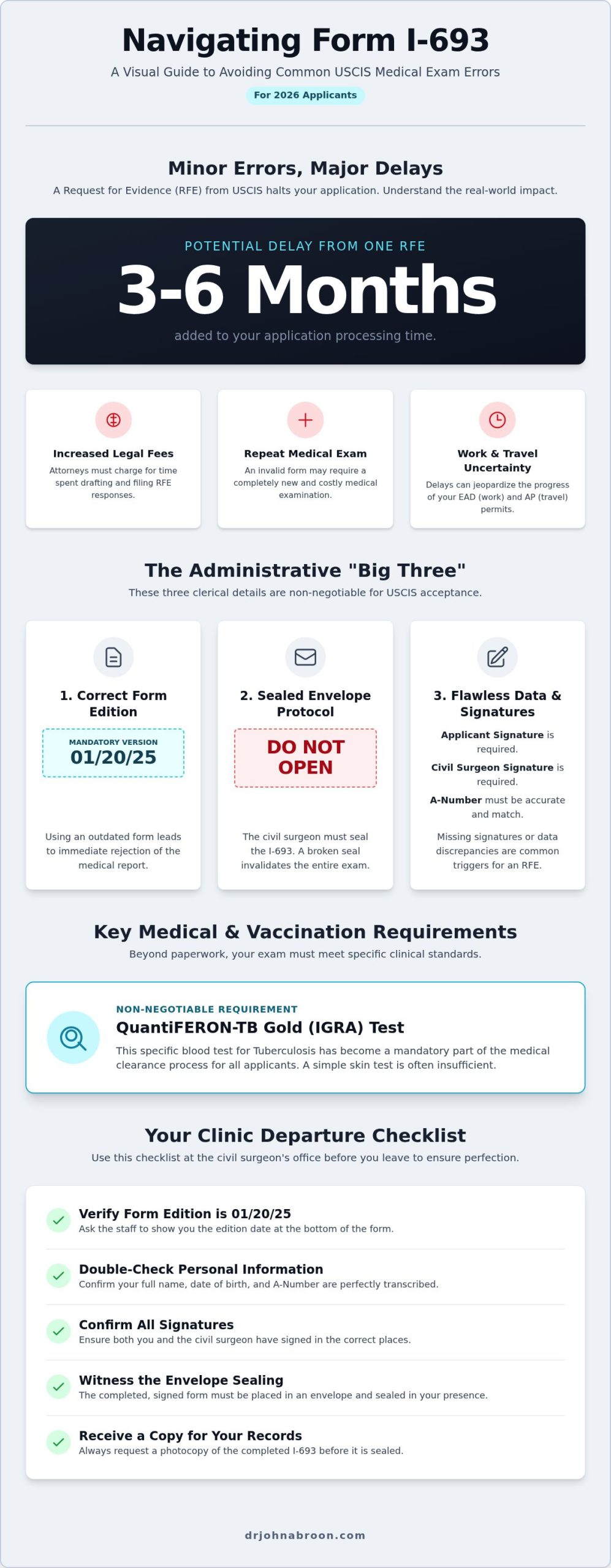
I-693 Checklist: What to Verify Before Leaving the Clinic
Once the civil surgeon seals the envelope, your opportunity to catch errors vanishes. This is why a proactive “pre-seal” audit is your best defense against common mistakes on i-693 form filings. You must verify that your name, date of birth, and A-Number match your passport and I-485 application exactly. Even a transposed digit in your A-Number can lead to a rejection. Check the vaccination table specifically; every row must have an entry or a valid waiver code. Blank boxes are one of the most frequent triggers for an RFE because they suggest the medical evaluation was incomplete.
The Patient Audit: Reviewing Your Copy
Before the final documents are placed in the official envelope, request a draft copy for a final review. This step is a hallmark of a high-end medical practice that prioritizes your success. Look closely at your address and passport number for typos. You should also confirm that the “Summary of Medical Examination” in Part 10 is marked correctly. Ensure the civil surgeon’s official stamp is clear and legible. Most importantly, don’t forget the “Part 2” signature. While it seems obvious, many applicants overlook their own signature in the rush of the appointment, which is a mistake USCIS will not overlook.
Timing Your Submission
Navigating the timeline of your application requires strategic planning. The former “60-day rule,” which required the doctor’s signature to be dated within 60 days of filing the I-485, has been eliminated. This simplifies your schedule significantly. Your completed I-693 is now valid for two years from the date of the civil surgeon’s signature. However, since concurrent filing became mandatory on December 2, 2024, you must have your medical results ready at the same time you submit your adjustment of status. For a deeper look at how to coordinate these dates, read our guide on the Immigration Medical Exam in NYC: Your Complete Guide to the I-693 Process.
Administrative precision is the foundation of a successful application. If you’re looking for a partner who values accuracy as much as you do, you can schedule your medical evaluation with our Upper East Side team today. We ensure every detail is checked twice so your envelope is perfect the first time. Our personalized approach removes the guesswork from the process, allowing you to move forward with absolute confidence in your documentation.
Expert USCIS Medical Exams in NYC: The John Abroon M.D. Advantage
Selecting a civil surgeon is more than a logistical necessity; it’s a strategic step in your immigration journey. While high-volume clinics often treat medical exams like an assembly line, our Upper East Side practice provides a concierge experience rooted in nearly 30 years of clinical excellence. John Abroon M.D. has served as a USCIS-designated civil surgeon since 1997. As a board-certified internist, he brings a level of diagnostic depth that high-volume centers simply cannot match. This expertise is your best defense against common mistakes on i-693 form submissions, as we treat your paperwork with the same precision we apply to complex medical diagnoses.
Our facility is designed to minimize the stress of the process. By offering in-office diagnostic testing, including EKGs and lab work, we eliminate the need for you to visit multiple locations. This streamlined approach doesn’t just save time. It ensures that every piece of data in your report is verified for accuracy before it’s entered into the final document. We understand that in the competitive New York medical landscape, reliability and personalized care are what patients value most.
A Personalized Approach to Immigration Health
Every applicant’s medical history is unique, and some require more than a standard check-up. John Abroon M.D. specializes in handling complex cases, including those that involve missing records or specific waiver requests. His background as a Primary Care Physician NYC: Comprehensive Internal Medicine on the Upper East Side allows him to view your immigration exam through the lens of global health and total well-being. He takes the time to listen, ensuring that any medical contraindications are documented with the clinical authority USCIS requires. This personalized attention prevents the generic errors that often lead to RFEs in high-volume settings.
Booking Your Appointment on the Upper East Side
To ensure a mistake-free form, come prepared to your first visit. You’ll need your passport, any available vaccination records, and your A-Number. Our team will guide you through the 2026 requirements, including the mandatory IGRA blood test and current seasonal mandates. We understand that your timeline is critical. Most patients receive their perfectly sealed I-693 envelope within a few business days of their results being finalized, allowing you to meet your filing deadlines with absolute confidence.
Don’t leave your future to chance or an administrative oversight. Secure your green card future. Schedule your USCIS medical exam with John Abroon M.D. today. We’re committed to providing the steady, reliable care you need to move forward in your adjustment of status journey.
Securing Your Path to Permanent Residency
Navigating the adjustment of status process requires both clinical health and administrative precision. By following the strategic protocols discussed, from verifying the latest form edition to ensuring the envelope remains sealed, you can move forward with absolute confidence. Avoiding common mistakes on i-693 form filings isn’t just about following instructions; it’s about partnering with a medical expert who treats your application with the legal and clinical rigor it deserves.
At our Upper East Side Manhattan office, we provide a concierge-level experience that prioritizes your success and peace of mind. John Abroon M.D., a Board-Certified Internal Medicine Specialist and USCIS Civil Surgeon since 1997, brings nearly three decades of specialized expertise to every evaluation. We handle the complex details so you can focus on your future in the United States. Don’t let a clerical error delay your dreams. Book Your USCIS Immigration Medical Exam in NYC today and take the final step toward your green card with a trusted professional by your side. Your journey toward permanent residency is within reach, and we’re here to ensure it’s a smooth one.
Frequently Asked Questions
Can I open the sealed I-693 envelope if I want to make a copy?
No, you must never open the sealed envelope provided by your civil surgeon. If the seal is broken or tampered with, USCIS will reject the form immediately. To avoid this and other common mistakes on i-693 form filings, our practice provides you with a complete personal copy of the document before the official version is sealed. This allows you to review your results with your attorney while keeping the submission packet pristine.
What happens if the civil surgeon uses the wrong form version?
USCIS will reject your medical report if it is submitted on an outdated edition of the form. As of August 2026, the 01/20/25 edition is the mandatory version for all new filings. Administrative precision is just as vital as your clinical results. We maintain rigorous protocols to ensure every patient receives the most current documentation, preventing the unnecessary delays that stem from using expired paperwork.
Does USCIS require the COVID-19 vaccine for the medical exam in 2026?
No, the COVID-19 vaccination is no longer a requirement for immigration medical exams as of March 11, 2025. While other immunizations such as Polio, MMR, and Hepatitis B remain mandatory, you don’t need proof of COVID-19 vaccination for your 2026 application. We stay current with all CDC and USCIS policy shifts to ensure your vaccination record is exactly what the government requires for approval.
How do I know if my doctor is a USCIS-certified civil surgeon?
You can confirm a physician’s status by using the official “Find a Civil Surgeon” tool on the USCIS website. It’s essential to verify this designation before your appointment, as results from a non-certified doctor will not be accepted. Dr. Abroon has been a designated civil surgeon since 1997, offering nearly 30 years of trusted expertise to the New York City metropolitan community.
What is the most common reason for an I-693 Request for Evidence (RFE)?
The most frequent cause for an RFE is an incomplete form, such as missing signatures or blank boxes in the vaccination table. These common mistakes on i-693 form submissions usually occur in high-volume clinics where details are overlooked. Choosing a concierge-style practice ensures that a board-certified internist reviews every field for accuracy, providing the clinical authority needed to move your application forward without interruption.
Is a TB skin test (PPD) still accepted for the green card medical exam?
No, the traditional Tuberculin Skin Test is no longer accepted for the majority of applicants. USCIS now requires an Interferon-Gamma Release Assay (IGRA) blood test, such as the QuantiFERON-TB Gold. This modern diagnostic tool is more accurate and is a mandatory requirement for your medical clearance. We perform this testing in-house on the Upper East Side to ensure your results are precise and processed quickly.
Can I use vaccination records from my home country if they are not in English?
Yes, you can use foreign vaccination records, but they must be accompanied by a certified English translation. The translator must provide a signed statement confirming their fluency and the accuracy of the translation. Bringing these translated documents to your visit allows us to credit your existing immunizations accurately and helps you avoid the cost and discomfort of receiving unnecessary booster shots during your exam.
How long is the I-693 medical exam valid once signed by the doctor?
A completed Form I-693 is valid for two years from the date of the civil surgeon’s signature. Since the implementation of mandatory concurrent filing in late 2024, you must submit your medical results at the same time as your I-485 application. This two-year validity period provides a reliable window for USCIS to process your green card without requiring you to undergo a second medical evaluation.