


A concierge membership buys a closer primary-care relationship, not simply a faster appointment. In this model, patients pay an annual fee or retainer for enhanced care, and concierge physicians typically care for fewer patients and are more readily available to members, according to the U.S. Government Accountability Office. Searching for a concierge doctor on call 24/7 in NYC means looking beyond the promise of access: the plan’s scope, services, and access arrangements shape what it provides. Pricing depends on those factors and is given after a quote request.
It’s reasonable to want clearer answers before committing to a membership, especially when the term “24/7” can mean different things in practice. This guide explains what concierge medicine involves, how access and appointments work, what can shape plan pricing, and what to consider when deciding whether this model suits your needs.
Key Takeaways
- Learn what concierge medicine typically changes about the relationship with a primary-care physician and how direct access fits into that model.
- Understand what same-day or next-day appointments mean and which access details to examine when comparing care arrangements.
- See how membership structure and included services shape a concierge plan, so you can assess what the arrangement is designed to provide.
- Explore the factors behind plan pricing and how an annual physical can support a more informed view of your health needs.
What is concierge medicine?
Concierge medicine pairs primary care with a membership relationship and closer physician access. According to the U.S. Government Accountability Office, concierge physicians typically care for fewer patients than conventional doctors and are more readily available to members, including by cell phone or same-day visits. A search for a concierge doctor on call 24/7 in NYC should focus on the plan’s actual access arrangements, not the label alone.
Direct Physician Access Channels
Round-the-clock access describes when and how a member can reach a physician; it doesn’t by itself explain response times or the care available remotely. Compare the stated channels, such as phone, email, or text, and note whether they connect you with a physician or a care team. For example, a plan can distinguish urgent concerns from routine questions and explain how each is handled. These details help clarify what direct access means outside office visits.
Specialist and Hospital Access
Specialist and hospital access depends on how primary care connects with other parts of the health system. Review how referrals, records, and follow-up are coordinated when a specialist visit or hospital evaluation becomes relevant. In Manhattan, this can matter when care involves several clinicians or a transition from hospital back to primary care. Direct physician access can support continuity, while specialist treatment and hospital services remain separate parts of the care pathway.
Practice Models and Credentials
Concierge medicine, direct primary care, and traditional practices differ in membership structure, access channels, and included visits. Compare these features side by side, including how each handles travel, referrals, and after-hours communication. To check a physician’s New York license and credentials, use the official state physician license lookup with the doctor’s full name, then compare the listing with the certifying board’s directory. Make sure the name and specialty match the physician you’re considering.
Same-day and next-day appointments
Same-day access can help address a new concern before it disrupts work or travel. The U.S. Government Accountability Office notes that concierge physicians may be more readily available to members, including through same-day appointments. Next-day scheduling is a different arrangement. Consider how the practice handles routine visits, urgent concerns, and requests outside regular scheduling hours.
In New York City, look for a concierge practice that clearly describes its arrangements for urgent care, telehealth, and hospital visits. These services are distinct: a video appointment may support an initial assessment, while other concerns may require an in-person visit or hospital evaluation.
Scheduling hours affect how quickly you can arrange an appointment. Review the practice’s process for booking during office hours and reaching the care team after hours. For a new but non-emergency symptom, for example, you should know whether to request an office visit, book a telehealth appointment, or use the practice’s designated contact channel. Clear instructions make personalized access easier to use.
Telemedicine connects patients and physicians remotely when an in-person examination isn’t necessary. Find out which concerns can be addressed by video or phone, how follow-up works, and when an in-person assessment may be recommended. These details are especially relevant during travel, when getting to a Manhattan office may be difficult, and clarify what enhanced access means in practice.
If your concierge physician is unavailable during a medical emergency, don’t wait for a routine appointment or return message. For severe or rapidly worsening symptoms, seek emergency care at a hospital. For a non-emergency concern, use the practice’s designated backup contact or scheduling route. Knowing the difference supports a reliable physician relationship without treating every urgent appointment as an emergency.
To explore care options in New York City, review the practice’s available information.
Concierge medicine membership model
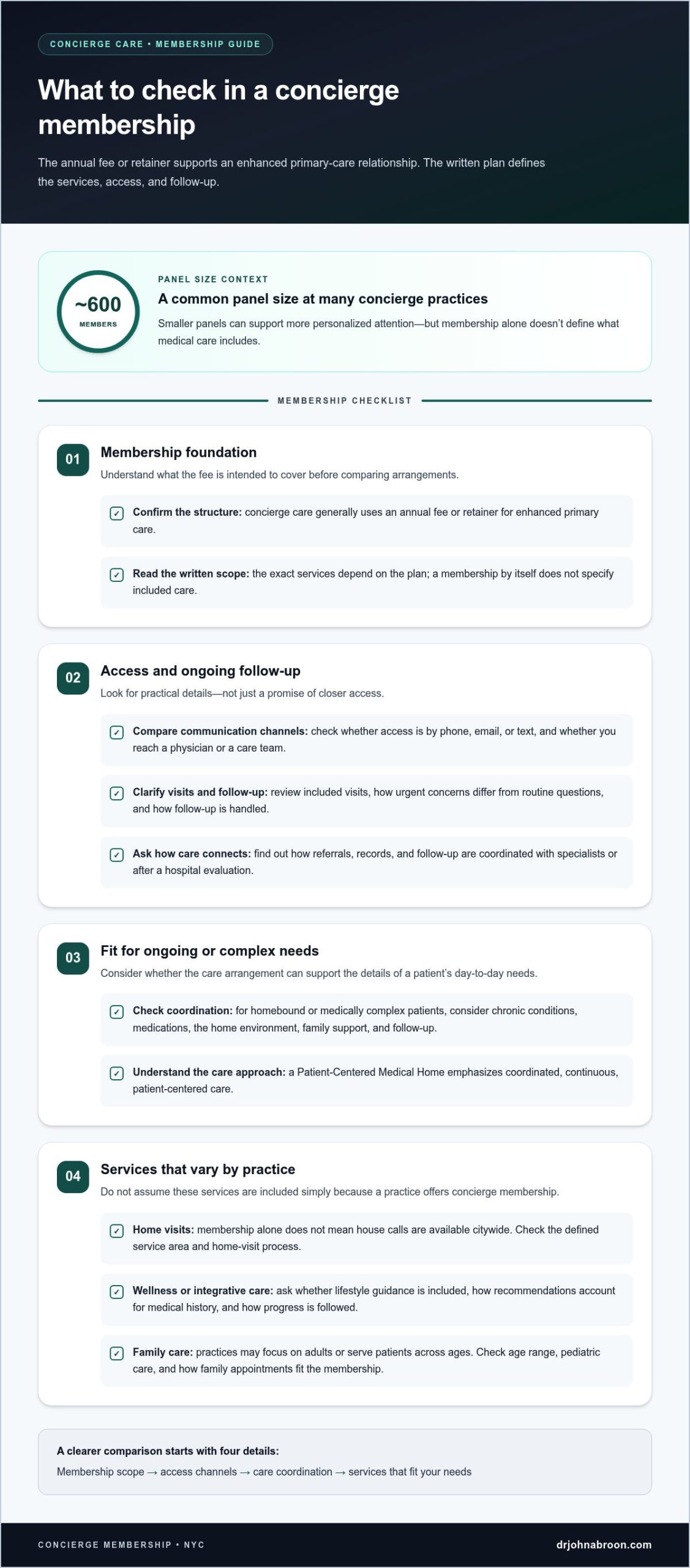
Concierge medicine generally uses an annual fee or retainer for enhanced primary care. The membership may shape access and the ongoing physician relationship, while the exact services depend on the plan. About 600 members per physician is a common panel size at many concierge practices. A smaller panel can support more personalized attention, but membership alone doesn’t define what medical care includes. Review the written scope, communication channels, visits, and follow-up process before comparing plans.
For a homebound or medically complex patient, practical fit depends on how the care model addresses chronic conditions, medications, the home environment, family support, and follow-up. These are also central to a Patient-Centered Medical Home approach, which emphasizes coordinated, continuous, patient-centered care. A patient managing several prescriptions, for example, may benefit from a care plan that keeps medication information and follow-up needs organized across visits.
Are house calls available from concierge doctors throughout NYC? A concierge membership alone doesn’t mean house calls are available citywide. Home visits are a distinct care arrangement, so the plan’s defined service area and home-visit process determine whether they meet a patient’s needs.
Wellness coaching and integrative medicine can mean different things from one practice to another. Look for specifics: whether care includes lifestyle guidance, how recommendations account for medical history, and how progress is followed over time. A patient working on sleep or nutrition, for instance, should know whether those goals are addressed during primary-care visits or through a separate service.
Family care varies by practice: some focus on adults, while others may serve patients across ages. Find out how age range, pediatric care, and family appointments fit the membership. Parents considering one physician relationship for the household should compare those details with virtual access, in-person visits, and care coordination for each family member.
Concierge plan pricing
Concierge plan pricing reflects the care arrangement, not just the physician’s appointment calendar. Patients generally pay an annual fee or retainer for enhanced primary care. The specific price depends on the case and is provided after a quote request. Relevant factors include the membership’s scope, access arrangements, and included services. Compare these details before deciding whether a plan fits your needs.
Start by separating membership benefits from services billed or arranged separately. Review whether the program describes routine visits, urgent concerns, same-day appointments, screenings, and follow-up. A clear outline shows what the annual arrangement is designed to cover, rather than leaving you to assume every clinical service is included. For example, ask how a routine preventive visit differs from an urgent evaluation under the plan.
Next, consider which access features matter in your daily life. A frequent traveler may value virtual communication, while someone with mobility challenges may prioritize a house-call arrangement. Stated hours, contact channels, and the approach to after-hours concerns all affect how accessible care feels. These practical details are more useful than a broad promise of availability because they show how care works in specific situations.
Finally, compare the plan’s structure with the care you expect to use. Consider whether the physician provides ongoing primary-care coordination, how referrals are handled, and what happens when a concern needs an in-person assessment. A list of included services and separate charges makes the comparison clearer. If urgent care or additional screenings matter to you, account for their place in the overall arrangement rather than relying on the membership label alone.
To discuss concierge care and request a quote based on your needs, request a concierge medicine quote.
John Abroon M.D: Annual Physical Exams
John Abroon M.D. offers Annual Physical Exams to help patients review their health and discuss preventive care with a physician. An exam can be a useful next step if you want to raise health questions, review your medical history, or plan appropriate diagnostic testing. The practice also provides Immigration Medical Exams and Pre-operative Medical Clearances for patients with those specific needs. Each service serves a different purpose, so choose according to the medical task you need to complete. An annual exam offers a broader health review, while a pre-operative clearance supports assessment before surgery. If you need a structured primary-care visit rather than emergency treatment, an annual physical may be a suitable place to begin. Contact John Abroon M.D. to discuss an Annual Physical Exam.
Choose Care That Fits Your Next Step
The right primary-care relationship should support the decisions you’re making about your health, not just offer a reassuring label. Before choosing a concierge doctor on call 24/7 in NYC, consider what kind of care you need now and how you want to approach follow-up over time. A preventive visit, a medical requirement for immigration, and preparation before surgery call for different kinds of clinical support.
John Abroon M.D. offers Annual Physical Exams, Immigration Medical Exams, and Pre-operative Medical Clearances. These services can help you take a focused next step, whether you’re planning a health review or addressing a specific medical requirement. Begin with the care need that matters most to you.
Contact John Abroon M.D to discuss your care needs and take a thoughtful next step.
Frequently Asked Questions
Which NYC concierge doctors offer 24/7 on-call access?
A concierge membership must specifically include round-the-clock on-call access; the concierge label alone doesn’t guarantee it. John Abroon M.D. offers concierge medicine in New York City. Access arrangements define how members reach the physician, how urgent messages are routed, and what happens when an issue requires emergency services. Reviewing these details helps distinguish continuous access from routine appointment scheduling.
What does 24/7 concierge doctor availability include in New York City?
Availability describes access to medical guidance, but the exact services depend on the membership arrangement. The plan may explain how to contact the practice after hours and how the care team handles a concern that can’t wait for a routine visit. Remote guidance and an in-person assessment, for example, are different forms of care. The stated access terms clarify which is available.
How quickly can an on-call concierge doctor respond in NYC?
Response time depends on the contact channel, when the message is sent, and the clinical urgency. A concern that can be handled remotely differs from one that needs an examination or hospital evaluation. Use the plan’s stated response expectations as your benchmark. In an emergency, seek emergency care rather than waiting for a routine callback or appointment.
What are the membership fees for NYC concierge medicine practices?
Concierge memberships commonly use an annual fee or retainer rather than charging only for each primary-care visit. The fee depends on the case and is provided after a quote request. Factors include the membership’s scope, access arrangements, and included services. Compare what the plan covers and how it handles additional clinical services to assess the arrangement beyond its price.
How do NYC concierge doctors compare with direct primary care and traditional practices?
Concierge practices generally charge an annual fee or retainer for enhanced primary care and typically have fewer patients per physician, with greater member access. Concierge medicine, direct primary care, and traditional practices can differ in membership structure, access channels, and included visits. Compare those details alongside travel arrangements, referrals, and after-hours communication.