


The difference between a successful adjustment of status and a frustrating delay often comes down to a single date on your medical form. For many NYC applicants, the realization that their paperwork might be outdated causes immediate stress and a deep fear of potential denial. We understand that navigating shifting USCIS regulations is overwhelming, especially when you’ve already invested so much time and emotion into your immigration journey.
If you’re wondering what to do if i-693 expires, you aren’t alone. The rules surrounding medical exam validity changed significantly in 2025, and staying compliant is vital to avoiding a costly Request for Evidence. You deserve a clear, clinical perspective that replaces confusion with a concrete plan of action. Our goal is to provide the reassurance and expert guidance you need to handle these requirements with ease and confidence.
In this 2026 guide, we’ll explain the current validity rules for forms signed before and after the November 2023 cutoff. You’ll also learn about the newest form editions and the steps to secure a fast, professional medical update with a USCIS-designated civil surgeon on the Upper East Side. We’ll ensure you’re fully prepared for a successful interview without the burden of unnecessary paperwork delays.
Key Takeaways
- Understand the 2025 USCIS policy update that grants indefinite validity to forms signed on or after November 1, 2023.
- Discover exactly what to do if i-693 expires by checking your form’s edition date and the civil surgeon’s signature in Part 8.
- Learn how to navigate a Request for Evidence (RFE) and meet the standard 87-day deadline with a new, compliant medical report.
- Streamline your update process in Manhattan with a board-certified internist who provides in-office diagnostic testing for faster results.
- Ensure your adjustment of status remains on track by aligning your medical documentation with the latest 2026 USCIS filing requirements.
Understanding I-693 Validity: The 2026 USCIS Rules
The Form I-693, formally known as the Report of Immigration Medical Examination and Vaccination Record, serves as a vital clinical bridge between your personal health and your future in the United States. Its primary function is to confirm that an applicant does not fall under any health-related grounds of inadmissibility. For years, the two-year expiration clock was a source of significant anxiety for applicants facing long processing times. However, the current 2026 landscape reflects a more patient-centered approach from USCIS, focusing on clarity and reduced repetition of medical testing.
The November 1, 2023 Policy Shift
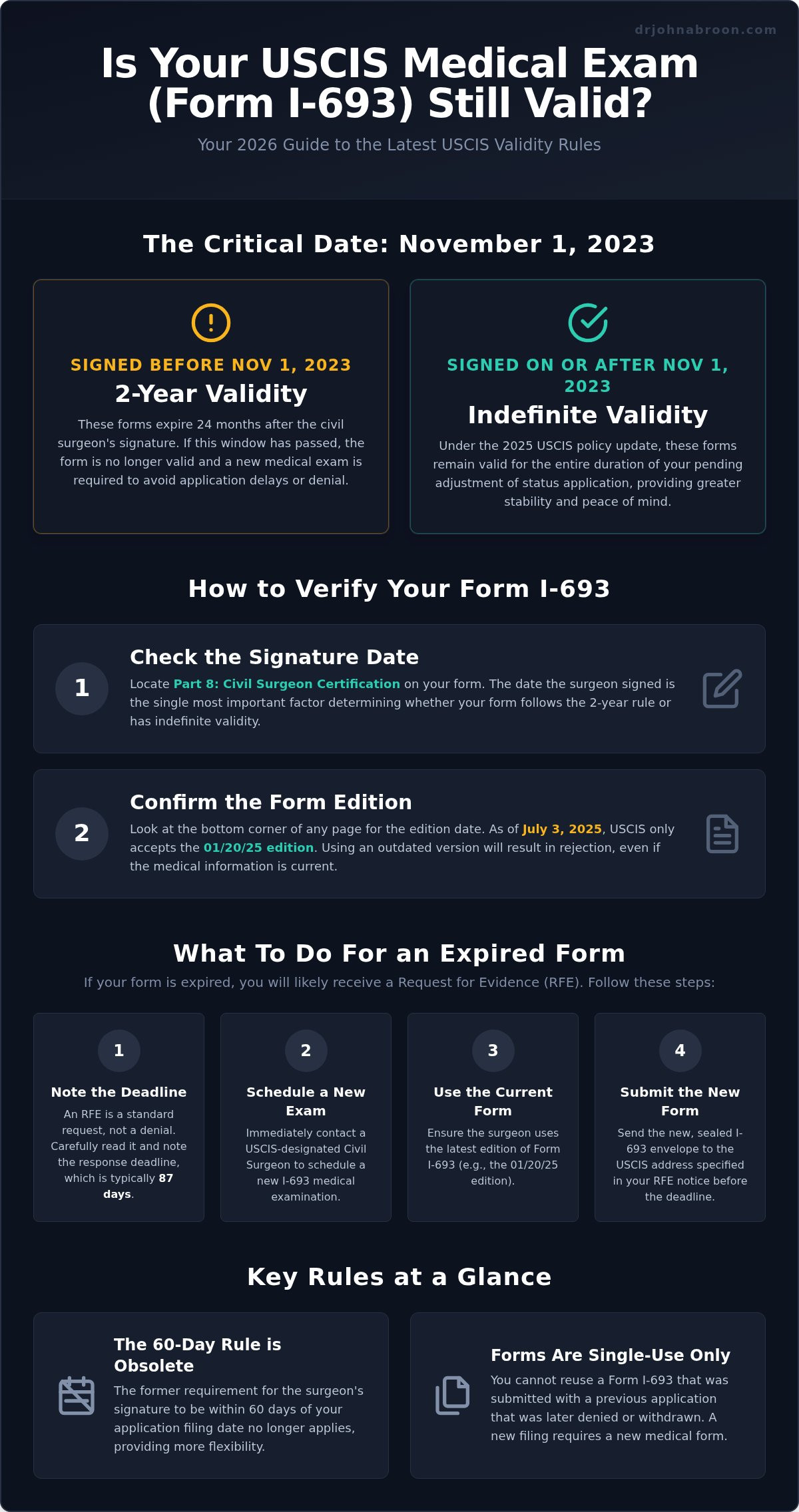
USCIS implemented a pivotal change to reduce administrative burdens and provide more stability for those in the Adjustment of Status (AOS) process. This shift effectively ended the two-year limit for most modern submissions, acknowledging that an individual’s core health status rarely changes in ways that impact immigration eligibility over a few years. Under 2026 standards, a properly completed Form I-693 signed on or after November 1, 2023, maintains indefinite validity as long as the underlying immigration application remains pending. This policy provides a sense of calm for New Yorkers navigating the often-lengthy AOS timeline.
When Does an I-693 Still Expire?
Despite the move toward indefinite validity, some applicants still find themselves in a precarious position. Legacy forms, which are those signed by a civil surgeon before November 1, 2023, still carry the traditional two-year expiration date. If your paperwork falls into this category and your green card hasn’t been approved within that window, you must understand what to do if i-693 expires to avoid an immediate rejection of your application. It’s a specific clinical update that requires decisive action.
Beyond the signature date, other factors can compromise the “freshness” of your medical record. USCIS now strictly enforces a single-use policy. If you submitted a medical form for a previous application that was later withdrawn or denied, you cannot reuse that same document for a new filing. Additionally, as of July 3, 2025, USCIS only accepts the 01/20/25 edition of the form. Knowing what to do if i-693 expires involves more than just checking a date; it requires ensuring your documentation meets the most current evidentiary standards.
Check Part 8 of your document copy today. The civil surgeon’s signature date is the ultimate anchor for your form’s status. If that date is approaching the two-year mark for an older form, or if you’re filing a brand new application, securing a fresh exam with a designated expert is the most reliable way to ensure your path to residency remains clear and uninterrupted.
How to Tell if Your Medical Form is Actually Expired
Determining the status of your medical exam requires a careful review of the physical document. You don’t need to be a legal expert to identify the key markers that dictate validity. According to the USCIS Policy Manual, the civil surgeon’s signature date is the primary factor in this calculation. Turn to Part 8 of your copy, where the clinician certifies the results. If the date recorded there is on or after November 1, 2023, your form is generally valid for the life of your pending application. If it predates that shift, you are likely facing a two-year expiration window.
Understanding what to do if i-693 expires starts with accurate self-assessment of these dates. If you find your form was signed before the cutoff and more than 24 months have passed, the document is no longer valid for your adjustment of status. This clarity allows you to take proactive steps before an officer flags the issue during your interview.
Reading the Form I-693 Edition Date
USCIS frequently updates form versions to reflect new health guidelines. Using an outdated edition can lead to an immediate rejection of your filing. Look at the bottom corner of any page to find the edition date. As of July 3, 2025, USCIS only accepts the 01/20/25 edition. If you discover your medical provider used an old version, you’ll need to have the exam results transferred to the current form to remain compliant.
The 60-Day Rule: Does it Still Apply?
The 60-day rule, which once required the doctor’s signature to be within 60 days of the filing date, was a major hurdle for many. In 2026, this rule is no longer an active concern for most applicants. USCIS removed this requirement to provide more flexibility and reduce the need for repeated exams. If you’re still worried about what to do if i-693 expires, remember that the signature date on Part 8 is now the primary factor, not how quickly you mailed the envelope after the exam.
While your attorney handles the legal strategy of your case, a USCIS-designated civil surgeon manages the clinical compliance. If you suspect your form is invalid or on the verge of expiring, speak to both. Your lawyer can advise on the timing of your filing, while your doctor ensures the medical data and vaccination records are current and accurate. This collaborative approach ensures your application moves forward without clinical or administrative delays.
Dealing with a USCIS Request for Evidence (RFE)
Receiving a Request for Evidence (RFE) can feel like a sudden hurdle in your immigration journey, but it’s often a straightforward request for clinical documentation. This notice, typically sent as Form I-797, indicates that your initial medical submission is either missing, incomplete, or no longer meets current standards. If you’re uncertain about what to do if i-693 expires, this official letter serves as your roadmap for the next steps. It’s a formal opportunity to rectify any gaps in your medical record before your application moves toward a final decision.
According to the USCIS Policy Manual on I-693 Validity, the agency issues these requests to ensure all applicants comply with the most recent health guidelines. You generally have an 87-day window to provide a response. While this timeframe may seem generous, the clinical process requires coordination. Laboratory tests, such as those for tuberculosis or syphilis, take time to process, and some vaccination series require multiple doses. Securing an appointment with a civil surgeon immediately upon receiving the RFE is essential to meeting this deadline without unnecessary stress.
Once your new examination is complete, the civil surgeon will provide you with a sealed envelope. You must never open this envelope. If the seal is broken, USCIS will reject the document, and you’ll likely have to repeat the entire medical exam and testing process. Your doctor will provide a separate copy of the results for your personal records, allowing you to review the findings without compromising the official submission.
Step-by-Step RFE Response Strategy
Success begins with organization. Start by gathering your original vaccination records and any previous lab results to present during your consultation. This preparation allows the civil surgeon to focus on what’s missing rather than duplicating what you already have. When considering what to do if i-693 expires, scheduling your update with a Manhattan-based specialist who offers in-office diagnostic testing can significantly reduce turnaround times. Every new form must cover all current CDC requirements, especially the Hepatitis B series which remains a frequent point of scrutiny in 2026.
Common Reasons for Medical RFEs in 2026
Many applicants receive RFEs due to incomplete vaccination records or clerical errors. While the COVID-19 vaccine was removed from the requirements in early 2025, confusion regarding this change can still lead to errors in older pending cases. Incomplete laboratory results for TB or syphilis are also common triggers for these notices. Additionally, USCIS may issue an RFE if the civil surgeon who signed your original form is no longer on the agency’s approved list. Ensuring every detail of your update is handled with clinical precision helps satisfy these rigorous standards the first time.
The Process of Getting a New I-693 in NYC
Securing a fresh medical clearance in the city’s fast-paced environment requires a structured, clinical approach. When you’re determining what to do if i-693 expires, the most effective first step is booking an appointment with a designated professional like Dr. John Abroon. Preparation begins before you even step into the office. You should organize your medical history and vaccination records to ensure the consultation is as productive as possible. This proactive stance helps avoid the stress of repeating tests you’ve already completed elsewhere.
The clinical process involves several essential stages. First, you’ll undergo a physical examination and specific screenings for communicable diseases. This includes blood and urine tests for Tuberculosis (TB), Syphilis, and Gonorrhea. If you’re missing any required immunizations, such as the Hepatitis B series which remains a high priority for USCIS in 2026, these will be administered during your visit. Finally, you’ll receive the essential sealed I-693 envelope for USCIS, along with a personal copy for your records. This ensures you have full visibility into your health data while keeping the official submission secure.
What to Bring to Your NYC Appointment
Arriving prepared is the best way to expedite your application. You must present a valid government-issued photo ID, such as a passport or IDNYC. Additionally, bring your complete vaccination history; if these records aren’t in English, ensure they’re translated by a certified professional. Having prior I-693 copies or recent lab results available can also provide helpful context for your current evaluation and may prevent unnecessary re-testing.
Laboratory Testing and Turnaround Times
USCIS requires specific diagnostic screenings that must be handled by a certified laboratory. For 2026, these include blood tests for Syphilis and TB, as well as a urine test for Gonorrhea. Choosing an Upper East Side internist who offers in-office diagnostic testing can significantly reduce your wait time. Instead of traveling to secondary lab sites, you can complete all requirements in one professional setting. If a test result comes back positive, it doesn’t mean your application is over. We’ll guide you through the necessary follow-up care and documentation required to satisfy USCIS health standards.
If your paperwork is outdated, don’t wait for a formal notice to take action. You can schedule your immigration medical exam NYC today to ensure your adjustment of status remains on schedule and compliant with the latest federal regulations.
Why Choose Dr. Abroon for Your I-693 Update
Selecting a civil surgeon isn’t just about finding a name on a government list; it’s about finding a partner who understands the high stakes of your adjustment of status. Dr. John Abroon brings a sophisticated blend of clinical authority and warm reassurance to every consultation. As a board-certified internist established in Manhattan since 1997, he provides a level of expertise that generic clinics often lack. When you’re facing the stress of an outdated form, knowing what to do if i-693 expires starts with choosing a provider who prioritizes both medical precision and your total well-being.
His comprehensive immigration medical exam NYC services are designed for maximum efficiency. By offering in-office diagnostic testing, including blood work and EKGs, Dr. Abroon eliminates the need for patients to navigate multiple facilities across the city. This centralized approach ensures that your data remains secure and your results are processed with the speed required for a successful application. You won’t have to worry about the logistics of external labs while managing your immigration deadlines.
Concierge-Level Medical Care on the Upper East Side
Seeing a primary care physician who manages your total well-being offers a distinct advantage over transactional urgent care settings. Dr. Abroon’s team manages the heavy lifting of the I-693 form, ensuring every field is completed according to the latest 2026 USCIS standards. Our practice remains deeply committed to maintaining the highest standards of patient safety and surgical readiness for every individual we serve. This personalized attention transforms a complex administrative requirement into a manageable, calm step in your health journey.
Fast and Accurate RFE Turnaround
Time is of the essence when a Request for Evidence arrives in your mailbox. We offer priority scheduling for applicants with pending USCIS deadlines to ensure you meet the response window with time to spare. Every document undergoes a rigorous double-check process to identify potential errors before the envelope is sealed. This meticulous attention to detail is specifically aimed at preventing a second RFE and securing your successful interview. If you’ve realized your previous medical results are no longer valid, we provide the definitive answer on what to do if i-693 expires. Schedule your I-693 update with Dr. Abroon today and move forward with the confidence that your medical documentation is in expert hands.
Secure Your Future with a Valid Medical Record
Managing the final stages of your adjustment of status shouldn’t be clouded by administrative uncertainty. By understanding signature date thresholds and monitoring for potential Requests for Evidence, you’ve taken the first step toward a successful interview. Whether your form was signed before the 2023 policy shift or you’ve received an official notice, knowing what to do if i-693 expires allows you to act with poise and precision.
Dr. John Abroon provides the expert, concierge-level care needed to resolve these clinical requirements quickly. As a board-certified NYC internist and USCIS-designated civil surgeon, he offers on-site laboratory testing at his Upper East Side location to streamline your update. This specialized approach ensures your paperwork meets the rigorous 2026 standards while you receive personalized care. Book Your USCIS Immigration Medical Exam in NYC with Dr. Abroon and proceed with the confidence that your health documentation is in professional hands. You’re closer than ever to reaching your goals; let’s ensure your application is as ready as you are.
Frequently Asked Questions
How long is an I-693 medical exam valid for in 2026?
In 2026, the validity depends on when the civil surgeon signed the document. If the signature is dated on or after November 1, 2023, the form remains valid indefinitely while your application is pending. However, if the signature predates that cutoff, the form carries a two-year expiration limit. This distinction is a major shift from previous regulations that required more frequent medical re-testing for all applicants.
Can I use my health insurance for an immigration medical exam in NYC?
Most health insurance plans don’t cover the professional fees associated with a specialized immigration medical exam. These evaluations are considered administrative rather than purely preventative or diagnostic. However, you might be able to use your insurance for specific laboratory tests or required vaccinations. We recommend contacting your insurance carrier to verify coverage for these specific clinical services before your appointment on the Upper East Side.
What happens if my I-693 expires while my Green Card application is pending?
If your form was signed before November 1, 2023, and your application remains pending past the two-year mark, the medical record will expire. USCIS will typically issue a Request for Evidence asking for a new Form I-693. Understanding what to do if i-693 expires is vital for maintaining your application’s momentum. You’ll need to schedule a new exam with a civil surgeon to provide updated clinical data that meets current federal standards.
Do I need to redo the entire exam if I receive an RFE for my medical?
If you receive a Request for Evidence, you’ll generally need a completely new medical evaluation to satisfy the latest requirements. This involves a new physical exam, updated laboratory tests for tuberculosis and syphilis, and any missing vaccinations. Because USCIS now requires the 01/20/25 edition of the form, a simple update to an old document isn’t sufficient. A fresh exam ensures your filing is fully compliant with 2026 standards.
Which vaccinations are currently required for the I-693 in 2026?
Required immunizations include Measles, Mumps, Rubella, Polio, Tetanus, Diphtheria, Pertussis, and Hepatitis B. During flu season, which runs from October 1 to March 31, a seasonal flu shot is also mandatory. As of January 22, 2025, the COVID-19 vaccine is no longer a requirement for the immigration medical exam. Dr. Abroon will review your history and administer any missing doses during your visit to our Manhattan office.
How quickly can Dr. Abroon complete a new I-693 form?
Our on-site laboratory testing allows us to finalize medical reports much faster than clinics that send samples to external sites. While laboratory processing for TB and syphilis takes a few days, most applicants receive their sealed envelope within a short business week. This rapid turnaround is essential when you’re figuring out what to do if i-693 expires and you’re working against an 87-day RFE response window.
What is the difference between a civil surgeon and a regular doctor for immigration?
A civil surgeon is a doctor designated by USCIS to perform immigration exams, while a regular doctor lacks this specific federal authorization. Only a designated expert can certify that an applicant meets the health-related requirements for permanent residency. Dr. Abroon has maintained his designation since 1997, providing him with the clinical experience and administrative knowledge necessary to navigate the complexities of the I-693 process for New Yorkers.
Will I get a copy of the I-693 results for my own records?
Every patient at our practice receives a complete copy of their medical results and vaccination records for their personal files. You’ll also receive the official I-693 in a sealed envelope, which is the only version USCIS will accept for your application. It’s vital that you don’t open the sealed version. Having your own copy ensures you have a permanent record of your immunizations and laboratory findings.