


A full medical checkup for peace of mind nyc residents can feel confident about starts with a conversation, not a long list of tests. It’s natural to want a thorough review of your health while wondering whether an appointment might miss something or lead to tests you don’t need.
Your age, medical and family history, symptoms, and personal risk factors can help guide what a clinician assesses and which tests may be appropriate. The goal is to make the reasons for each step clear, so you know what to expect and what questions to ask.
This article explains what a checkup may include, how to prepare, and how to understand results and follow-up recommendations. At Dr. John Abroon’s Upper East Side practice, annual physical exams and diagnostic testing may include an in-office EKG or pulmonary function testing when the clinician considers it appropriate. A clear discussion of your health and next steps can make a checkup feel less uncertain and more useful.
Key Takeaways
- A full medical checkup for peace of mind nyc should be guided by your health needs, not a preset list of tests.
- Ask why a test is recommended and what its results can and cannot tell you.
- Gather medication details, relevant health records, prior results, and questions before your appointment.
- Compare physicians by considering qualifications, personalized care, and follow-up communication.
- An internist can help you understand findings and plan appropriate next steps.
Full Medical Checkup for Peace of Mind NYC: What It Can and Cannot Tell You
A comprehensive checkup is a clinician-led assessment, not a guaranteed package of every available test. Its purpose is to understand your health in context, identify concerns that may need attention, and consider appropriate preventive care. For a full medical checkup for peace of mind nyc, the value comes from a thoughtful evaluation and clear explanations, not simply from the number of tests performed.
What does a comprehensive medical checkup usually include?
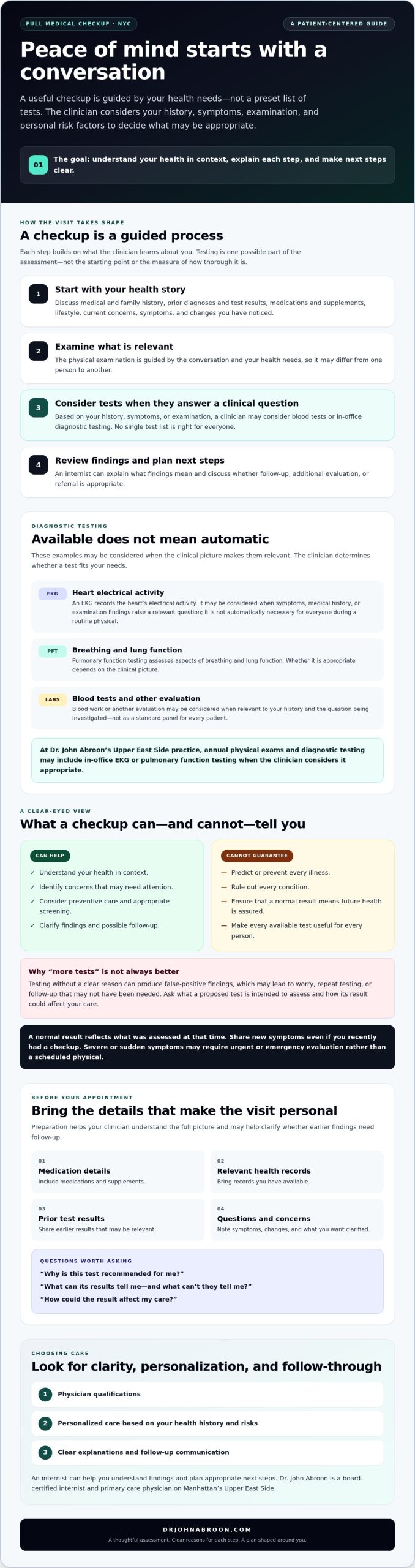
Your clinician may ask about your medical history, medications and supplements, lifestyle, family history, and current concerns. The physical examination is guided by that conversation and your health needs, so it may differ from one visit to another. This neutral overview of what a full medical checkup includes explains the role of an examination within a broader assessment.
Laboratory work or in-office diagnostics may be considered when relevant. For example, an internist may recommend blood tests or consider an EKG based on your history, symptoms, or examination. Dr. John Abroon’s Upper East Side practice offers diagnostic testing, including in-office EKG and pulmonary function testing. The clinician determines whether a particular test is appropriate. These are options, not a standard checklist or a promise that every test will be performed.
Why a fixed list of tests is not right for everyone
Age, prior test results, family history, symptoms, and individual risk factors can affect which screenings make sense and when. A result that matters for one patient may not be useful for another. Testing without a clear reason can produce false-positive findings, which may lead to worry, repeat testing, or follow-up that may not have been needed. Ask what a proposed test is intended to assess and how its result could affect your care.
Personalized preventive care matches screening and testing to a person’s health history and risks, while recognizing that no checkup can predict or prevent every illness.
Screening can identify a concern that deserves closer evaluation, but it cannot rule out every condition or guarantee future health. A normal result reflects what was assessed at that time. Share new symptoms even if you recently had a checkup, and don’t wait for a routine preventive appointment to discuss a new or worsening problem. Severe or sudden symptoms may require urgent or emergency evaluation rather than a scheduled physical.
How a NYC Internist Personalizes Your Checkup and Diagnostic Tests
A personalized checkup starts with a clinical question: What does your history, current health, and examination suggest should be addressed? An internist gathers that context before recommending tests, then explains what each test could clarify. This makes a full medical checkup for peace of mind nyc more useful than simply completing a long list of procedures.
How medical history helps guide testing
Expect to discuss prior diagnoses, medications and supplements, family health history, past test results, and any symptoms or changes you’ve noticed. Details that seem minor may help the clinician understand a pattern or decide whether an earlier result needs follow-up. Age and individual risk factors also help shape which preventive screenings are worth discussing.
A clinician may consider whether blood work or another evaluation is relevant based on your history and the question being investigated. That doesn’t mean every patient needs the same laboratory panel or imaging. Bring records you have, and ask how a proposed test could influence your care. Harvard Health Publishing offers a discussion of the benefits and limits of a checkup, including why an appointment’s value depends on its purpose and context.
When an EKG or other diagnostic test may be considered
An EKG records the heart’s electrical activity. A clinician may consider one when symptoms, medical history, or examination findings raise a relevant question. It isn’t automatically necessary for everyone during a routine physical. Pulmonary function testing assesses aspects of breathing and lung function, and whether it is appropriate also depends on the clinical picture.
Dr. John Abroon is a board-certified internist and primary care physician on Manhattan’s Upper East Side. His practice offers diagnostic testing, including in-office EKG and pulmonary function testing. The clinician can determine whether an available test fits your needs. Ask about preparation or scheduling requirements when arranging care.
Testing is only one part of the process. After reviewing your history and examination, the internist can explain findings and discuss whether additional evaluation or referral is appropriate. Depending on what the evaluation shows, next steps might include monitoring a result, arranging further testing, or coordinating with another clinician. Ask what happens next and when you should expect to hear about results.
If you’re considering a preventive visit, learn more about annual physical exams and discuss which evaluations may be appropriate for your situation.
Does a Full Checkup Guarantee Peace of Mind? Understanding Benefits and Limits
A thorough preventive visit can help you understand your health and decide what deserves attention, but it can’t provide certainty about every condition. More tests don’t automatically mean better care or greater reassurance. Each test has a purpose and limitations. Adding tests without a clear clinical reason may create confusing results or follow-up that doesn’t improve your care.
What screening results can and cannot show
Screening tests look for selected risks or signs of a particular condition. They don’t diagnose every illness, and a normal result reflects only what was assessed at that point in time. It isn’t a guarantee that you won’t develop a health problem later. A normal screening result also shouldn’t dismiss symptoms that continue or change. Tell your clinician what you’re experiencing, even if recent results were reassuring.
For a full medical checkup for peace of mind nyc, think of screening as one part of an ongoing conversation about your health, rather than a final all-clear. Harvard Health Publishing discusses the benefits and limits of a checkup, including why the value of a physical depends on the person and the care being considered. If you develop new, severe, or worsening symptoms, seek prompt medical attention instead of waiting for a routine preventive visit. Sudden or serious symptoms may require emergency care.
What happens if a checkup finds something unexpected?
An out-of-range result can feel unsettling, but it doesn’t automatically mean you have a serious disease. A clinician interprets it alongside your health history, symptoms, examination, and other relevant information. Some findings may be minor, temporary, or less meaningful once considered in context. Ask what the result may indicate, how certain that interpretation is, and what follow-up is recommended.
Depending on the finding, a clinician may suggest repeating a test, monitoring the issue over time, ordering further evaluation, or referring you to another specialist. Sometimes no immediate action is needed. The appropriate next step depends on the result and your circumstances, so clear explanations matter as much as the initial screening.
Reassurance doesn’t have to mean every result is normal. It can come from understanding what a result means, what remains uncertain, and what plan makes sense. If you leave an appointment unsure about a finding, ask whom to contact, how follow-up will happen, and what changes in your health should prompt another conversation.
How to Prepare for a Full Medical Checkup in New York City
A little preparation can help your clinician focus on what matters to you and make better use of your appointment. Gather the information you have and note anything you want to discuss. You don’t need to know which tests you should have. That decision can follow a review of your health and concerns.
What to bring and discuss at your appointment
Use this simple sequence to prepare for a full medical checkup for peace of mind nyc:
- Write down your medications. Include prescription medicines, over-the-counter products, supplements, and any allergies or medication reactions.
- Gather relevant health information. Note prior diagnoses, significant family health history, recent laboratory results, and specialist reports if you have them.
- Track what has changed. List symptoms, concerns, or changes since your last evaluation. Include when they began and what seems to affect them.
- Prepare your questions. Jot down topics you don’t want to forget, such as a screening recommendation or a result you’d like explained.
- Confirm visit instructions. Ask the office whether any preparation is needed, including whether you should fast. Don’t assume fasting or a particular test is required.
Your notes don’t need to be lengthy or perfectly organized. Even a brief list can help you describe your health clearly and make sure important details are part of the conversation.
Questions to ask about tests, results, and follow-up
If your clinician recommends a test, ask what it’s intended to assess and why it fits your history or current concerns. You can also ask whether preparation is needed, how and when results will be communicated, and who will explain what they mean. If a result needs follow-up, clarify the next step and whom to contact with questions.
For visit-specific information, review the practice’s details about annual physical exams and ask the office which preparation instructions apply to your appointment. Requirements can vary depending on the evaluation or testing being considered, so confirm them directly rather than relying on general advice.
To discuss appointment logistics or ask what information to bring, contact Dr. Abroon’s practice. Sharing your questions in advance can help you feel prepared for a thoughtful conversation about your health.
Choosing a Full Medical Checkup in NYC: A Personalized Next Step
Choosing a clinician is about more than finding a convenient appointment. A useful checkup connects your health history and concerns to an appropriate evaluation, with a clear explanation of findings and what to do next. As you compare options for a full medical checkup for peace of mind nyc, consider these four points:
- Qualifications: Check the clinician’s relevant internal medicine or primary care credentials.
- Personalization: Ask how the clinician considers your medical history, current concerns, and individual risks.
- Testing rationale: Look for clear explanations of why a test may be appropriate, what it can show, and what its limits are.
- Follow-up: Find out how results are explained and how the practice discusses further evaluation when needed.
An internist can consider your health as a whole, rather than viewing each concern in isolation. Depending on the evaluation, that may include reviewing relevant history, discussing preventive care, interpreting findings, and coordinating next steps. The practice’s services matter too, so confirm that it offers the type of visit you’re seeking.
What to look for in a NYC checkup provider
Before scheduling, verify practical details with the office: the clinician’s credentials, the practice location, current appointment availability, fees, and whether your insurance is accepted. Ask what tests are available and whether any require separate scheduling or preparation. Clear answers can help you decide whether the practice fits your needs and plan for your visit.
When comparing primary care providers in NYC, focus on whether the clinician can explain recommendations in terms you understand, including what happens after the appointment.
Discuss your checkup with Dr. John Abroon’s practice
Dr. John Abroon is a board-certified internist and primary care physician on Manhattan’s Upper East Side. His practice offers annual physical exams and diagnostic testing, including in-office EKG and pulmonary function testing. The clinician determines whether a test or recommendation is appropriate based on each patient’s evaluation. No particular test or outcome is guaranteed.
If you’re considering a preventive visit, contact the practice to ask about appointment logistics, fees, insurance, and any preparation that may apply. Discuss a personalized checkup with Dr. Abroon’s practice.
Take the Next Step Toward More Confident Preventive Care
A worthwhile checkup isn’t defined by how many tests it includes. It’s shaped by your health history, concerns, and risk factors, with a clinician explaining why each evaluation may be useful. Preparing your records and questions can help you take an active role. Keep in mind that screening offers a snapshot of your health, not a guarantee about the future.
Choosing a full medical checkup for peace of mind nyc means looking for thoughtful assessment and clear follow-up, not simply a longer test list. Dr. John Abroon is a board-certified internist and primary care physician with an Upper East Side practice in New York City. The practice offers annual physical exams and diagnostic testing, including in-office EKG and pulmonary function tests when clinically appropriate.
If you’re ready to discuss a preventive evaluation, ask the practice about appointment logistics and what to bring. Contact Dr. Abroon’s practice to discuss a personalized checkup.
Frequently Asked Questions
What does a full medical checkup usually include?
A full medical checkup usually includes a clinician’s review of your health history, medications, lifestyle, current concerns, and relevant risk factors, along with an examination guided by your needs. Tests may be recommended when they help assess a specific concern or screening need, but there isn’t one standard package for everyone. In New York City, ask your clinician what each suggested test is meant to clarify and how results will be discussed.
Is a full medical checkup the same as an annual physical?
The terms can overlap, but “full medical checkup” doesn’t necessarily mean a separate or more extensive set of tests than an annual physical. The scope depends on the clinician’s evaluation and your health needs, not the label alone. Dr. John Abroon’s New York City practice offers annual physical exams. Ask what the visit includes, which concerns you can discuss, and whether additional evaluation may be appropriate.
Can a full checkup detect every health problem?
No. A checkup can assess selected aspects of your health and identify findings that may need attention, but it can’t detect every condition or predict future illness. Normal results are a snapshot, not a guarantee that a health issue is absent or won’t develop. If you have new, severe, or worsening symptoms, contact a clinician promptly rather than waiting for a preventive appointment or relying on a recent normal result.
How often should I get a full medical checkup?
There isn’t one schedule that fits every adult. How often to have a checkup depends on factors such as age, medical history, ongoing conditions, risk factors, and the clinician’s recommendations. Dr. Abroon’s practice offers annual physical exams, but discuss the appropriate interval with your physician. Don’t wait for your next routine visit if you develop symptoms or a health concern that needs attention.
Do I need blood work or an EKG during a full checkup?
Not necessarily. Blood work or an EKG may be considered when your history, symptoms, examination, or screening needs give the clinician a reason to recommend them. They aren’t automatically required for every patient. Dr. John Abroon’s Upper East Side practice offers diagnostic testing, including in-office EKG and pulmonary function testing. Ask why a test is relevant to you, what it can show, and whether preparation is needed.
How much does a full medical checkup cost in NYC?
The cost can depend on the type of visit, the clinician’s fees, and whether diagnostic or laboratory testing is included or billed separately. Insurance coverage and out-of-pocket responsibility also vary by plan and provider. Contact the New York City practice before scheduling to ask about fees, accepted insurance, what the visit may include, how testing is handled, and whether additional charges could apply.
How should I prepare for a medical checkup?
Bring an up-to-date medication and supplement list, note allergies and prior diagnoses, and gather relevant test results or specialist records if available. Write down symptoms, changes in your health, family history, and questions you want to raise. Before the appointment, ask the office whether you need to fast or follow other instructions. Don’t assume. These details help your clinician understand your situation and guide a focused discussion.