


Could one elevated blood pressure reading automatically cancel your surgery? Not necessarily. Pre-op clearance for patients with high blood pressure is a contextual assessment, not a pass-or-fail decision based on one number. Your medical history, blood pressure patterns, overall health, and planned procedure all help shape the next steps.
It’s understandable to feel concerned if your reading is higher than usual, especially if you’re unsure whether to take your regular medication on the day of surgery. A single elevated measurement may not tell the whole story. Follow medication instructions from your care team rather than guessing or making changes on your own.
This article explains how clinicians evaluate blood pressure before surgery, which readings and records to bring, and how to resolve medication questions with your surgical and anesthesia teams. You’ll also learn how an internist considers your health alongside the planned procedure and chooses tests based on your individual needs. Dr. John Abroon, a board-certified internist and primary care physician in New York City, provides personalized pre-operative medical clearances to help patients and their care teams plan with greater clarity.
Key Takeaways
- Pre-op clearance for patients with high blood pressure considers more than one reading, including your health history and planned procedure.
- Bring recent blood pressure readings, relevant medical records, a complete medication and supplement list, and your surgeon’s forms to the evaluation.
- Tell the clinician about symptoms, other health conditions, and how you manage your blood pressure so they can assess your situation in context.
- Get clear, individualized instructions about blood pressure medication before surgery, and coordinate any changes with your care team.
- Testing is tailored to your health and procedure. Clearance helps inform surgical planning but doesn’t replace decisions by your surgeon or anesthesiologist.
What High Blood Pressure Means for Pre-Op Clearance
Pre-operative clearance is a medical assessment that helps inform surgical readiness and planning. It doesn’t guarantee that surgery will proceed, and the decision isn’t based on blood pressure alone. For pre-op clearance for patients with high blood pressure, a clinician considers the planned procedure alongside your overall health, symptoms, medical history, treatment, and available records.
In plain language: Pre-op clearance is a review of your health before surgery. It helps your care team identify relevant risks and plan next steps. A blood pressure reading is one part of that assessment, not a universal pass-or-fail rule.
A single elevated office reading doesn’t necessarily reflect your usual blood pressure. Stress, recent activity, discomfort, and other circumstances can affect a measurement. Clinicians may repeat the reading and compare it with home or prior office readings you share. This fuller picture can help distinguish a one-time elevation from a pattern that may need attention. For background on the condition and its management, see this overview of understanding hypertension.
Does high blood pressure automatically prevent surgery?
Not necessarily. The decision depends on the clinical context and the treating team’s assessment. A clinician may consider repeated measurements, your medical history and symptoms, other health conditions, and the type of procedure planned. An online checklist can’t determine whether surgery should proceed or be delayed. Timing decisions belong to the clinicians responsible for your care.
Why the surgical team reviews blood pressure
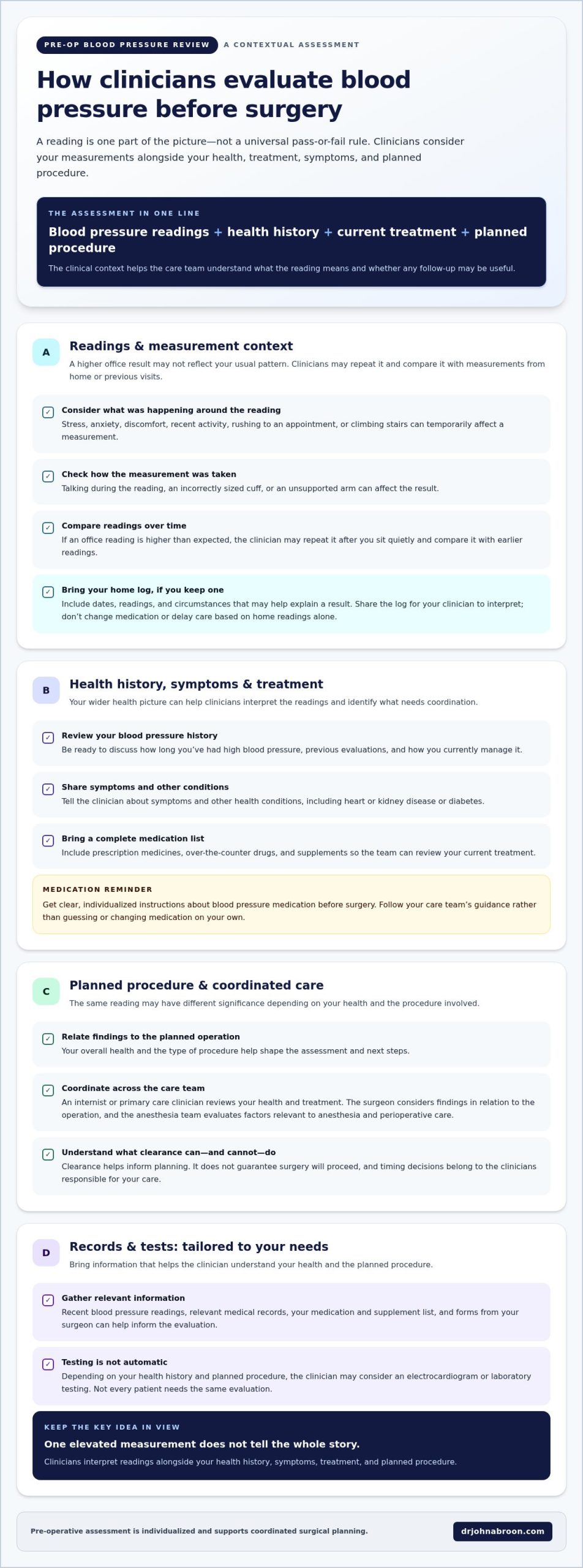
Your blood pressure history helps the team understand your overall health before, during, and after a procedure. Your primary care clinician or internist can review your medical history and current treatment, assess your health, and communicate relevant findings. The surgeon considers those findings in relation to the planned operation, while the anesthesia team evaluates factors that may affect anesthesia and perioperative care. Each member of the team contributes to a coordinated plan.
A personalized assessment can also clarify what information or follow-up may be useful, rather than treating one number as the whole story. To learn more about what a pre-surgical evaluation can involve, read the pre-operative medical clearance guide.
How Clinicians Evaluate Hypertension Before Surgery
A blood pressure measurement is useful, but it doesn’t tell the whole story. During pre-op clearance for patients with high blood pressure, clinicians consider readings over time alongside your medical history, symptoms, current treatment, and planned operation. The same reading may have different significance depending on a person’s health and the procedure involved.
A blood pressure reading matters most when interpreted alongside your health history, symptoms, treatment, and planned procedure.
Office readings, home measurements, and measurement context
Blood pressure can rise temporarily after rushing to an appointment, climbing stairs, or feeling anxious. Measurement technique matters too: talking during the reading, using an incorrectly sized cuff, or keeping your arm unsupported can affect the result. If an office reading is higher than expected, the clinician may repeat it after you’ve had time to sit quietly and compare it with previous measurements.
If you already keep a home blood pressure log, bring it to the appointment. Include dates and readings, and note any circumstances that may help explain a result. The log can show whether a higher office reading is typical for you or differs from your usual pattern. Don’t change medication or delay care based on home readings alone. Share them with your clinician so they can interpret them in context.
What medical history and tests may inform the assessment
Your clinician may review how long you’ve had high blood pressure, previous evaluations, and your current treatment. Other conditions, such as heart or kidney disease or diabetes, can also shape the assessment. Share any symptoms you’ve noticed and provide a complete list of prescription medicines, over-the-counter drugs, and supplements. These details help the clinician understand your health and identify questions to coordinate with the surgical or anesthesia team.
Testing is individualized, not automatic. Depending on your health history and planned procedure, the clinician may consider an electrocardiogram or laboratory testing. These tests are used when they can help answer a clinical question or inform planning. Not every patient needs the same evaluation.
Dr. John Abroon, a board-certified internist and primary care physician in New York City, provides personalized pre-operative medical clearances and diagnostic testing. An assessment can help organize relevant findings and clarify next steps with your care team. Learn more about personalized pre-operative medical clearance.
High Blood Pressure Before Surgery: Common Concerns and What They Mean
It’s understandable to worry that a high reading could disrupt your surgery plans. But a single measurement doesn’t determine the outcome. For pre-op clearance for patients with high blood pressure, clinicians interpret readings alongside your health, symptoms, treatment, and planned procedure. The table below provides general context, not a diagnosis or a rule for deciding whether surgery can proceed.
| Situation | What it may mean | What to do |
|---|---|---|
| One high reading | Stress, recent activity, or measurement conditions may affect a single result. It may not reflect your usual blood pressure. | Share the reading and any recent home measurements with your clinician. Don’t make medication changes based on one result. |
| Established hypertension | Your clinician can review your pattern of readings, treatment, medical history, and planned procedure to assess what planning may be needed. | Provide your medication details and relevant records, and follow the care team’s guidance. |
| Very high reading or concerning symptoms | A very high reading, especially with symptoms such as chest pain, shortness of breath, weakness, confusion, or sudden vision or speech changes, may need urgent assessment. | Seek immediate medical care for severe or sudden symptoms. Don’t wait for a routine pre-op appointment. |
Does one high reading mean surgery will be postponed?
Not automatically. The clinician may repeat the measurement or consider it alongside other readings and your medical history before recommending next steps. The surgeon and anesthesia team determine procedure timing using the full clinical picture. No single reading or online checklist can guarantee that surgery will proceed or predict that it will be postponed.
Should blood pressure medication be taken before surgery?
Instructions can vary based on the medication, your health, and the procedure. Don’t stop, start, skip, or adjust a prescribed medicine on your own, even if a home reading looks different from usual. Ask your treating team for clear instructions about what to take and when, and share any uncertainty before the day of surgery.
If you’re unsure how to respond to a reading, report it to your clinician rather than trying to manage it alone. For severe or sudden symptoms, seek immediate medical care. Surgical planning can be addressed once your immediate health needs are assessed.
Preparing for Pre-Op Clearance with High Blood Pressure
A little preparation can make your pre-op visit more focused and help your clinician coordinate with your surgical team. For pre-op clearance for patients with high blood pressure, bring more than recent readings: medication details, relevant medical history, and clear information about the planned procedure all help provide context.
Quick checklist: Bring your medical records, an up-to-date medication and supplement list, any blood pressure readings you already track, and details about your upcoming surgery.
What to bring to your appointment
- Medical records: Bring relevant prior test results and information about past evaluations or conditions related to your blood pressure.
- Medication and supplement list: Include each prescription and over-the-counter medicine, supplement, dose, and prescribing clinician. Note any recent changes, including medicines you’ve started or stopped.
- Blood pressure readings: If you already keep a home log, bring the dated readings. When useful, note the circumstances, such as whether you had just exercised or were feeling unwell. Don’t start measuring more often than your clinician has advised just for this appointment.
- Surgery details: Write down the procedure name, scheduled date, surgeon’s name, and available contact information for the surgeon or anesthesia team. Bring any forms or instructions you’ve received.
Also tell your clinician about symptoms you’ve experienced, even if they seem unrelated, and mention any recent changes in your health. A complete account helps the clinician interpret your readings and tailor the assessment instead of relying on one measurement.
What to do if readings are elevated before the appointment
Follow the guidance you’ve already received from your clinician. If you take a reading, record the date and, if relevant, what was happening at the time. Don’t try to rapidly lower your blood pressure on your own, and don’t change, skip, or take extra medication unless your treating clinician specifically instructs you to do so.
If you develop concerning symptoms or have questions about a particular reading, contact your treating team for guidance. For severe or sudden symptoms, seek immediate medical care rather than waiting for a scheduled pre-op visit.
Appointment timing and required paperwork can vary with the planned procedure. Confirm with the surgical team when your evaluation should take place and which records or forms they need, so the information can be shared in time for planning.
For an individualized pre-operative assessment, schedule a pre-operative medical clearance with Dr. John Abroon’s New York City practice.
Getting Individualized Pre-Op Clearance in New York City
Pre-operative planning is most useful when it reflects the person having surgery, not just a single blood pressure number. For pre-op clearance for patients with high blood pressure, an internist can bring relevant health information together, assess how it relates to the planned procedure, and help clarify any follow-up or coordination needed before surgery.
What a personalized medical evaluation can clarify
The assessment may include a review of your blood pressure history, current medications, other health conditions, and procedure details, along with a physical examination. If additional testing could help answer a clinical question, the clinician selects it according to your health and the operation. An electrocardiogram or laboratory testing may be appropriate in some cases, but testing isn’t automatically the same for every patient.
The evaluation and documentation can organize relevant findings and communicate next steps to the surgical team. This information supports planning; it doesn’t replace the surgeon’s decision about the procedure or the anesthesiologist’s assessment of anesthesia-related needs. Keep following medication instructions from your treating clinicians, and share any new symptoms or treatment changes with them.
Plan your pre-operative evaluation on the Upper East Side
Dr. John Abroon is a board-certified internist and primary care physician who provides pre-operative medical clearances in New York City. Located on the Upper East Side, the practice offers a personalized evaluation that considers your health history and surgical plans. Learn more about the practice’s approach to internal medicine in this primary care physician guide for NYC.
To prepare, bring records and medication information relevant to your health, along with procedure details and instructions from your surgical team. These materials can help focus the evaluation and support clear communication about what happens next. If you’re ready to plan your assessment, schedule a pre-operative medical evaluation with Dr. Abroon’s New York City practice.
Take the Next Step With a Personalized Pre-Op Plan
A high blood pressure reading doesn’t tell the whole story. Pre-op clearance for patients with high blood pressure considers your readings in context, including your medical history, symptoms, current treatment, and planned procedure. Bringing relevant records and a medication list can make the evaluation more informative. Medication instructions should come from your treating team.
Dr. John Abroon is a board-certified internist and primary care physician who provides pre-operative medical clearances and diagnostic testing at his Upper East Side practice in New York City. A personalized evaluation can organize relevant findings and help clarify next steps with your surgeon and anesthesia team. Clearance supports surgical planning, but the treating clinicians determine whether and when surgery proceeds.
Schedule a personalized pre-operative medical evaluation with Dr. Abroon to discuss your health and upcoming procedure. Thoughtful preparation and coordinated guidance can help you approach surgical planning with greater clarity.
Frequently Asked Questions
Can I have surgery if I have high blood pressure?
Yes, high blood pressure doesn’t automatically prevent surgery. For pre-op clearance for patients with high blood pressure, clinicians consider your blood pressure pattern, overall health, symptoms, treatment, and planned procedure. The surgeon and anesthesia team use this clinical picture to guide timing and planning. An individualized evaluation can clarify what information or follow-up is needed, but no online answer can guarantee that a particular surgery will proceed.
What blood pressure is too high for surgery?
There isn’t one number that applies to every patient and procedure. The 2026 guidance from the Association of Anaesthetists and the British and Irish Hypertension Society says elective surgery may proceed with clinic blood pressure below 180/120 mmHg, or home or ambulatory readings below 175/115 mmHg. A clinic reading above 180/120 mmHg calls for postponement under that guidance until it falls below the threshold. Your treating team determines how the guidance applies to you.
Will one high blood pressure reading cancel my surgery?
Not necessarily. A single elevated reading may reflect temporary factors, such as anxiety, recent activity, or measurement conditions, and may not represent your usual blood pressure. Your clinician may repeat the measurement or compare it with prior readings and your health history. The surgeon and anesthesia team make timing decisions using the full clinical picture, so one reading alone can’t predict whether surgery will proceed or be delayed.
Should I take my blood pressure medication on the day of surgery?
Follow individualized instructions from your treating team. Whether to take a medication before surgery can depend on the specific drug, your health, and the procedure. Don’t independently skip, start, stop, or change a prescribed medicine, even if your blood pressure reading is higher or lower than usual. If you don’t have clear instructions, contact the surgical or anesthesia team before the day of surgery for guidance.
What should I bring to a pre-op appointment if I have hypertension?
Bring an up-to-date list of prescription medicines, over-the-counter drugs, and supplements, including doses and prescribing clinicians. Include recent medication changes, available blood pressure readings, and relevant prior test results or medical records. Share the procedure name, scheduled date, surgeon’s details, and any forms or instructions you received. In New York City, follow your surgical team’s instructions about when the evaluation should take place and which records they need.
Can anxiety make my blood pressure high before surgery?
Yes, anxiety can contribute to a temporarily higher reading, as can rushing to an appointment, recent activity, discomfort, or measurement technique. Tell the clinician if you feel anxious or if the reading differs from measurements you’ve recorded at home. If you already keep a dated blood pressure log, bring it. Don’t change medication or delay care based on home readings alone; discuss them with your treating team.
Do I need extra tests for pre-op clearance if I have high blood pressure?
Not automatically. Testing depends on your medical history, examination, symptoms, blood pressure treatment, and planned procedure. A clinician may consider an electrocardiogram or laboratory testing when it could inform your assessment, but these aren’t routine requirements for every patient with hypertension. An internist can review your overall health and coordinate relevant findings with the surgical team, helping determine whether additional evaluation is appropriate for your situation.