


What will help you make the most of your first concierge doctor visit? A clear sense of what matters to you is often more useful than a perfect medical file. You may wonder which records and medication details to gather, or worry you’ll forget a key symptom once you’re in the room. Knowing how to prepare for your first concierge doctor visit can help you feel more at ease and keep the conversation focused.
Preparation doesn’t need to be complicated. A concise health history, an up-to-date medication list, and a few questions give your doctor a helpful starting point. Think about your priorities, whether that’s preventive care, a new concern, or a better understanding of your overall health.
This guide explains what information to bring, how to organize symptoms and questions, and what to expect from a relationship-centered approach to primary care. A first concierge visit is an opportunity to discuss your health as a whole and agree on thoughtful next steps, not just focus on one concern. At Dr. John Abroon’s Upper East Side practice, personalized care and preventive medicine shape that conversation, supported by modern diagnostic tools and experience serving New York City since 1997.
Key Takeaways
- Choose the health priorities you most want to discuss. You don’t need a complete medical history to begin a useful conversation.
- Gather available records and note medication names, doses, allergies, past diagnoses, procedures, and recent test results.
- Prepare a few concise questions about your care and how communication with the practice works.
- Use a simple plan for the appointment: share your priorities, add relevant context, ask questions, and recap the next steps.
- Learning how to prepare for your first concierge doctor visit can help you begin a focused, personalized primary care relationship with Dr. John Abroon.
Before your first concierge doctor visit, decide what you want help with
You don’t need to reconstruct every detail of your medical history before meeting a new doctor. Start with what you know and what feels important now. A short, honest account of your health is more useful than a polished timeline that leaves out the concern you most want to discuss.
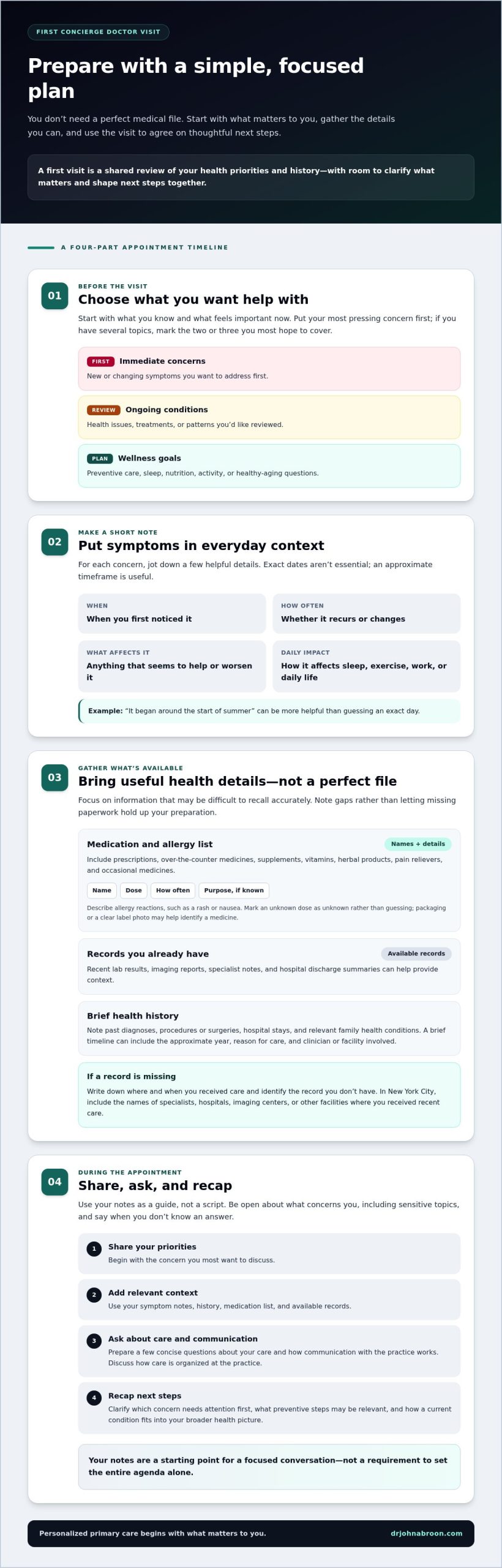
A first visit is a shared review of your health priorities and history, with the goal of understanding what matters to you and shaping thoughtful next steps together. Before the appointment, sort your priorities into three groups: immediate concerns, ongoing conditions, and longer-term wellness goals. This structure gives the conversation direction while leaving room for follow-up questions.
Choose the health concerns you want to discuss first
For each new symptom, change, or recurring concern, jot down when you first noticed it, how often it occurs, and whether anything seems to make it better or worse. Exact dates aren’t essential. “It began around the start of summer” is more helpful than trying to guess a precise day.
Note how the concern affects daily life. For example, mention if discomfort interrupts sleep, breathlessness changes how you exercise, or recurring headaches make it harder to concentrate at work. These details help your doctor understand the concern in context, not just as a symptom on a list.
- Immediate concerns: New or changing symptoms you want to address first.
- Ongoing conditions: Health issues, treatments, or patterns you’d like reviewed.
- Wellness goals: Preventive care, sleep, nutrition, activity, or healthy-aging questions.
Put the most pressing concern at the top, then add preventive and lifestyle questions. If you’re unsure what deserves priority, briefly list everything and mark the two or three topics you most hope to cover. That’s a practical starting point for how to prepare for your first concierge doctor visit, without expecting yourself to set the entire agenda alone.
Set realistic expectations for a concierge medicine appointment
Concierge practices can structure visits and services differently. A general overview of concierge medicine can explain the range of care models. During your appointment, discuss how your care is organized at Dr. John Abroon’s practice.
Think beyond “What will happen during the visit?” Consider what you want to understand by the end: which concern needs attention first, what preventive steps may be relevant, or how a current condition fits into your broader health picture. Ask the doctor to clarify priorities and explain the reasoning behind proposed next steps. For more context about this personalized approach in New York City, see the NYC concierge medicine guide.
Your notes are a guide, not a script. Be open about what you’re worried about, including sensitive concerns, and say when you don’t know an answer. A focused beginning gives your doctor a clearer sense of your needs and creates space for a personal conversation about preventive and primary care.
Gather your medical records, medication list, and health history
You don’t need to assemble a perfect file before your appointment. A few well-organized details can help your doctor understand your health background. Focus first on information that may be difficult to recall accurately, such as medication doses, procedure dates, and recent test results. Note any gaps rather than letting missing paperwork hold up your preparation.
Use this simple sequence to get started:
- Make a current list of medicines, supplements, and allergies.
- Collect test results and records you already have access to.
- Write a brief history of diagnoses, procedures, hospital stays, and relevant family health conditions.
- Note where and when you received care if a record isn’t available.
Make a useful medication and allergy list
An accurate medication list includes prescriptions, over-the-counter medicines, and supplements. For each item, write the name, dose, how often you take it, and its purpose if you know it. Include vitamins, herbal products, pain relievers, and medicines you take only occasionally. List medication allergies and describe the reaction, such as a rash or nausea, rather than recording only the drug name.
Keep the list somewhere easy to update, such as a phone note or a printed page. If you’re unsure of a dose, mark it as unknown instead of guessing. Bring the packaging or a clear photo of the label if that would help identify a medicine. Your doctor can review the information with you and clarify details during the visit.
Collect records without letting missing paperwork delay preparation
Gather records that are readily available, such as recent lab results, imaging reports, specialist notes, and hospital discharge summaries. You can also note past diagnoses, surgeries, hospital stays, and relevant family history. A brief timeline is enough to begin: record the approximate year, the reason for care, and the clinician or facility involved.
In New York City, include the names of specialists, hospitals, imaging centers, or other facilities where you received recent care. If a report is missing, write down where and when the care took place and identify the record you don’t have. Don’t spend all your preparation time chasing paperwork. A note about what’s unavailable gives your doctor useful context and helps distinguish missing information from care you haven’t received.
These practical steps can make how to prepare for your first concierge doctor visit feel more manageable: bring what you have, label what’s uncertain, and keep the information easy to review. Learn more about care with Dr. John Abroon and his practice’s approach to preventive health.
Prepare questions about your care, communication, and concierge services
A short list of questions can help you leave the appointment with a clearer understanding of your health and how your care will work. Separate clinical questions from questions about communication and practice procedures. This keeps your health priorities at the center while making room to understand the care relationship.
You don’t need to ask every question below. Choose the ones that fit your situation and start with what matters most. Open-ended prompts such as “How do you recommend we approach this?” invite a conversation, while a brief follow-up can clarify a specific detail. Treat your list as a guide, not an interview script.
Questions that help explain your health priorities
Ask questions that connect symptoms, personal history, and next steps. For example, ask which concern should be addressed first, whether a symptom needs follow-up, and how a recommended evaluation relates to what you’ve described. For preventive care, ask which steps make sense in light of your health history and individual risk factors. If a test is recommended, ask what it is intended to clarify and how the result may inform the plan.
Questions that clarify the care relationship
Ask how routine follow-up and communication work, and which services are part of professional care or may involve separate charges. Clear answers help you understand both the clinical plan and practical next steps. The practice’s approach to primary care on the Upper East Side connects ongoing internal medicine with personalized, preventive care.
Use this two-column guide to choose a few questions for your notes:
| Health questions to ask | Care-process questions to clarify |
|---|---|
| Which of my concerns should we address first? | How is routine follow-up handled in this practice? |
| Does this symptom need monitoring or follow-up? | What’s the best way to communicate about a non-urgent concern? |
| Which preventive steps fit my health history and risk factors? | Which services involve separate charges, if any? |
| How would a recommended test help answer our clinical question? | What should I expect after a test or evaluation is recommended? |
As you consider how to prepare for your first concierge doctor visit, keep each question specific to your needs. You might say, “I’d like to understand what this test could tell us,” or “What follow-up would make sense if this symptom continues?” If an answer uses unfamiliar terminology, ask for a plain-language explanation. A thoughtful exchange helps you understand the reasoning behind your care plan and take part in decisions about your health.
On appointment day, share your history clearly and leave with next steps
A useful first visit is a conversation, not a test of how much medical information you can recall. Begin with the concern or goal that matters most, then add the background your doctor needs to understand it. Refer to your notes, pause to think, or say when you’re unsure. Clear communication helps your physician build a fuller picture and decide what to explore next.
A simple sequence can keep the discussion on track:
- Lead with your priorities. Name the main concern and any other goals you hope to cover.
- Share relevant context. Explain when the issue began, how it has changed, and what you’ve tried or noticed.
- Ask your questions. Use your notes, and speak up if an explanation or term isn’t clear.
- Summarize the plan. Confirm what happens next, who is responsible, and any expected timing.
Explain symptoms and history in a clear, useful order
For a symptom, describe its beginning, pattern, and changes over time. Mention what affects it, whether it interferes with sleep or daily activities, and any past evaluation or treatment response that may be relevant. Connect those details to your current health priorities, such as managing an ongoing condition or discussing prevention. If you can’t remember an exact date or detail, say so rather than guessing.
Discuss sensitive concerns directly. You might say, “I’m uncomfortable bringing this up, but I’ve noticed…” or “I have a concern about…” A plain opening can help your physician understand what you’re experiencing. If a medical term is unfamiliar, ask for a simpler explanation or an example. You should leave understanding what was discussed, not feeling pressure to pretend everything is clear.
Next steps depend on your needs and the physician’s clinical judgment. An examination, diagnostic testing, or a recommendation may be appropriate, but the approach should relate to your history, symptoms, and priorities. Ask what a proposed evaluation is intended to clarify and how its results may inform your care.
Confirm the plan before leaving the appointment
Before the visit ends, briefly repeat the agreed plan in your own words. Confirm recommended tests, referrals, or follow-up arrangements, and ask whom to contact with questions about the plan or results. If a step has an expected timeframe, note it rather than assuming timing that hasn’t been discussed. Clarify any instruction you’re unsure how to follow before acting on it.
Keep a short record on paper or in your phone. Include the next action, who is responsible, and when it is expected to happen. This gives you a practical reference after you leave and helps you notice if a detail needs clarification. You can schedule a visit with Dr. John Abroon to begin a personalized primary care relationship.
Start your personalized primary care relationship with Dr. John Abroon
A first concierge visit can begin a more personal conversation about your health, not simply a review of one symptom. Dr. John Abroon is a board-certified internist and primary care physician serving New York City from Manhattan’s Upper East Side. His practice, established in 1997, emphasizes personalized care, preventive medicine, and modern diagnostic tools.
Your preparation provides useful context: what concerns you, what you’ve experienced, and what you hope to address. You don’t need every record or every answer. A thoughtful summary gives your internist a starting point for understanding your overall health and deciding which questions or next steps are relevant.
What your preparation helps your internist understand
Your priorities and health history frame the conversation, but recommendations should be specific to you. Your physician considers your history, examination, and clinical needs when deciding whether an evaluation, diagnostic test, or other next step is appropriate. Modern diagnostic tools can support that assessment when relevant to the concerns discussed. Testing is not a one-size-fits-all checklist.
Preventive care also benefits from personal context. Your current concerns, past diagnoses, family history, and health goals can help shape a discussion about which preventive steps may be suitable. If you’re thinking about routine health maintenance, the annual physical exam guide offers context on this aspect of preventive care.
Being prepared doesn’t mean arriving with a diagnosis or a complete medical file. It means helping your doctor understand the questions you want answered and the details that may matter. From there, the conversation can focus on your individual needs and clarify a practical direction for your primary care.
Take the next step toward a first visit in New York City
Before scheduling or attending, set aside your short list of priorities and gather records that are already available. Keep your notes easy to access, whether on paper or in your phone. If you don’t have a particular document, note what it relates to and where the care took place. Missing paperwork doesn’t erase the value of your account.
Knowing how to prepare for your first concierge doctor visit can help you begin the relationship with greater confidence, but you don’t have to make the conversation perfect. Bring what you have, speak openly about what matters to you, and ask for clarification whenever you need it. That is a sound foundation for personalized primary care in New York City.
To explore a first visit with Dr. John Abroon, request an appointment.
Take the next step with confidence
Your first visit doesn’t need to be perfectly planned to be worthwhile. A few clear priorities and an open conversation give your physician a useful starting point. Questions and follow-up help shape what comes next. Preparation supports the relationship, but you are not responsible for having every answer.
Knowing how to prepare for your first concierge doctor visit can help you arrive feeling more at ease and ready to take part in decisions about your health. From there, care can develop through an ongoing understanding of your needs, health history, and goals.
Dr. John Abroon is a board-certified internist and primary care physician serving New York City. At his Upper East Side practice, established in 1997, personalized care brings traditional medicine together with modern diagnostic tools. If you’re ready to explore a more individualized approach to primary care, explore care with Dr. John Abroon and request an appointment.
Frequently Asked Questions
Is a first concierge doctor visit the same as an annual physical?
Not necessarily. A first visit may focus on your medical background, current concerns, and goals, while an annual physical centers on preventive health. The two can overlap, depending on your needs and the practice’s approach. If you’re booking with a New York City physician for a specific symptom, mention it when arranging the visit so it can be considered alongside any preventive care you’re seeking.
How long does a first concierge doctor appointment take?
Appointment length varies by physician, practice, and the reason for your visit. Some concierge practices schedule extended consultations, but you shouldn’t assume a particular duration. Ask about the planned format when arranging the appointment, and allow time to discuss your history, priorities, and questions. If something changes, such as a new concern, let the practice know so it can advise you about scheduling.
Do I need to fast before my first concierge doctor visit?
Don’t fast unless you’ve been given instructions for a specific test or procedure. A first appointment doesn’t automatically require fasting. If you received preparation directions, follow them; if they’re unclear, contact the practice before your visit. Instructions may depend on whether a test is planned. Bring your medication and supplement list, and mention any dietary or medical concerns that could affect preparation.
Can I bring a family member or caregiver to my first visit?
You may find it helpful to have someone accompany you, particularly if you’d like support recalling details or taking notes. Whether another person can join and how they participate depends on the practice and your preferences. Raise your request when arranging the appointment. You can also ask to speak privately with the physician for part of the visit, especially if you want to discuss personal health matters independently.
Is concierge medicine covered by health insurance?
Coverage depends on your insurance plan and the specific service. A membership or retainer may be handled differently from professional medical services, so don’t assume one payment covers every visit, test, or service. Review your plan documents and ask the practice how billing is handled for the care you’re considering. This is general information, not insurance or financial advice; your insurer can explain your plan’s terms.
Can I see a concierge doctor if I already have a primary care physician?
You can explore concierge care while you have an existing primary care physician, but plan any transition to avoid gaps. Clarify who will manage prescriptions, pending test results, and ongoing conditions during the change. With your permission, sharing records can help a new physician understand your care history. If you’re considering how to prepare for your first concierge doctor visit, include a question about continuity so responsibilities are clear.
What if I don’t remember my full medical or family history?
Share what you remember and be clear about what you’re unsure of. Don’t guess at diagnoses or dates. A note such as “approximately five years ago” is more useful than a confident but inaccurate date. If you know a relative had a health condition but not the details, say that. Available records or the name of a prior New York clinician or facility may help fill in context later.