


What if the only thing standing between you and your Green Card is a single sealed envelope? Receiving a Request for Evidence can feel like your application has fallen into a USCIS black hole, especially with the agency now issuing deadlines as short as 30 days. It’s natural to feel a sense of urgency when your future in the United States depends on a clock that’s already ticking.
We understand that the uncertainty of the i-693 rfe response time can be overwhelming for many applicants in New York City. You’ve worked hard on your filing, and the fear of a technical error or a missed deadline is a heavy burden to carry. This guide will help you navigate the 2026 processing landscape with confidence. You’ll discover current USCIS timelines, learn how to prepare a bulletproof medical packet, and find out how a dedicated civil surgeon can help you avoid further delays. We’ll explore the path from RFE to approval, ensuring your journey toward permanent residency remains steady and personalized.
Key Takeaways
- Expect a typical i-693 rfe response time of 30 to 90 days for most NYC applicants, although USCIS maintains an official processing goal of 60 days after receiving your response.
- Identify the common reasons for medical RFEs in 2026, including the use of outdated form editions or missing diagnostic tests that are now mandatory for adjustment of status.
- Prepare for shorter response windows by gathering your vaccination history before your appointment to ensure your civil surgeon can complete your exam quickly and accurately.
- Select a USCIS-designated civil surgeon who offers a meticulous, concierge-level review to ensure your medical packet is complete and requires no further follow-up from immigration officers.
Understanding the I-693 Request for Evidence (RFE)
An I-693 Request for Evidence (RFE) is a formal notification from USCIS stating that your I-485 Adjustment of Status application is missing the required medical certification. While it may feel like a setback, this notice actually indicates that an officer is actively reviewing your file. It’s a critical bridge between your current status and permanent residency. Understanding the i-693 rfe response time starts with recognizing that this request is a priority; it is often the final piece of evidence needed to grant your Green Card.
The requirement for a medical exam is rooted in the long-standing history of medical examinations for immigrants, designed to ensure public health safety. In 2026, USCIS has become more stringent about the technical accuracy of these forms. If your initial submission was missing, expired, or contained clerical errors, the RFE is your one chance to correct the record without a denial. You must act with clinical precision to ensure the second submission is flawless.
Why did I get an RFE for a medical exam?
Most applicants receive an RFE because their medical documentation doesn’t align with the latest 2026 standards. Common triggers include:
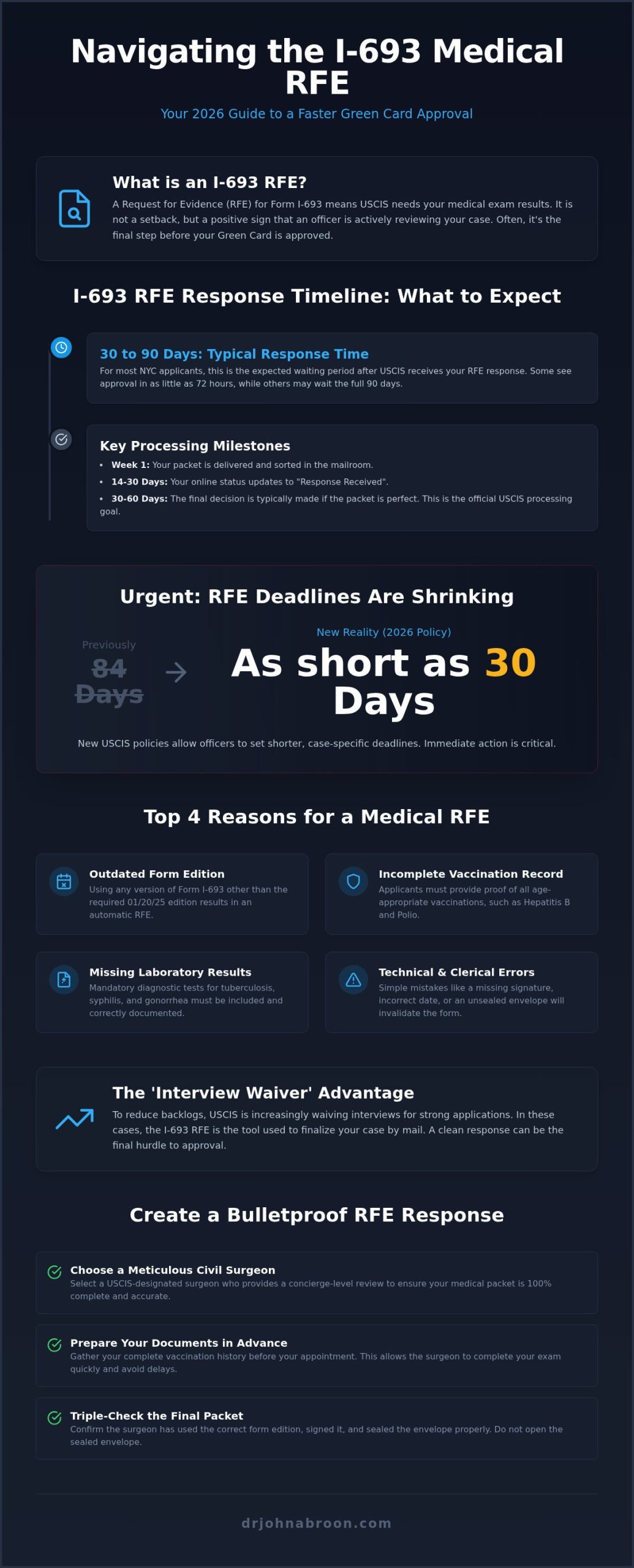
- Outdated Form Editions: As of July 3, 2025, USCIS only accepts the 01/20/25 edition of Form I-693. Submitting an older version results in an automatic RFE.
- Missing Laboratory Results: New diagnostic requirements for tuberculosis, syphilis, and gonorrhea must be strictly followed. If a civil surgeon misses a specific blood test, the entire form is invalid.
- Incomplete Vaccination Records: Applicants must show proof of all age-appropriate vaccinations. While the COVID-19 requirement was removed in January 2025, others like Hepatitis B and Polio remain mandatory.
- Technical Errors: Simple mistakes, such as a missing signature or an unsealed envelope, can trigger a request for a new exam.
Policy updates effective August 5, 2026, allow officers to set case-specific deadlines. While you might expect 84 days to respond, some notices now demand a return within 30 days. This makes immediate action essential.
The ‘Interview Waiver’ Trend in 2026
A significant shift in 2026 is the increasing frequency of interview waivers. To reduce backlogs, NYC Field Offices often waive the formal in-person interview if the rest of the application is strong. In these cases, the I-693 RFE is the tool USCIS uses to finalize the case by mail. When you receive this request, it often means you won’t have to step foot in a government office. A clear and accurate RFE response is often the final hurdle to your Green Card approval.
I-693 RFE Response Time: What to Expect in 2026
The period following the submission of your medical records is often filled with a mix of anticipation and anxiety. For most applicants in the New York City area, the i-693 rfe response time typically ranges from 30 to 90 days. While USCIS has established an official processing goal of 60 days for cases once an RFE response is received, the actual speed of your approval often depends on the specific workload of the officer assigned to your file. Some fortunate applicants see an approval notice within 72 hours of delivery, while others may wait several months as their case moves through the administrative queue.
Local geography plays a surprising role in these timelines. Applicants handled by the Manhattan Field Office may experience different rhythms than those processed in Queens or Brooklyn. This variation often stems from the volume of “interview waiver” cases being prioritized at any given moment. To ensure your paperwork is in perfect order before it reaches these busy offices, you might consider scheduling an immigration medical exam with a seasoned professional who understands these local nuances.
Timeline Milestones After Mailing Your Response
Understanding the internal journey of your mail helps manage expectations during the “black hole” period. During the first week, your packet is delivered and sorted in the field office mailroom. It’s a common myth that your online status will update within 14 days; in reality, it often takes 14 to 30 days for a clerk to scan your response into the system and trigger the “Response to USCIS Request for Evidence Was Received” notification. The final decision phase usually occurs between days 30 and 60, provided the medical packet is complete and follows the Official Form I-693 Information guidelines.
Confirmed vs. Estimated Processing Times
While official USCIS charts provide broad estimates, many applicants turn to community data on platforms like Reddit or the Lawfully app for real-time NYC insights. These crowd-sourced trackers often show that cases at the National Benefits Center (NBC) move at a different pace than those transferred to local field offices for final adjudication. Regardless of where your case sits, using certified mail with return receipt is non-negotiable. This provides the clinical certainty you need to prove delivery, allowing you to rest easy knowing the i-693 rfe response time clock has officially started. Accurate, well-documented submissions are the most effective way to ensure you stay on the shorter end of the processing spectrum.
Factors That Influence Your I-693 Approval Speed
The speed at which your Green Card is granted after submitting medical evidence depends on several moving parts. While community forums often suggest the process is entirely random, the i-693 rfe response time is actually influenced by specific administrative factors. We see many applicants who feel anxious about these delays, but often the wait is simply a matter of administrative queueing rather than a problem with the file itself.
One primary factor is the clarity of the RFE notice you received. A standard request asking for a missing I-693 is typically processed faster than a complex request requiring clarification on a specific medical condition or a vaccination waiver. If your background checks and other I-485 components are already cleared, the medical response is often the final trigger for approval. However, if USCIS is still waiting on security clearances, even a perfect medical submission won’t result in an immediate decision.
Field Office Workloads in New York City
The efficiency of your assigned field office plays a substantial role in your i-693 rfe response time. Manhattan (Federal Plaza) and Queens (Long Island City) are two of the busiest offices in the country. If your file is transferred to a different office to balance the workload, you may receive a “Case Transfer” notice. While this can feel like a delay, it often means your file is moving to a location with more immediate availability to review it. Additionally, keep an eye on the calendar; USCIS often pushes for a surge in approvals toward the end of the fiscal year on September 30 to meet annual quotas, which can lead to faster turnarounds in late summer.
The ‘Perfect Packet’ Advantage
You can influence your approval speed by ensuring your response is organized for maximum efficiency. A USCIS officer spends only a few minutes reviewing each file, so a clearly labeled packet helps them say “Yes” faster. Place the original RFE notice directly on top of your sealed medical envelope so the mailroom can route it to the correct officer immediately. Using a guide to the I-693 medical exam ensures you understand the clinical requirements before you even step into the doctor’s office. A perfect packet is one that requires no further clarification from a civil surgeon. By submitting a meticulous and accurate form, you remove the need for a second RFE, which is the single most effective way to avoid a “black hole” period in your application process.
How to Respond to an I-693 RFE to Avoid Delays
Responding to an RFE requires more than just filling out a form; it demands a strategic approach to ensure your case stays on track. Every day counts, especially since some notices now carry 30-day response windows. To optimize your i-693 rfe response time, you must act decisively. We recommend following these four clinical steps to minimize the risk of a second RFE or, worse, a Notice of Intent to Deny (NOID).
- Step 1: Locate a USCIS-designated civil surgeon in NYC immediately. Don’t wait until the final week. A seasoned expert can often accommodate urgent requests, but lab results still require 3 to 5 business days to process.
- Step 2: Gather all prior vaccination records. Having your history ready speeds up the exam and prevents the need for unnecessary booster shots.
- Step 3: Verify the form edition. As of July 3, 2025, USCIS only accepts the 01/20/25 edition of Form I-693. A specialized surgeon will ensure you’re using the correct version to prevent administrative rejection.
- Step 4: Keep the medical envelope sealed. USCIS will only accept the I-693 if it is in the original, unopened envelope provided by the doctor. Opening it voids the exam and requires a complete restart.
Choosing the Right NYC Civil Surgeon
Selecting a board-certified internist like Dr. Abroon provides a layer of reliability that high-volume clinics often lack. In a busy urban environment, many facilities prioritize speed over accuracy, leading to the very clerical errors that trigger RFEs in the first place. By choosing a practitioner with decades of experience, you ensure that every diagnostic requirement and vaccination entry meets the rigorous 2026 standards. For a detailed look at what to expect during your visit, consult our Immigration Medical Exam in NYC: Your Complete Guide to the I-693 Process. If you need to secure an appointment quickly, you can schedule your immigration medical exam today to keep your application moving forward.
Mailing and Tracking Your Response
Once you have your sealed envelope, how you send it is just as important as what’s inside. We strongly advise using USPS Priority Mail Express or FedEx with a “Signature Required” requirement. This provides undeniable proof of delivery and starts the clock on your i-693 rfe response time. If your online status hasn’t updated to “Response Received” after 60 days, it’s time to inquire with USCIS. Ignoring an RFE or missing the deadline is not an option, as it frequently leads to a denial of your entire I-485 application.
Fast-Track Your Medical RFE Response in NYC with Dr. Abroon
Receiving an RFE can be a high-stakes moment in your immigration journey. When you’re managing tight deadlines and the uncertainty of the i-693 rfe response time, you need a medical partner who prioritizes both speed and clinical excellence. Our Upper East Side practice offers a concierge-like experience that removes the administrative friction from your response. We understand that a single error on your medical form can lead to months of additional waiting or a second RFE. That’s why we provide a meticulous review of every vaccination and lab result to ensure it meets the strict 2026 USCIS standards. Our goal is to provide you with a sense of calm and reliability during what can be a stressful period of transition.
Every patient’s situation is unique, and we tailor our approach to address the specific concerns listed in your RFE notice. Whether you’re dealing with missing records from your home country or complex diagnostic requirements, we provide the personalized attention necessary to resolve these issues. By choosing a specialized practitioner, you ensure that your medical packet is prepared with the precision required for a swift Green Card approval. We focus on getting it right the first time so you don’t have to worry about your case falling back into a processing queue.
Expertise You Can Trust in Manhattan
Dr. John Abroon has served as a USCIS-designated civil surgeon since 1997. This deep-rooted experience in the NYC medical community allows him to navigate the specific preferences of local field offices with ease. As a board-certified Primary Care Physician NYC: Comprehensive Internal Medicine on the Upper East Side, he brings a level of diagnostic authority that high-volume clinics simply can’t match. Our facility is equipped with on-site diagnostic testing, including EKGs and blood work, which allows us to provide fast, reliable results. We don’t just fill out forms; we provide holistic care that addresses your total well-being while securing your immigration future.
Schedule Your RFE Medical Exam Today
Time is your most valuable asset when responding to a medical RFE. Our team is prepared to facilitate expedited appointments to help you meet the 30-day or 60-day deadlines set by USCIS. When you visit our office, please bring the original RFE notice, your passport, and all available vaccination records. We’ll handle the complex requirements of the 2026 medical exam, allowing you to focus on the next chapter of your life in the United States. Don’t let a clerical mistake prolong your i-693 rfe response time. Take the final step toward your Green Card with a team that values precision and personalized attention. Book your I-693 Medical Exam with Dr. Abroon today to ensure your response is handled with the care it deserves.
Securing Your Future with a Precise Medical Response
Navigating the final stages of your Green Card application requires both speed and technical accuracy. While the average i-693 rfe response time in 2026 reflects a busy administrative landscape, a meticulously prepared medical packet can significantly shorten your wait. By ensuring your submission uses the correct 01/20/25 form edition and includes all mandatory diagnostic tests, you eliminate the friction that often leads to avoidable delays. Your focus should remain on the goal: a seamless transition to permanent residency.
Professional guidance is your best defense against the administrative “black hole.” Dr. John Abroon, a USCIS-designated civil surgeon since 1997, offers the board-certified internist expertise needed to handle complex vaccination and laboratory requirements. At our convenient Upper East Side location, we provide the personalized care and concierge-level attention your case deserves. We understand the high stakes of your application and are committed to delivering results that stand up to the most rigorous federal review.
Schedule Your Fast-Track I-693 Exam in NYC with Dr. Abroon to ensure your response meets every current standard. You’ve come too far to let a clerical error stand in your way; we’re here to help you cross the finish line with confidence and peace of mind.
Frequently Asked Questions
How long does USCIS take to approve I-485 after RFE medical 2026?
USCIS typically approves an I-485 within 60 to 90 days after receiving your medical response. While the agency has an internal 60-day processing goal, the actual i-693 rfe response time depends on the current backlog at your local NYC field office. Some applicants receive approval in as little as two weeks, while others in Manhattan or Queens may wait longer during peak filing seasons or fiscal year transitions.
Can I submit my I-693 medical response in person at a NYC Field Office?
You generally cannot submit your medical response in person at a NYC field office unless specifically instructed in your notice. Most RFEs require you to mail the sealed envelope to a designated service center or field office address. If you have an upcoming interview, you may be told to bring it with you. Always follow the precise mailing instructions on your official notice to avoid administrative delays.
What happens if I miss the 60-day deadline for my I-693 RFE?
Missing the deadline stated in your RFE notice can lead to an immediate denial of your Green Card application. In 2026, USCIS officers have greater discretion to deny cases without further warning if deadlines aren’t met. Some notices now feature 30-day windows instead of the traditional 84 days. If you’re approaching the cutoff, contact a civil surgeon on the Upper East Side immediately to facilitate an expedited examination.
Does receiving an I-693 RFE mean my interview is waived?
Receiving a medical RFE often suggests that USCIS is attempting to adjudicate your case without a formal interview. This “interview waiver” trend has become common in 2026 to help reduce local backlogs. While it isn’t a 100 percent guarantee that your interview is canceled, providing a flawless medical packet is the best way to encourage a mail-based approval. A clear response often serves as the final step in the process.
Will USCIS send a confirmation when they receive my medical RFE response?
USCIS doesn’t typically send a physical letter confirming receipt, but your online case status should update to “Response to USCIS Request for Evidence Was Received.” This update often takes 14 to 30 days to appear. We strongly recommend using a mailing service with a signature requirement, such as FedEx or USPS Priority Mail Express. This provides you with clinical certainty that your documents reached the correct officer.
Can I use any doctor for my I-693 RFE response?
You must use a USCIS-designated civil surgeon for your I-693 medical exam. A regular primary care physician cannot sign the required forms unless they hold this specific federal designation. Dr. John Abroon has been a designated civil surgeon since 1997, providing the board-certified expertise necessary for these complex filings. Using an experienced professional ensures your vaccinations and lab tests meet the rigorous standards required for a successful response.
How much does a medical RFE response exam cost in NYC?
Fees for an immigration medical exam in NYC vary based on the specific diagnostic tests and vaccinations you require. These professional fees cover the doctor’s time for the physical assessment, the review of your medical history, and the processing of laboratory specimens for mandatory screenings like tuberculosis and syphilis. Since every patient’s vaccination history is unique, the total cost depends on which boosters or blood titers are clinically necessary for your file.
What should I do if my online status doesn’t change after mailing the I-693?
If your online status remains unchanged 60 days after delivery, you should take proactive steps to verify your case progress. Start by checking your certified mail or FedEx tracking to confirm the date and time of delivery. If the i-693 rfe response time exceeds the standard window, you can submit an online inquiry through the USCIS website or contact the National Customer Service Center for a status update on your application.