


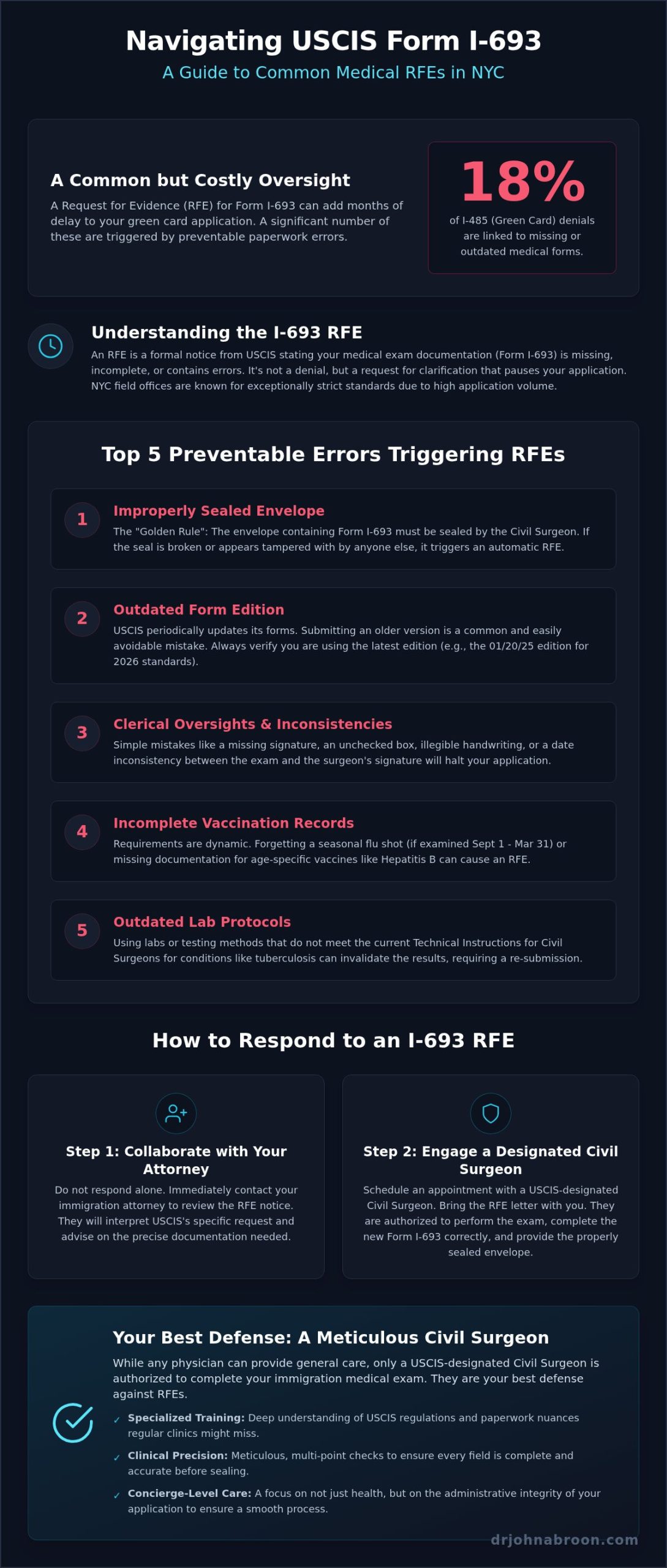
Did you know that roughly 18% of I-485 denials are linked to missing or outdated medical forms? It’s a staggering figure that highlights how even the most diligent applicants can be sidelined by a single clerical oversight. If you’ve received a notice from USCIS, you’re likely searching for the common reasons for i-693 rfe nyc to understand exactly where your process went wrong. We recognize the anxiety that comes with a potential delay, and we’re here to provide the clinical authority and warm reassurance you need to move forward confidently.
In this guide, you’ll discover the frequent mistakes that trigger these requests, such as using an outdated form edition or failing to meet the latest concurrent filing requirements. We’ll explain how a specialized medical exam on the Upper East Side ensures your paperwork is error-free and fully compliant with 2026 standards. By the end of this article, you’ll have a clear path to correcting your RFE and securing your green card approval with the help of a dedicated civil surgeon. You don’t have to navigate these complex requirements alone; precision and personalized care are within your reach.
Key Takeaways
- Understand why NYC field offices maintain exceptionally strict standards for medical documentation and how an RFE can impact your residency timeline.
- Identify the most common reasons for i-693 rfe nyc, including frequent clerical omissions and incomplete vaccination records that trigger automatic delays.
- Stay informed on 2026 USCIS policy updates, specifically regarding the mandatory form edition and the current validity rules for pending applications.
- Learn a proactive two-step approach to responding to an RFE by collaborating immediately with your immigration attorney and a designated civil surgeon.
- Discover how the meticulous, concierge-level care of a board-certified internist on the Upper East Side provides the clinical precision needed to avoid future errors.
Understanding the I-693 Request for Evidence (RFE) in NYC
An I-693 Request for Evidence (RFE) is a formal notice from USCIS indicating that your medical documentation is missing, incomplete, or contains errors. In the high-pressure environment of New York City, receiving this letter can feel like a significant setback. It essentially stalls your green card timeline, often adding months of waiting to an already lengthy process. However, it’s helpful to view an RFE as a request for clarification rather than a denial of your residency. It’s a procedural hurdle designed to ensure every applicant meets the health-related grounds for inadmissibility before a final decision is made.
The NYC field office is particularly strict because it manages one of the highest application volumes in the country. To maintain efficiency, officers often employ rigorous screening protocols where even minor discrepancies trigger a notice. Distinguishing between an administrative RFE, such as a missing signature, and a medical follow-up, like a request for further tuberculosis testing, is crucial. Understanding the common reasons for i-693 rfe nyc allows you to respond with the precision required to get your application back on track.
The Role of the USCIS Civil Surgeon
Only a physician designated by USCIS as a civil surgeon has the legal authority to sign your Form I-693. While a regular NYC internist provides excellent general care, they lack the specific training and authorization to certify immigration records. This distinction is where many applicants encounter trouble. Dr. John Abroon, a board-certified internist on the Upper East Side, has served as a designated civil surgeon for decades. This dual expertise means our practice doesn’t just check your health; we apply a meticulous clinical eye to the paperwork itself. We focus on the details that regular clinics might overlook, ensuring that your submission meets every specific USCIS standard from the start.
Common RFE Triggers in the New York District
The competitive NYC immigration market leaves little room for error. One of the most common reasons for i-693 rfe nyc is the use of outdated lab protocols or incomplete vaccination histories. NYC officers are known for their strict adherence to record-keeping. They frequently flag applications for:
- Illegible handwriting or unsealed medical envelopes.
- Missing dates on specific vaccination series required for 2026.
- Inconsistencies between the medical exam date and the civil surgeon’s signature.
A delay in New York isn’t just a matter of paperwork; it’s a loss of time and peace of mind. By choosing a practice that understands these local nuances, you protect your application from the automated filters that frequently sideline less precise submissions.
The Most Common Preventable Errors on Form I-693
The integrity of your medical documentation rests on a few critical, often overlooked details. Perhaps the most inflexible rule involves the sealed envelope. If the seal is broken or tampered with before it reaches a USCIS officer, your application will likely trigger an immediate Request for Evidence. This “Golden Rule” exists to ensure the medical findings remain exactly as the civil surgeon recorded them. We handle this process with extreme care, providing you with a pristine, tamper-proof envelope that meets every federal standard.
Clerical oversights remain high on the list of common reasons for i-693 rfe nyc. Even a single unchecked box or a missing signature on one of the form’s many pages can lead to an administrative halt. Officers look for absolute consistency between your personal data and the clinical findings. Ensuring you use the latest edition of Form I-693, currently dated 01/20/25, is another essential step in avoiding a preventable rejection. Our staff performs multiple quality checks to verify that every page is signed and every required field is complete.
Vaccination Record Discrepancies
Vaccination requirements are dynamic and vary by age and season. As of March 11, 2025, the COVID-19 vaccine is no longer a mandatory component of the immigration medical exam. However, the seasonal flu vaccine is required for all exams conducted between September 1 and March 31. Clinics often overlook age-specific requirements for Hepatitis B or Polio, which can lead to frustrating delays. Providing clear, translated evidence of your prior immunizations helps us document your history accurately. If you’re unsure about your records, consulting a board-certified internist in Manhattan can help clarify which boosters you truly need.
Laboratory Testing Omissions
Lab work is another area where precision is non-negotiable. USCIS requires specific screenings for tuberculosis, syphilis, and gonorrhea based on the applicant’s age. These omissions are among the most common reasons for i-693 rfe nyc. For instance, the IGRA blood test for tuberculosis is mandatory for most applicants age two and older. Screening for syphilis is required for those aged 18 to 44; gonorrhea testing applies to those aged 18 to 24. Missing even one of these age-mandated tests is a frequent trigger for an RFE. We work exclusively with USCIS-approved laboratory partners to ensure your results are processed correctly and integrated seamlessly into your final report.
Navigating 2026 USCIS Policy Changes and Form Editions
USCIS policies are notoriously fluid, and 2026 has introduced specific nuances that catch many Manhattan applicants off guard. Perhaps the most rigid requirement is the form edition date. As of July 3, 2025, the edition dated 01/20/25 became mandatory. If your civil surgeon uses an older version, your application will face an automatic RFE, regardless of your health status. This clerical mismatch is a leading factor among the common reasons for i-693 rfe nyc, often occurring when clinics fail to purge old stock from their digital or physical systems.
To safeguard our patients, we consult the Official USCIS Form I-693 Instructions weekly to monitor for sudden administrative shifts. Dr. Abroon verifies form versions daily to ensure every patient receives the most current documentation available. This high-level scrutiny is a hallmark of our concierge-level care on the Upper East Side, where we prioritize your peace of mind alongside your physical health.
Form Edition Precision
You can find the edition date in the bottom corner of every page of the I-693. It’s a small detail, but for a USCIS officer, it’s a binary pass-fail test. Manhattan clinics must stay updated on weekly USCIS bulletins to avoid submitting obsolete paperwork. Dr. Abroon verifies form versions daily to ensure every patient receives the most current documentation available. We maintain a direct line to these updates because we understand that your time is your most valuable asset in the NYC immigration process.
Validity Windows Explained
The “Forever Valid” rule is a significant policy shift that benefits many, but it requires careful interpretation. For forms signed by a civil surgeon on or after November 1, 2023, the I-693 generally remains valid as long as the underlying application is pending. This is a departure from the old two-year expiration rule. However, this validity is tied to a specific application; if you withdraw or face a denial, you’ll need a fresh exam for any new filing. Understanding these timelines helps prevent the clerical gaps that represent common reasons for i-693 rfe nyc.
Timing still matters, especially with the requirement for concurrent filing that began in late 2024. You should no longer wait for an RFE to submit your medical results; they must be filed alongside your Form I-485. We recommend scheduling your physical as soon as your legal team is ready to file. This proactive approach ensures your signature date aligns perfectly with your submission, preventing the issues that used to plague the system before the “60-day rule” was eliminated in March 2023. By securing your exam early with a board-certified internist, you eliminate the stress of last-minute corrections.
How to Respond to an I-693 RFE Effectively
Receiving a Request for Evidence (RFE) triggers an immediate sense of urgency, but it doesn’t have to signal the end of your application. Think of this notice as a precise roadmap for what USCIS needs to finalize your case. Your first move should be to review the letter with both your immigration attorney and an experienced civil surgeon. They’ll help you determine if the issue is a clerical omission, such as a missed signature, or a medical requirement like a missing lab test. Responding with clinical precision is the only way to avoid further delays in the competitive NYC immigration timeline.
Analyzing the USCIS Letter
USCIS letters use specific, often dense language to describe deficiencies. You might see phrases like “insufficient evidence of TB screening” or “outdated form version.” These clerical and medical gaps are among the common reasons for i-693 rfe nyc. It’s vital that you don’t open the original sealed medical envelope if it was returned to you. Opening that envelope yourself invalidates the document instantly. Instead, bring the RFE letter and any copies of your previous medical records to a specialist who can decode the officer’s specific concerns and provide a valid correction.
The Correction Appointment
When you realize your previous clinic made an error, you need a correction appointment that prioritizes meticulous detail. At our Upper East Side practice, Dr. John Abroon frequently performs “RFE rescues” for patients who were let down by high-volume clinics. For your visit, bring the RFE notice, your government-issued ID, and any immunization records you’ve gathered since your last exam. In 2026, our in-office diagnostic testing allows for rapid turnaround times, often resolving lab-based RFEs within just a few business days. This efficiency is critical because USCIS response deadlines are strictly enforced and leaving them to the last minute is risky.
Once the new Form I-693 is complete, Dr. Abroon will seal it in a fresh, tamper-proof envelope. We ensure every page is cross-referenced against the common reasons for i-693 rfe nyc to prevent a second notice. Finally, mail your response to the exact field office address listed on your RFE letter. We always recommend using a trackable mailing service to confirm delivery. Taking these decisive steps transforms a stressful delay into a manageable detour on your path to residency.
If you’ve received a notice from USCIS and need a reliable, error-free correction, schedule your immigration medical exam rescue with our Upper East Side team today.
Why a Trusted NYC Civil Surgeon is Your Best Defense Against RFEs
Choosing the right civil surgeon is the most effective way to address the common reasons for i-693 rfe nyc before they even occur. In the high-stakes environment of Manhattan, where immigration timelines are often measured in years, you need more than a signature; you need the clinical authority of a board-certified internist. Dr. John Abroon has provided this level of meticulous care since 1997, combining elite medical credentials with a supportive, personalized bedside manner. We treat your Form I-693 as a critical medical certification rather than a simple administrative task. Precision matters here.
Our practice bridges the gap between medical health and legal compliance. We maintain direct communication with your immigration attorney when necessary, ensuring that every detail aligns with your specific legal strategy. This concierge-level care reduces the inherent stress of the process, moving logically from the initial consultation to the final, tamper-proof sealing of your documents. By identifying potential issues early, we eliminate the common reasons for i-693 rfe nyc that often plague high-volume “exam mills.” We value your time.
Meticulous Medical Review
A thorough physical exam is your primary shield against health-related grounds for inadmissibility. Dr. Abroon’s personalized approach means we take the time to understand your complex medical history, preventing the vague documentation that often leads to follow-up requests. We offer diagnostic testing in-office, which streamlines the process and ensures that results are integrated into your report with absolute accuracy. This level of decisive action is why we are considered a premier destination for immigration medical services. For a deeper look at the logistics, see our Immigration Medical Exam in NYC: Your Complete Guide to the I-693 Process.
The Abroon Difference in Manhattan
Patients travel from all five boroughs to our Upper East Side clinic because they value reliability over speed. We reject the “exam mill” philosophy, opting instead for a “Done Right the First Time” approach that has earned us a reputation for excellence. Our UES location offers a calm, professional sanctuary where you can complete your diagnostic testing and exam in one coordinated visit. This environment is designed to make you feel empowered rather than overwhelmed. Don’t leave your residency to chance. Schedule your expert I-693 exam with Dr. John Abroon today and secure your future with confidence.
Secure Your NYC Residency with Clinical Precision
Navigating the complexities of immigration paperwork requires more than just filling out forms; it demands an expert eye that understands the nuances of 2026 USCIS regulations. By staying informed about the common reasons for i-693 rfe nyc, such as outdated form versions or missing laboratory results, you take the first step toward a successful application. Remember that an RFE is simply a request for clarity, and with the right medical partner, it’s a hurdle you can easily clear.
Dr. John Abroon brings over 25 years of experience as a board-certified internist to every consultation. Our Upper East Side practice provides a high success rate for RFE-free submissions by focusing on meticulous detail and personalized care. We offer in-office diagnostic testing to ensure your results are accurate and timely, giving you the peace of mind you deserve during this high-stakes journey. Don’t let clerical errors delay your future in Manhattan. Schedule Your USCIS Medical Exam on the Upper East Side today. Your path to a green card is within reach, and we’re here to ensure your medical documentation is as steady and reliable as your ambition.
Frequently Asked Questions
What happens if I open the sealed medical envelope by mistake?
If you open the sealed envelope, the document is immediately invalidated for USCIS purposes. The integrity of the form depends on it remaining sealed until an officer reviews it. You’ll need to return to your civil surgeon to have the results re-certified and placed in a fresh, tamper-proof envelope. We ensure our envelopes are clearly marked to prevent these accidental openings that cause unnecessary delays.
Can I use my regular primary care doctor for the I-693 exam in NYC?
You cannot use a regular primary care physician unless they are a USCIS-designated civil surgeon. While your doctor provides excellent general care, only a designated specialist has the authority to sign Form I-693. Dr. Abroon is a designated civil surgeon on the Upper East Side who specializes in these evaluations. Using a non-designated doctor is one of the common reasons for i-693 rfe nyc.
How long do I have to respond to an I-693 RFE from USCIS?
You must respond by the specific deadline listed on your RFE letter, which typically ranges from 30 to 90 days. USCIS doesn’t grant extensions for medical evidence, so it’s vital to schedule your correction appointment immediately. Failing to meet this deadline can result in the denial of your residency application. We prioritize RFE rescue appointments to help you meet these strict New York timelines and keep your case moving.
Does Dr. Abroon offer expedited lab results for RFE responses?
Dr. Abroon offers in-office diagnostic testing to provide a fast turnaround for RFE responses. Because we handle many screenings on-site at our Manhattan clinic, we can often finalize your results within a few business days. This speed is essential when you’re working against a USCIS deadline. We aim to make high-stakes medical decisions feel manageable through a combination of rigorous science and a supportive, welcoming narrative.
Why did USCIS say my vaccination record is incomplete if I have my shots?
USCIS often flags records as incomplete if they lack specific dates, proper translations, or age-mandated boosters like Hepatitis B. Even if you’ve had your shots, the documentation must meet strict federal standards for 2026. We carefully review your history to ensure every requirement is met. Clarifying these discrepancies is a key part of our personalized approach and helps avoid common reasons for i-693 rfe nyc.
Do I need to redo the entire medical exam if I only missed one test?
You often don’t need to redo the entire physical examination if you only missed a specific laboratory test. However, the civil surgeon must re-evaluate your record and sign a new Form I-693 with current dates. This ensures the entire document is consistent and valid for submission. We focus on correcting the specific deficiency identified in your RFE letter while maintaining the high clinical standards USCIS expects.
How much does it cost to fix an I-693 RFE in NYC?
The cost to resolve an RFE depends on whether you need new laboratory tests, additional vaccinations, or a re-certification of the form. Every patient’s situation is unique, so we provide a clear breakdown of the necessary professional fees after reviewing your USCIS notice. We position our clinic as a high-end, reliable alternative to “exam mills” by ensuring your correction is handled correctly the first time.
Is a chest X-ray always required for the green card medical exam in 2026?
A chest X-ray isn’t always required for the green card medical exam in 2026. USCIS protocols prioritize the IGRA blood test for tuberculosis screening in most applicants age two and older. You only need a chest X-ray if your blood test returns a positive result or if you have specific clinical symptoms. We perform the required blood work in-office to determine the most appropriate next steps for your health and residency.