


A concierge label doesn’t automatically make primary care personal. If you’re searching for personalized primary care nyc, look beyond the payment model and ask what care involves in practice: Does the physician consider your health history, explain recommendations clearly, and tell you how follow-up works? These details matter whether you’re considering a traditional practice or concierge medicine.
It’s reasonable to want a doctor who sees you as an individual, while finding it difficult to compare appointment processes, communication, and available services. Personalization can take different forms and doesn’t automatically require a membership. The right fit depends on your health needs, preferences, and what the practice offers.
This guide explains what individualized primary care may include, how to compare physicians in New York City, and which questions to ask before choosing. It also covers the value of an internist’s training and practical factors such as location. Dr. John Abroon is a board-certified internist with an Upper East Side practice established in 1997, offering one local example to consider as you compare options.
Key Takeaways
- Personalized primary care nyc should take your medical history, needs, and priorities into account, with clear expectations for follow-up rather than relying on a label alone.
- Compare physicians by credentials, internal medicine experience, clinical scope, and how they address your concerns and preventive-care priorities.
- Understand the difference between individualized care, concierge medicine, and an annual physical before deciding what fits your needs.
- Ask about appointment scheduling, communication, insurance, and payment arrangements, then decide whether the practice’s approach works for you.
- Prepare a concise medical history, medication list, and questions for your first discussion. Dr. John Abroon is a board-certified internist on the Upper East Side offering annual physical exams and diagnostic testing.
What Personalized Primary Care in NYC Should Mean for You
Personalized primary care is care guided by a patient’s medical history, current needs, health priorities, and appropriate follow-up.
When comparing personalized primary care nyc options, focus on how the physician applies that approach. A useful visit gives you room to describe what has changed, explain your main concerns, and discuss how your health history may affect next steps. The conversation should respond to your circumstances, not simply follow the same checklist for every patient.
Primary care can include prevention, assessment of health concerns, and ongoing care. Personalization helps shape how a physician considers those areas for an individual. It describes an approach, not a guarantee of a particular appointment length, access to a physician, outcome, or follow-up schedule. Ask each practice what its process includes and confirm the details that matter to you.
How individualized care differs from a one-size-fits-all visit
A tailored clinical conversation considers your medical history alongside current symptoms, medications, and relevant family or lifestyle context. For example, a new concern may call for a different discussion than a routine check-in. An existing diagnosis may also affect which questions or next steps are appropriate.
Testing and recommendations should reflect individual circumstances and clinical judgment. A diagnostic test may be useful for one patient and unnecessary for another. Screening and follow-up needs can also vary, so don’t assume every patient should receive the same tests or follow the same schedule. Ask why a recommendation is being made, what it is intended to address, and how you’ll hear about results or next steps.
Who may value a more tailored primary care relationship
An individualized approach may appeal to people managing ongoing conditions, facing changing health needs, or coordinating care with multiple specialists. It may also suit someone looking for preventive guidance and a consistent point of contact for discussing health concerns over time.
Your priorities are personal. One patient may value a physician’s internal medicine experience, while another may focus on clinical scope, location, or communication and follow-up. Confirm that the services you need are offered, then ask how the practice would approach your situation. The right fit depends on both your needs and preferences and what the practice can provide. Concierge medicine is a separate practice model that may involve a membership, not the definition of personalized care itself.
What to Evaluate in a Personalized NYC Primary Care Practice
Once you’ve identified what matters to you, compare each physician’s training and practice processes with your needs. A polished website or broad service list can’t tell you exactly how a doctor will approach your health. Ask specific questions about clinical expertise, available services, and what happens after a visit.
Compare credentials, specialty fit, clinical scope, medical-history review, testing, results communication, referrals, and appointment access. For more ideas, the MedlinePlus guide to Choosing a primary care provider includes questions to consider as you evaluate your options.
Questions about clinical expertise and services
Ask whether the physician’s specialty and experience fit your health concerns. An internist specializes in adult medicine, which may be relevant if you’re managing ongoing health issues or several concerns at once. Find out how the physician reviews your medical history, current symptoms, medications, and preventive-care priorities before making recommendations.
Clarify which diagnostic tests the practice performs in-office and how the physician decides whether a test is appropriate for you. Dr. John Abroon is a board-certified internist, and his practice offers in-office EKG and pulmonary function testing. The availability of a test doesn’t mean every patient needs it. Ask how the practice handles concerns outside its stated services, including whether you may need care from another clinician.
Questions about communication and continuity
Ask how you’ll receive test results and who will explain recommended next steps. Find out how the practice shares relevant information with outside clinicians involved in your care, and whether you should provide records or contact details for your specialists. These questions help you understand the office’s approach to continuity without assuming every practice coordinates care in the same way.
Be direct about appointment access and communication: How do patients request appointments? How should you contact the office with a question? What is the process for discussing a concern between visits? Confirm current scheduling and communication practices with the office instead of relying on general assumptions about personalized primary care nyc.
Use the answers to assess both clinical and practical fit. For a closer look at a Manhattan practice, review Dr. John Abroon’s primary care practice and its stated services on the Upper East Side.
Personalized Care, Concierge Medicine, and Annual Physicals: Know the Difference
These terms describe different things. A personalized approach refers to how a physician considers your health and preferences. Concierge medicine describes a practice model that may include a membership. An annual physical is a specific type of visit. Understanding the difference helps you compare personalized primary care nyc options without assuming that a label tells you what care, access, or costs to expect.
| Term | What it describes | What to clarify |
|---|---|---|
| Personalized approach | Care shaped by your health history, needs, and priorities. | How the physician tailors discussions, recommendations, and follow-up. |
| Concierge medicine | A practice model that may involve a membership alongside other payment arrangements. | Membership terms, services included, insurance, fees, and access policies. |
| Annual physical exam | A visit to review health and discuss relevant concerns and preventive questions. | What the visit covers and whether additional follow-up may be recommended. |
Does personalized primary care mean concierge medicine?
Not necessarily. A physician can take an individualized approach, but that phrase alone doesn’t establish a membership, particular access, or payment terms. Concierge medicine is a distinct practice model, and arrangements vary. Ask the practice what any membership includes, how payment works, and which services or access policies apply. Don’t infer specific benefits from the word “concierge.” For more detail as you consider the model, see this NYC concierge medicine guide.
Choosing a physician also means weighing practical and clinical fit, not just terminology. MedlinePlus offers guidance on how to choose a primary care provider, including factors to consider when evaluating a practice.
How an annual physical fits into ongoing primary care
An annual physical exam is an opportunity to review your health, relevant history, and questions about prevention. It isn’t, by itself, a complete definition of an ongoing primary care relationship. Depending on your findings and your clinician’s judgment, you may need additional discussion or follow-up. Recommendations aren’t identical for every patient. Learn more about what to expect from an annual physical exam in NYC.
How to Decide Whether a NYC Primary Care Physician Fits Your Needs
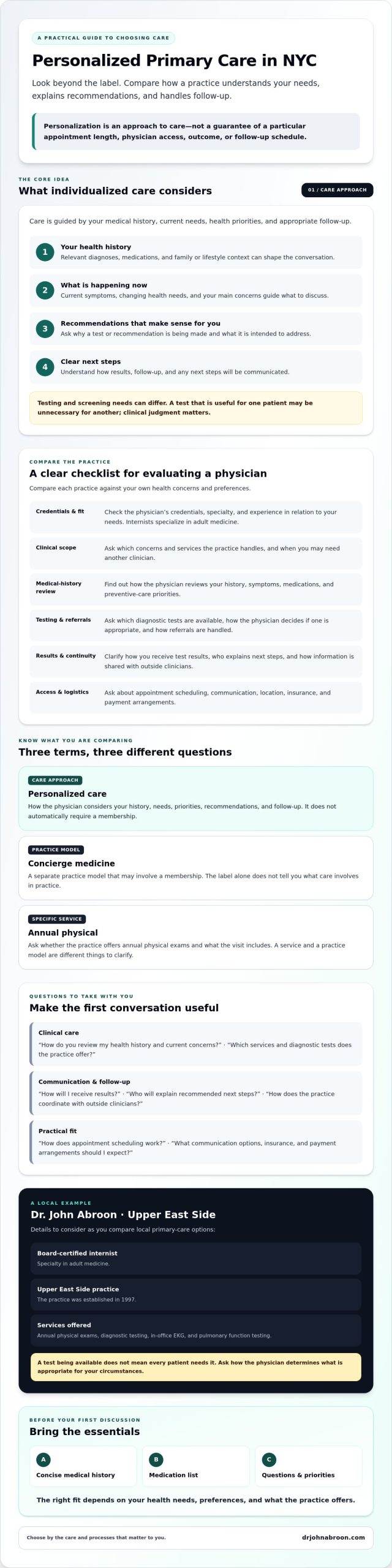
Choosing among personalized primary care nyc options is easier when you turn broad preferences into specific questions. Use this four-step process to compare clinical fit, practical details, and whether the physician’s approach feels right for you.
- 1. Identify your priorities. List your main health concerns, ongoing care needs, current clinicians, and what you want help managing. Decide which factors matter most, such as internal medicine experience, location, or communication preferences.
- 2. Confirm the practice’s scope. Ask whether the physician’s specialty and services align with your needs. If you see specialists, find out how the practice handles records and relevant information from outside clinicians.
- 3. Ask practical questions. Confirm the current appointment-request process, communication options, accepted insurance, and payment arrangements directly with the practice. Ask how results, referrals, and recommended follow-up are handled rather than assuming those processes are the same everywhere.
- 4. Assess the fit. Consider whether the physician listens carefully, explains recommendations clearly, and addresses your priorities. Practical details matter too: an office that’s convenient for an initial appointment may be difficult to reach regularly.
A practical checklist before choosing a physician
Before contacting a practice, write down your main health priorities, current clinicians, and any ongoing care needs. Prepare a concise medical history, current medication list, and questions you want answered. Confirm the practice’s services and logistics directly, including scheduling, communication channels, and payment details.
Consider travel within NYC as well. If you’re looking at a practice on Manhattan’s Upper East Side, think about how manageable the trip from home or work would be for regular visits or follow-up. Convenience isn’t a substitute for clinical fit, but location can affect how easily care fits into your routine.
What to discuss at an initial visit
Ask how the physician considers your history when discussing prevention and decides whether a test or recommendation is appropriate. Clarify how you’ll receive results, discuss next steps, and handle referrals. If you already work with specialists, ask what records or contact information would help support communication about your care. A useful first discussion should give you a clearer understanding of the physician’s approach, rather than leaving you to make assumptions about services or access.
For broader context as you compare options, read this Upper East Side primary care physician guide. If Dr. John Abroon’s location and clinical background seem relevant, explore his primary care practice and confirm current details directly with the office.
Explore Personalized Primary Care with Dr. John Abroon on the Upper East Side
Dr. John Abroon is a board-certified internist and primary care physician with a practice on Manhattan’s Upper East Side. For patients comparing personalized primary care nyc options, his internal medicine background and the practice’s services offer concrete points to explore. The practice was established in 1997, a local detail to consider alongside your clinical priorities and practical needs.
What patients can learn about the practice
The practice offers annual physical exams and diagnostic testing, including in-office EKG and pulmonary function testing. Other services include immigration medical exams, pre-operative medical clearances, travel medicine, weight-loss management, urgent care, executive physicals, and concierge medicine. Availability doesn’t mean a service is appropriate for every patient. Ask whether a specific service fits your situation and how the physician determines what care or testing is suitable.
A service list can help you decide what to ask, but it won’t answer every question about the patient experience. If you’re considering the practice, ask how your medical history and current concerns would inform a discussion, and what next steps might be relevant to your needs. Consider whether the Upper East Side location is practical for appointments and any follow-up you may need.
A clear next step for NYC patients
Before speaking with the office, note your main health priorities, prepare a concise medical history and medication list, and write down your questions. You might ask which services relate to your needs, how to request an appointment, what communication options are available, and how insurance and payment arrangements work. Confirm current details directly, since scheduling, coverage, and practice policies can change.
A useful conversation can help you assess clinical and practical fit. Notice whether your questions are answered clearly and whether you understand what the practice offers, what may require another clinician, and how recommended follow-up is handled. These details can help you decide whether the physician’s approach aligns with your expectations without assuming a particular outcome or level of access.
If the location and services seem relevant to your priorities, explore Dr. Abroon’s practice and contact the office to confirm current service details and ask your questions. Focus on the physician’s qualifications, the care you’re seeking, and whether the practice’s approach seems suitable, rather than deciding based on a label alone.
Choose Care That Fits Your Health and Your Life
The right personalized primary care nyc option is about more than a label. Look for a physician who considers your health history and priorities, explains recommendations clearly, and offers services that fit your needs. Before choosing, compare clinical qualifications, ask how communication and follow-up work, and confirm practical details such as scheduling and payment directly with the practice.
Dr. John Abroon is a board-certified internist and primary care physician with an Upper East Side practice established in 1997. Its in-office diagnostic testing includes EKG and pulmonary function testing. Whether a particular service is appropriate depends on your circumstances and clinical judgment.
If the location and practice details align with what you’re looking for, explore primary care with Dr. John Abroon and contact the office to confirm current services and practical arrangements. A conversation with the practice can help you take a considered next step.
Frequently Asked Questions
What does personalized primary care mean?
Personalized primary care means a physician considers your medical history, current concerns, health priorities, and appropriate follow-up when discussing your care. In NYC, you can prepare for a visit by bringing your medication list and questions so the physician can understand your circumstances. Personalization describes an approach, not a guarantee of specific appointment access, services, or outcomes. Ask how the practice reviews your history and communicates recommended next steps.
Is personalized primary care the same as concierge medicine?
No. Personalized care describes a clinical approach, while concierge medicine is a practice model that may involve a membership arrangement. The term “personalized” alone doesn’t tell you what a practice charges, what a membership includes, or what access policies apply. Ask the office to explain its payment arrangements, services, and communication policies. Dr. John Abroon’s New York practice offers concierge medicine, but confirm current terms directly with the practice.
How do I choose a primary care physician in NYC?
Choose a physician whose qualifications, clinical experience, and services align with your needs, then consider the practical fit. Ask how the physician considers your history and preventive-care priorities, how the office handles results and follow-up, and how referrals are approached. Confirm current scheduling procedures, insurance participation, payment details, and communication options as well. For Manhattan patients, location and travel time may matter for ongoing visits. Dr. John Abroon is a board-certified internist on the Upper East Side.
Can a primary care physician coordinate care with my specialists?
A primary care physician may consider information from your specialists as part of your overall care, but coordination processes differ by practice. Ask how records are shared, whether you should provide specialist notes or contact details, and how recommendations from different clinicians are addressed. Don’t assume information will transfer automatically. Before a visit, make a list of your specialists and bring relevant records or test results if the office requests them.
What happens at a personalized primary care visit?
A personalized primary care visit may include discussion of your health history, current concerns, medications, and questions about prevention. The physician may recommend an examination, testing, or follow-up based on your situation and clinical judgment. Dr. Abroon’s practice offers annual physical exams and in-office diagnostic testing, including EKG and pulmonary function testing. These services aren’t appropriate for everyone, so ask what your clinician recommends and why.
How often should I see a primary care physician?
There isn’t one visit schedule that fits every patient. How often to see a primary care physician depends on your health, medical history, current concerns, and clinician recommendations. Someone managing an ongoing condition may need a different follow-up plan than someone coming in with a specific question or for an annual physical exam. Ask your physician what timing makes sense for you, and how to arrange follow-up if your needs change.