


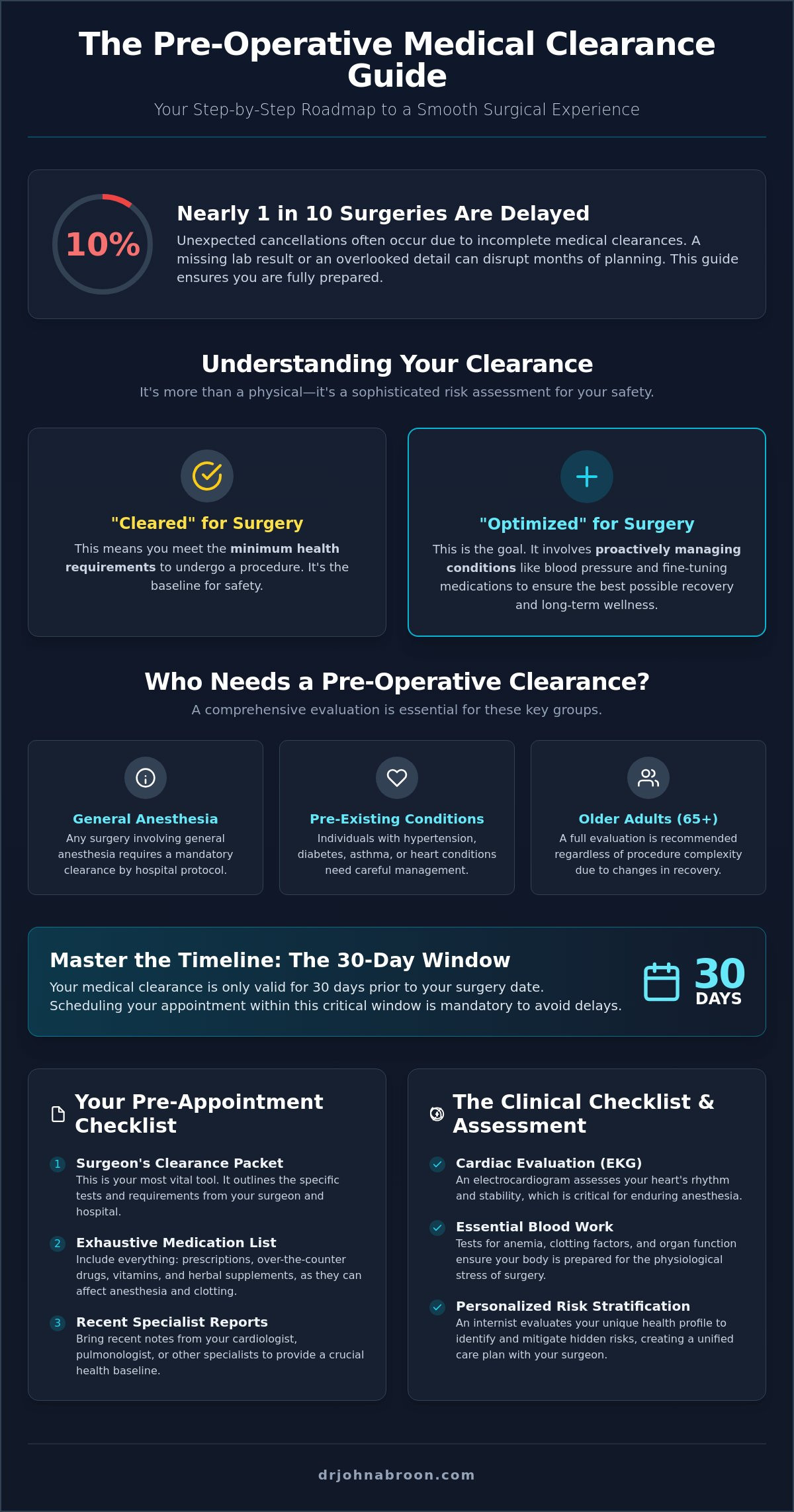
Nearly 10% of surgeries face unexpected delays or cancellations because of incomplete medical clearances. In a city where schedules are tight and hospital protocols are rigorous, missing a single lab result can disrupt months of planning and preparation. It’s a stressful hurdle that no patient should have to face while already managing the natural anxieties of an upcoming procedure.
We believe your focus should stay on your recovery, not on chasing down paperwork. This comprehensive pre-operative clearance checklist nyc guide provides a clear, step-by-step roadmap to ensure your medical clearance is handled with clinical precision and personalized care. By following this guide, you’ll gain a thorough understanding of your surgical risk and ensure a “passed” report reaches your surgeon’s desk on time. We will walk you through the specific diagnostic tests required, the critical 30-day validity window, and the essential documents you need for an efficient, stress-free appointment at our Upper East Side practice.
Key Takeaways
- Understand why a specialized medical clearance is a critical safety measure rather than a routine physical.
- Learn which documents and medication lists to gather to ensure your appointment is efficient and productive.
- Follow a comprehensive pre-operative clearance checklist nyc to identify the diagnostic tests, such as EKGs and blood work, that prevent surgical delays.
- Master the timing of your clearance to stay within the mandatory 30-day window required by New York City hospitals.
- Discover the benefits of choosing a board-certified internist for a personalized risk assessment that prioritizes your safety and long-term health.
What is Pre-Operative Medical Clearance and Why is it Mandatory?
A pre-operative medical clearance is a specialized diagnostic evaluation that determines if a patient is physically prepared to undergo the physiological stress of surgery and anesthesia. While it may feel like another administrative step, it’s actually a sophisticated risk assessment. Preoperative care ensures that every body system, particularly the heart and lungs, can withstand the procedure. In the competitive medical landscape of New York City, surgeons rely on independent internists to provide an objective, deep-dive analysis of a patient’s health. This separation of duties ensures that the professional performing the surgery and the professional assessing the risk are both focused entirely on their specific areas of expertise, maximizing your safety.
There is a significant difference between being “cleared” for surgery and being “optimized” for surgery. A simple clearance might mean you meet the minimum health requirements to survive a procedure. Optimization is our goal. It involves fine-tuning your health, adjusting chronic medications, and managing underlying conditions like high blood pressure or anemia to ensure you have the best possible recovery. This process isn’t just about avoiding a “no” from the hospital; it’s about securing the best possible “yes” for your long-term wellness. From a legal standpoint, following the New York State Surgical and Invasive Procedure Protocol (NYSSIPP) is mandatory for all NYC hospitals and diagnostic centers, requiring a verified clearance to prevent complications before they occur.
The Role of the Internist in Risk Stratification
An internist acts as a medical detective during the clearance process. We look beyond the surface to evaluate cardiac and pulmonary stability, which are the two most critical factors when administering anesthesia. We identify “hidden” conditions, such as undiagnosed heart murmurs or respiratory issues, that could complicate your time in the operating room. By collaborating directly with your surgical team, we create a unified care plan that addresses your unique physiology. This partnership ensures that everyone in the room is aware of your specific health profile before the first incision is made.
Who Needs a Clearance Checklist?
Not every minor procedure requires a full medical workup, but a pre-operative clearance checklist nyc is essential for several key groups. If you are undergoing any surgery involving general anesthesia, your hospital will mandate this clearance. It’s also vital for individuals with pre-existing conditions like hypertension, diabetes, or asthma, as these require careful management during the surgical window. Finally, older adults, typically those age 65 and over, should always seek a comprehensive evaluation, regardless of the procedure’s complexity. This accounts for the natural changes in how the body processes anesthesia and recovers from trauma. Using a pre-operative clearance checklist nyc ensures that no detail is overlooked during these critical assessments.
Your Pre-Appointment Checklist: What to Gather Before Your Visit
Success in the exam room depends heavily on the preparation you do at home. Your surgeon’s office should provide a “Clearance Packet.” This document is your most vital tool. It outlines the specific expectations of the surgical facility and the anesthesia team. Without it, your internist is working with incomplete information. This packet often dictates the exact parameters of your pre-operative clearance checklist nyc, ensuring every box is checked according to hospital protocol. It acts as the bridge between your surgeon’s requirements and our clinical findings.
Your medication list must be exhaustive. Don’t limit this to prescription drugs. Include over-the-counter pain relievers, herbal supplements, and daily vitamins. Certain supplements can significantly interfere with blood clotting or anesthesia. We also need to see recent reports from any specialists you visit regularly. If you see a cardiologist or pulmonologist, their most recent notes provide a baseline for your current stability. While we will perform the common tests before surgery during your visit, comparing these new results to your history is how we identify subtle, high-risk changes. If you have questions about which records are necessary, the team at Dr. John Abroon’s practice is ready to provide guidance before your scheduled visit.
Documentation and Paperwork Essentials
Effective communication between your internist and the surgical center is paramount. Before your appointment, verify the exact forms required by your NYC surgical center. Some facilities have proprietary digital portals, while others rely on traditional faxes. Confirm the direct fax number or email for your surgeon’s clinical coordinator. We recommend keeping a personal physical copy of all your results. This ensures that if a digital file is misplaced on the morning of your procedure, you have the proof of clearance in hand. If you are a new patient, arrange for your historical medical records to be sent to our office ahead of time to ensure a seamless review.
Personal Health History Preparation
Your personal narrative is just as important as your lab results. Think back to any previous procedures. Did you experience nausea or a slow wake-up time after anesthesia? Does anyone in your family have a history of complications with sedation? These details are critical for the anesthesiologist. Create a clear list of all allergies, paying close attention to latex or specific medications like penicillin. Document any recent changes in your physical stamina. If you find yourself experiencing new shortness of breath or a decrease in exercise tolerance, these are vital data points for our risk stratification. Providing this level of detail makes your pre-operative clearance checklist nyc a truly personalized safety plan.
The Clinical Checklist: Essential Tests and Screenings
The foundation of any pre-operative clearance checklist nyc is the comprehensive physical exam. This assessment isn’t a routine checkup; it’s a targeted systemic review designed to stress-test your health before the surgeon begins. We monitor your vital signs to establish a stable baseline and perform a deep-dive examination of your heart, lungs, and neurological function. This ensures your body is resilient enough to handle the trauma of surgery and the subsequent recovery phase.
Decoding the Diagnostic Tests
An Electrocardiogram (EKG) is the “gold standard” for pre-op cardiac screening. Even if your surgery isn’t heart-related, anesthesia significantly impacts your heart rate and rhythm. An EKG allows us to detect underlying arrhythmias or signs of previous silent heart damage that could pose a major risk under sedation. Following established Preoperative testing guidelines, we also order specific blood panels to look for hidden vulnerabilities. A Complete Blood Count (CBC) identifies anemia or infection, while a Basic Metabolic Panel (BMP) evaluates electrolyte balance and kidney health, both of which are crucial for processing surgical medications.
Coagulation studies are equally vital for your safety. These tests measure how quickly your blood clots. If your blood is too “thin,” the risk of surgical hemorrhage increases; if it’s too “thick,” the risk of post-operative blood clots rises. For patients with a history of smoking or chronic asthma, we may include Pulmonary Function Testing to evaluate oxygen transfer. We also perform a urinalysis to screen for asymptomatic infections. These minor infections could otherwise travel through the bloodstream and cause serious complications at the surgical site.
In-Office Testing vs. External Labs
Timing is everything in the New York medical world. Utilizing in-office diagnostic testing offers a distinct advantage for busy patients. Instead of traveling to a separate lab and waiting days for results, we handle most screenings during your visit. This efficiency is a core component of a successful pre-operative clearance checklist nyc, as it allows us to identify and address any abnormalities immediately.
Same-day testing prevents unnecessary delays in the NYC surgical cycle. When we control the diagnostic process, we ensure that every lab result and EKG tracing is accurate and sent directly to your surgeon’s coordinator. This streamlined approach eliminates the risk of lost paperwork and ensures your surgical team has every piece of data they need to proceed with confidence. By keeping everything under one roof, we provide a seamless experience that respects your schedule and your health.
The Timeline Checklist: Managing Your Clearance Schedule
Timing is the most common reason for surgical delays in New York City. Even with a perfect health profile, a report that arrives too early or too late can trigger a mandatory postponement. Most major NYC hospitals and surgical centers enforce a strict 30-day validity period for medical clearances. This ensures that the data reflecting your cardiac and pulmonary health is current and accurate on the day of your procedure. Managing this window requires a strategic approach to your pre-operative clearance checklist nyc, balancing the need for early data with the reality of expiration dates.
Navigating the 30-Day Rule
The 30-day rule is a safety protocol, not just a bureaucratic hurdle. If your health status changes between the exam and the surgery, the risk profile of the anesthesia changes as well. For this reason, we recommend booking your appointment for 14 to 21 days before your surgery date. This specific timing provides a “buffer zone” that is late enough to stay within the 30-day window but early enough to address any unforeseen issues. If your surgery is postponed for any reason, you must check with your surgical coordinator immediately. Many facilities require a full re-clearance if the new date falls even one day outside the original 30-day period.
Handling Abnormal Test Results
An abnormal lab result or an irregular EKG reading does not automatically mean your surgery is cancelled. Instead, it initiates the “optimization” phase of your care. If we discover elevated blood sugar or high blood pressure, we use the remaining time before your surgery to stabilize these levels. This proactive management is why the 14 to 21-day booking window is so vital. It allows us to coordinate quick follow-ups with specialists on the Upper East Side without disrupting your surgical schedule. We focus on fine-tuning your physiology so you arrive at the hospital in peak condition. If you are approaching your surgical date and haven’t secured an appointment, you can schedule your pre-operative clearance with our team to ensure your timeline remains intact.
The final step in your timeline is verification. Once our office completes the evaluation, we send the “passed” report directly to your surgeon’s coordinator. We recommend that patients call the surgical office 48 hours after their clearance appointment to confirm the documents were received and uploaded into the hospital’s system. This final confirmation closes the loop and provides the peace of mind you need as you head into your procedure. A successful pre-operative clearance checklist nyc is only complete when the surgeon has the physical report in hand, ready for your “time out” before the operation begins.
Expert Pre-Operative Clearance on the Upper East Side
Selecting the right physician for your medical evaluation is a decision that impacts both your safety and your peace of mind. While a walk-in urgent care clinic may offer basic convenience, these facilities often lack the deep clinical continuity and specialized expertise required for a truly thorough risk assessment. Dr. John Abroon provides a sophisticated alternative, combining the rigorous standards of a board-certified internist with the personalized, concierge-style care expected in Manhattan’s premier medical community. Our approach ensures that your pre-operative clearance checklist nyc is not just a form to be signed, but a comprehensive strategy for a successful surgical outcome.
The Benefits of Professional Coordination
One of the greatest stressors for surgical patients is the logistical “back-and-forth” between different medical offices. We eliminate this friction by acting as the central hub for your preoperative data. Dr. Abroon’s extensive experience with major NYC hospitals and surgical centers means we understand the specific nuances and preferences of the city’s top surgical teams. We provide pre-operative medical clearance expertise that bridges the gap between your primary health history and the immediate requirements of the operating room. When a question arises from an anesthesiologist or a surgical coordinator, we speak their language and provide the necessary clinical data directly, ensuring your procedure remains on schedule.
Ready for Your Surgery? Book Your Clearance
Preparing for surgery is a significant life event, and we believe your medical clearance should be the most reassuring part of that journey. When you schedule a priority pre-op appointment at our Upper East Side office, you aren’t just a number in a waiting room. You are an individual whose total well-being is our primary focus. During your visit, Dr. Abroon conducts a focused, unhurried consultation that covers every aspect of your pre-operative clearance checklist nyc. We review your results in real-time, discuss any necessary health optimizations, and ensure you feel empowered with knowledge before you leave.
Our facility is designed to respect the busy schedules of Manhattan professionals. By offering in-office diagnostic testing and direct communication with your surgeon’s office, we streamline the entire process into a single, efficient visit. Before you walk out our doors, we perform a final checklist review to confirm that every required lab, EKG tracing, and specialist note is organized and ready for transmission. This meticulous attention to detail is why patients across New York City trust Dr. Abroon to handle their most critical medical milestones. Take the next step in your health journey by securing an appointment that prioritizes your safety and respects your time.
Secure Your Surgical Success with Confidence
Preparing for an upcoming procedure requires more than just a date on the calendar. It demands a meticulous approach to your physical health. By understanding the strict 30-day validity window and ensuring every test on your pre-operative clearance checklist nyc is performed with clinical precision, you effectively eliminate the threat of last-minute cancellations. We’ve explored how comprehensive diagnostics and expert risk stratification form the bedrock of a safe, predictable surgical experience.
Dr. John Abroon, a board-certified internist who has served the community since 1997, brings elite credentials and a reassuring bedside manner to every evaluation. Our Upper East Side facility offers the convenience of in-office EKG and diagnostic testing, ensuring your results are accurate and delivered promptly to your surgical team. You don’t have to navigate these complex protocols alone. Schedule Your NYC Pre-Operative Clearance with Dr. Abroon today to secure your timeline and prioritize your well-being. We’re dedicated to ensuring you feel prepared, empowered, and ready for a successful recovery.
Frequently Asked Questions
How long is a pre-operative medical clearance valid in NYC?
A pre-operative medical clearance is typically valid for 30 days prior to your scheduled surgery date. Many major hospitals and surgical centers in New York City enforce this strict window to ensure your health status remains current and stable. If your procedure is rescheduled beyond this 30-day period, you will likely need a follow-up assessment to refresh your “passed” status and ensure all data is accurate.
Can I get my medical clearance at an urgent care center?
While some urgent care centers offer basic physicals, they often lack the specialized expertise and clinical continuity needed for complex surgical risk assessments. A board-certified internist provides a deeper level of diagnostic scrutiny and direct coordination with your surgeon’s office. This concierge-level care ensures that every requirement on your pre-operative clearance checklist nyc is met with precision, significantly reducing the risk of last-minute administrative delays.
What happens if my EKG is abnormal during the clearance?
An abnormal EKG doesn’t automatically result in a cancelled surgery; instead, it triggers a necessary “optimization” phase. We will evaluate the specific nature of the irregularity to determine if it poses a genuine risk under anesthesia. In many cases, we can manage the condition through medication adjustments or a quick consultation with a specialist to ensure you are stable and safe before your procedure date arrives.
Do I need to fast before my pre-operative blood work?
Fasting requirements depend entirely on the specific blood panels your surgeon has requested for your evaluation. If your metabolic panel includes a glucose check or if lipid levels are being evaluated, you will usually need to fast for eight to twelve hours before your appointment. We recommend drinking plenty of water during this time to stay hydrated, which makes the blood draw process easier and more comfortable.
What should I do if my surgeon hasn’t provided a clearance packet?
You should contact your surgeon’s clinical coordinator immediately to request their specific clearance requirements or forms. Every surgical team has different preferences regarding which tests and systemic reviews are mandatory for their facility. Having this packet in hand during your appointment allows us to tailor our evaluation to their exact standards, ensuring no vital data is missing when we submit your final report.
How long does the actual pre-op appointment take?
A thorough pre-operative consultation typically takes between 45 and 60 minutes to complete properly. This timeframe allows for a comprehensive physical exam, an in-office EKG, and a detailed review of your medical history and medications. Because we offer diagnostic testing on-site, we can complete the majority of your requirements in a single visit, respecting your busy Manhattan schedule while maintaining an elite standard of care.
Will my insurance cover the cost of the medical clearance?
Most health insurance plans cover pre-operative medical clearances because they are considered a medically necessary safety service. Since this evaluation is required for your safety during a covered procedure, it’s generally handled similarly to other diagnostic visits. We always recommend confirming the specifics of your coverage, including any potential co-pays or deductibles, with your insurance provider before your scheduled appointment at our practice.
What is the difference between a physical exam and medical clearance?
A routine physical exam focuses on general wellness and preventative health, while a medical clearance is a targeted risk assessment for surgery. The clearance evaluation specifically examines how your body will respond to the physiological stresses of anesthesia and the surgical procedure itself. It’s a deeper, more specialized diagnostic process that focuses on cardiac and pulmonary stability to ensure your safety throughout the entire pre-operative clearance checklist nyc process.