


A walk-in isn’t something to count on for travel care. If you’re looking for a travel clinic near Grand Central Station, plan to book an appointment so there’s time to discuss your itinerary and health needs. Grand Central Terminal is at 89 E 42nd Street and is served by the 4, 5, 6, 7, and S subway lines.
Planning travel vaccines or medication can feel like one more task before a trip, especially when you’re balancing a tight schedule and insurance questions. A travel clinic near Grand Central Station can help you discuss destination-specific prevention, but planning ahead and bringing the right details makes the visit more useful.
This guide explains how to prepare for a travel-medicine appointment, what to consider when arranging care near Grand Central Station, and how to review insurance benefits for a visit or recommended services. It also covers practical ways to reduce food and water risks while traveling.
Key Takeaways
- Plan your travel-health visit around your itinerary and care needs, and learn what to clarify before arriving as a walk-in.
- Yellow fever vaccination must be given at an authorized yellow fever vaccine clinic; learn how to identify the right type of care.
- Use Grand Central as a transit starting point and compare nearby routes, including the walk to Lenox Hill Hospital.
- Insurance coverage can differ for consultations, vaccines, and medicines, so learn which plan details matter when reviewing benefits.
- Build practical food and water precautions into your trip preparation to help reduce avoidable travel-related risks.
Tropical medicine and infectious diseases
Travel medicine connects your destination, health history, and planned activities to prevention steps. One key rule: yellow fever vaccination must take place at an authorized yellow fever vaccine clinic.
Travel vaccines and prescriptions
Start pre-travel planning with your itinerary. Share every destination, the timing of each stop, and the activities you expect to do. A clinician can consider those details alongside your health history when discussing vaccines and medicines.
Bring your vaccination record and a current medication list. These help the clinician review which vaccines you’ve already received and consider potential medication interactions. Discuss travel prescriptions early enough to understand how and when to use them during your trip.
Travel prescriptions can address destination-related health risks, including malaria prevention medication when appropriate. The medicine and directions depend on your itinerary and personal health factors. Follow the prescribed schedule and clarify any instructions before departure.
Specialist care and vaccination requirements
Travel medicine focuses on preventing health risks associated with international travel. A clinician can consider infectious-disease risks alongside your route, medical history, and vaccine record. The International Society of Travel Medicine directory can help travelers locate a travel medicine clinic.
For a travel vaccination visit in New York, age eligibility depends on the vaccine and the traveler’s circumstances. Recommendations may differ for a child and an adult; medical history and destination also shape the assessment. Bring the traveler’s age, vaccine record, and itinerary.
Yellow fever vaccination has an additional clinic requirement: it must be administered at an authorized yellow fever vaccine clinic. Many authorized clinics also provide other shots and medicines. Clinic listings are for traveler convenience and don’t constitute CDC endorsement, recommendation, or a guarantee of service quality.
Malaria prevention is another itinerary-specific discussion. Risk depends on where you’ll travel, so identify each destination rather than describing the trip only by country. A clinician can consider your route and health history when discussing preventive medication and directions.
To prepare, organize your destination list, travel dates, vaccine record, medication list, and questions about infectious diseases. If you’re searching for a travel clinic near Grand Central Station, use the International Society of Travel Medicine to find travel medicine clinics. Then focus your visit on tailored prevention, vaccine eligibility, and prescriptions that fit your plans.
Walking distance and duration
Travel clinics near Grand Central can be located with help from the International Society of Travel Medicine. Grand Central Terminal, at 89 E 42nd Street, connects travelers with the 4, 5, 6, 7, and S subway lines.
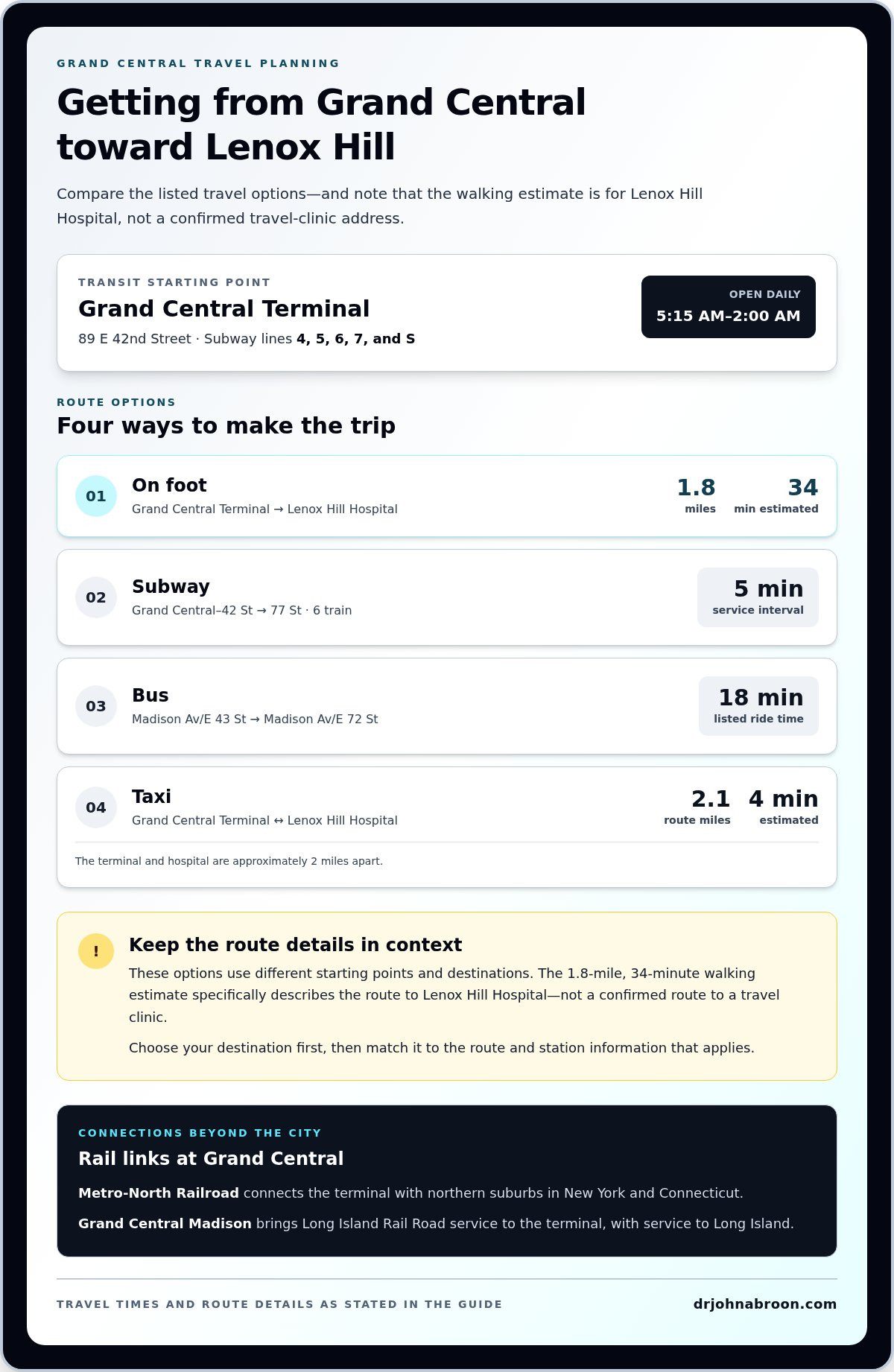
The available walking benchmark is the route from Grand Central Terminal to Lenox Hill Hospital: 1.8 miles, or an estimated 34 minutes on foot. That route gives you a concrete reference for planning a trip toward the Upper East Side, not a clinic address.
For anyone searching for a travel clinic near Grand Central Station, use the International Society of Travel Medicine to find travel medicine clinics. Clinic listings are provided for travelers’ convenience and don’t constitute CDC endorsement, recommendation, or a guarantee of service quality.
- On foot: The Grand Central Terminal to Lenox Hill Hospital route is 1.8 miles and takes an estimated 34 minutes.
- The MTA subway runs every 5 minutes.
- By bus: The MTA bus from Madison Av/E 43 St to Madison Av/E 72 St takes 18 minutes.
- By taxi: Grand Central Terminal and Lenox Hill Hospital are approximately 2 miles apart. The taxi route is 2.1 miles, with an estimated travel time of 4 minutes.
These options use different starting points and destinations. For the subway, begin at Grand Central-42 St and travel to 77 St. For the bus, the listed route starts at Madison Av/E 43 St and ends at Madison Av/E 72 St. The walking estimate specifically describes the route to Lenox Hill Hospital, rather than a confirmed route to a travel clinic.
Grand Central Terminal is open to the public daily from 5:15 AM to 2:00 AM. Metro-North Railroad connects the terminal with northern suburbs in New York and Connecticut. Grand Central Madison brings Long Island Rail Road service to the terminal, with service to Long Island.
Before setting out, choose your destination first, then match it to a route and station. If you’re walking, allow for the full 34-minute estimate to Lenox Hill Hospital. If you take the 6 train, use 77 St as the endpoint shown in the route information. For travel medicine care, plan your travel medicine visit around your itinerary and transportation needs.
Accepted insurance plans
Insurance coverage for travel care depends on the plan and the service. A consultation, vaccine, and prescription may each be handled differently, even during one visit. The useful question is not only whether a clinic accepts your insurance. It’s whether your specific benefits apply to the care you need.
Start with your insurance card and plan benefit summary. Review office visits, preventive care, immunizations, and prescription medication, since each category can have separate coverage rules. For example, your plan may treat a travel consultation differently from a vaccine given during that visit.
Network status is another key factor. A plan may distinguish between in-network and out-of-network care, affecting your share of the bill and the claims process. Check the exact plan name on your card, not just the insurer’s brand. Employer plans under the same insurer can have different networks and benefits.
- Visit: Identify how the plan processes an office or specialist consultation.
- Vaccines: Review whether immunizations are covered and how the plan classifies them.
- Medication: Check prescription coverage separately from the clinic visit.
- Network: Use the precise plan name and network shown on your insurance card.
- Cost sharing: Review any deductible, copayment, or coinsurance that applies to each service.
For a clear benefits review, list the services you expect to receive. A travel consultation, a vaccine, and a malaria-prevention prescription are separate items to ask about. Use your plan’s member materials or contact member services to learn how each is classified. Keep the explanation with your travel paperwork.
Ask how claims are handled. Some plans use direct billing for covered care, while others require you to pay first and submit a claim. Follow your plan’s instructions. If you pay upfront, keep itemized receipts and any claim forms required by your insurer.
Before scheduling near Grand Central, gather your insurance card, exact plan name, and questions about each service. This helps you review the expected visit, vaccine, and prescription benefits separately instead of assuming one answer covers all three. Coverage depends on your plan and how each service is billed, so check the benefit details for each item.
Appointment and walk-in information
Plan the visit around your destination, departure date, and vaccination needs. Booking ahead gives you time to discuss those details.
Clinic contact details
The International Society of Travel Medicine can help travelers find a travel medicine clinic. Use its clinic-finding resource to identify nearby options, then use each clinic’s listing for its address, phone number, and hours. Grand Central Terminal is at 89 E 42nd Street, but that is the terminal address, not a clinic address.
Keep clinic details separate from transit information. Grand Central Terminal is open daily from 5:15 AM to 2:00 AM; those are terminal hours, not clinic hours. Write down the clinic’s own location and contact details before planning your trip from the station.
Booking and vaccine timing
Book as early as practical after setting your itinerary. Timing depends on your destination, departure date, health history, and the vaccines or medicines being considered. A travel consultation can review those factors and help organize prevention steps before your trip.
For a multi-stop itinerary, consider each destination, not just the first arrival city. Share your planned route and departure date when booking so the clinician can discuss vaccine timing and prescriptions in the context of your actual plans.
Yellow fever vaccination must be given at an authorized yellow fever vaccine clinic. Many authorized clinics also provide other shots and medicines. Include this requirement in your planning if yellow fever vaccination is part of your preparation.
Walk-in visits and appointment essentials
Walk-in access depends on the clinic’s process, so an appointment gives you a clearer plan. Before traveling, use the clinic’s published contact details to learn about its arrival process and hours. Grand Central’s opening hours are not a guide to a clinic’s schedule.
Bring your itinerary, departure date, vaccination record, medication list, and insurance card. These help structure a discussion about destination-specific prevention, prescriptions, and coverage. For a child, bring their vaccination record and include them in the travel plans you share.
At the visit, describe each destination, the length and purpose of each stop, and your planned activities. Mention relevant health conditions and current medicines. These details help shape travel-health recommendations and identify questions to address before departure.
For convenient routing, Grand Central Terminal is served by the 4, 5, 6, 7, and S subway lines. Choose the clinic address first, then plan from the station to that destination. Keep the clinic’s phone number and appointment details accessible during your trip.
Food and water precautions
Food and water choices are part of preparing for international travel. Practices that feel routine at home may need more attention abroad. Before departure, plan for drinking water, meals, snacks, and hand hygiene. For example, decide what you’ll use for drinking water in transit and at your destination.
Consider the water source before drinking or brushing your teeth. If local tap water isn’t considered safe for those uses, choose sealed bottled water or another treated option. Check that the bottle’s seal is intact. Ice, fountain drinks, and water used to rinse produce may also involve local water, so include them in your choices.
At meals, favor freshly prepared food served hot. Take care with raw or undercooked items, including seafood, eggs, and meat. Choose fruit you can wash with safe water or peel yourself. These practical choices help you assess what’s on your plate rather than relying only on how a restaurant looks.
- Choose sealed drinking water when the local source is unsuitable.
- Think about ice and water used in drinks or food preparation.
- Select thoroughly cooked dishes, such as a hot meal prepared to order.
- Wash or peel fruit using a method appropriate for the local water supply.
- Clean your hands before eating, especially after handling money or using shared surfaces.
Hand hygiene matters throughout a travel day. Use soap and water before meals when available. Carry hand sanitizer for times when a sink isn’t accessible, such as during a long transfer. Clean your hands after using the restroom and before handling food, snacks, or reusable utensils.
Keep your plan realistic for the itinerary. A guided tour, airport connection, and restaurant meal each present different food and water choices. Pack familiar snacks for transit if they suit your needs, and identify where you can buy sealed drinks or refill a bottle safely. If you have allergies or dietary restrictions, plan how to communicate them clearly at meals.
Food and water precautions don’t replace destination-specific travel advice. Discuss your route, planned activities, and any health conditions during a travel medicine consultation. That conversation can help you consider practical prevention alongside your broader travel-health preparation.
John Abroon M.D: Annual Physical Exams
John Abroon M.D. offers Annual Physical Exams for patients seeking preventive care beyond trip preparation. An annual exam is an opportunity to discuss general health, current medications, and questions beyond travel planning. The practice also offers Immigration Medical Exams, Pre-operative Medical Clearances, and Diagnostic Testing for separate medical needs.
Consider an annual exam when you want to review your health with a physician, rather than focusing only on destination-specific risks. Bringing a current medication list and relevant health records can make the conversation more useful. Travel decisions still depend on your itinerary and personal health needs, while routine preventive care supports a broader view of well-being.
To discuss an Annual Physical Exam or another listed service, contact John Abroon M.D. or visit drjohnabroon.com.
Make Your Next Health Step Count
Trip preparation can also prompt you to consider health needs beyond your itinerary. A travel visit focuses on destination-related planning, while ongoing health questions may call for a separate conversation with a physician. Finding a travel clinic near Grand Central Station is one step; keeping broader care organized supports a more considered approach to your health.
John Abroon M.D. offers Annual Physical Exams for preventive care, Immigration Medical Exams for immigration-related requirements, and Pre-operative Medical Clearances for patients preparing for surgery. These services address different needs, so consider the purpose of your visit and the questions you want to discuss.
Bring your priorities into the conversation, whether they involve upcoming travel or another medical concern. A clear next step can make planning feel more manageable and keep the focus on care relevant to you.
Contact John Abroon M.D to discuss travel care, and take your next step with confidence.
Frequently Asked Questions
Do I need an appointment?
For planned travel care, arrange an appointment rather than relying on a walk-in. A scheduled visit gives you time to discuss your itinerary, health history, and preventive-care questions. If departure is close, share the date when booking. Bring your vaccination record and medication list to help make the consultation focused and useful.
How far is each clinic from Grand Central Station, and how long does it take to walk there?
There isn’t a single walking distance for every travel clinic, since each has its own address. One nearby-care reference is Lenox Hill Hospital: the walking route from Grand Central Terminal is 1.8 miles, with an estimated walk of 34 minutes. That figure describes the hospital route, not every clinic. Use the specific clinic address as your destination when planning your walk.
Which nearby clinics offer travel vaccines and destination-specific consultations?
The International Society of Travel Medicine directory can help travelers locate a travel medicine clinic. When comparing options in Manhattan, look for clinics that offer pre-travel consultations. A useful appointment covers your destinations, activities, health history, and vaccination record. Directory listings are for travelers’ convenience and don’t constitute CDC endorsement or a guarantee of service quality.
Which travel vaccines are available at clinics near Grand Central Station?
Vaccine recommendations depend on your destinations, health history, and previous vaccinations, so there isn’t one universal travel-vaccine list for every traveler. Many authorized yellow fever vaccine clinics also provide other shots and medicines. If yellow fever vaccination is part of your plans, it must be given at an authorized clinic. Bring your itinerary and vaccine record to discuss appropriate options.
Do nearby travel clinics accept insurance, and what payment methods do they take?
Insurance coverage depends on your plan and how the visit, vaccine, or prescription is classified. Review benefits for consultations, immunizations, and medications separately, using the exact plan name on your card. Payment methods vary by clinic. Before your visit, use the clinic’s contact information to understand its payment process, and bring your insurance card and any required identification.
Do nearby clinics require appointments, and how can I book one?
Use the clinic’s scheduling process to arrange a travel-medicine appointment. The International Society of Travel Medicine directory can help you find clinics in Manhattan; contact your chosen clinic directly to book. Share your destination and departure date when scheduling. These details help frame your request and prepare you to bring the right records.
Which clinics provide yellow fever vaccination and an official vaccination certificate?
Yellow fever vaccination must be given at an authorized yellow fever vaccine clinic. Many such clinics also provide other shots and medicines. If you need an official vaccination certificate for your trip, explain that when arranging care and bring your travel documents. Directory listings are provided for convenience and don’t represent CDC endorsement or a guarantee of service quality.