


Last week, a patient preparing for a two-month journey through Southeast Asia came into our Upper East Side office completely overwhelmed. He had a spreadsheet of conflicting CDC guidelines from 2024, blog post advice about side effects, and visa requirements that seemed to change daily. His excitement for the trip was being replaced by a genuine fear of getting sick abroad or being denied entry.
It’s a familiar story for ambitious New Yorkers. You shouldn’t have to become an infectious disease expert just to plan your vacation. The logistical challenge of finding reliable information and scheduling appointments can feel like a full-time job, adding unnecessary stress to what should be an exciting time.
This guide cuts through that chaos. Here, you will find a clear, medically-backed strategy for the specific travel vaccinations NYC residents need for their 2026 international journeys. We’ll walk you through creating a personalized health plan that considers your unique medical history, provides all necessary documentation, and gives you the ultimate confidence to travel well.
Key Takeaways
- Learn the critical difference between required vaccines for legal entry and recommended vaccines for your personal safety abroad.
- Discover the ideal timeline for your travel health plan, beginning 6-8 weeks before departure to ensure comprehensive protection.
- Understand why a board-certified internist provides a superior strategy for your travel vaccinations nyc compared to a standard clinic.
- Prepare for a productive consultation by identifying the essential documents, like your itinerary and health records, to bring to your appointment.
What is Travel Medicine and Why Do New Yorkers Need It?
International travel should be about new experiences, not unexpected illnesses. That is the central purpose of Travel medicine, a specialized field of internal medicine dedicated to the pre-travel health of individuals crossing international borders. It’s a proactive discipline focused on preventing diseases and managing health risks before you ever step on a plane. For New Yorkers, who depart from some of the world’s busiest travel hubs, this preventative care isn’t a luxury; it’s an essential part of responsible travel planning for 2026 and beyond.
Your journey’s health risks begin long before you reach your destination. In 2023 alone, over 74 million passengers passed through JFK International Airport, creating a dense environment for pathogen transmission. As a resident of this global crossroads, your pre-travel consultation must account for both your departure point and your destination. The goal is to ensure you are protected from diseases that are rare in Manhattan but common in Southeast Asia, Africa, or even parts of Europe. This requires a clear distinction between two types of immunizations:
- Required Vaccinations: These are legally mandated for entry into certain countries. The most common example is the Yellow Fever vaccine, required by more than 100 countries, primarily in Africa and South America, to prevent its importation.
- Recommended Vaccinations: These are not required for entry but are strongly advised by health organizations like the CDC to protect your personal health. This category includes vaccines for diseases like Typhoid, Hepatitis A and B, and Japanese Encephalitis, based on your specific itinerary, activities, and health history.
Understanding these categories is the first step in preparing for a safe trip. A comprehensive plan for travel vaccinations nyc will address both, ensuring your journey is both legally compliant and personally protected.
The Difference Between Routine and Travel Immunizations
Your annual flu shot and ten-year Tdap booster are vital for your health in New York City, but they don’t prepare your immune system for the unique pathogens found abroad. Travel immunizations target diseases you have little to no exposure to in the United States. Dr. Abroon consults the CDC’s “Health Information for International Travel” (commonly known as the Yellow Book), the definitive guide for travel medicine. He then meticulously cross-references its global health directives with your personal NYC health records to create a truly individualized vaccination schedule.
Common Diseases Encountered by International Travelers
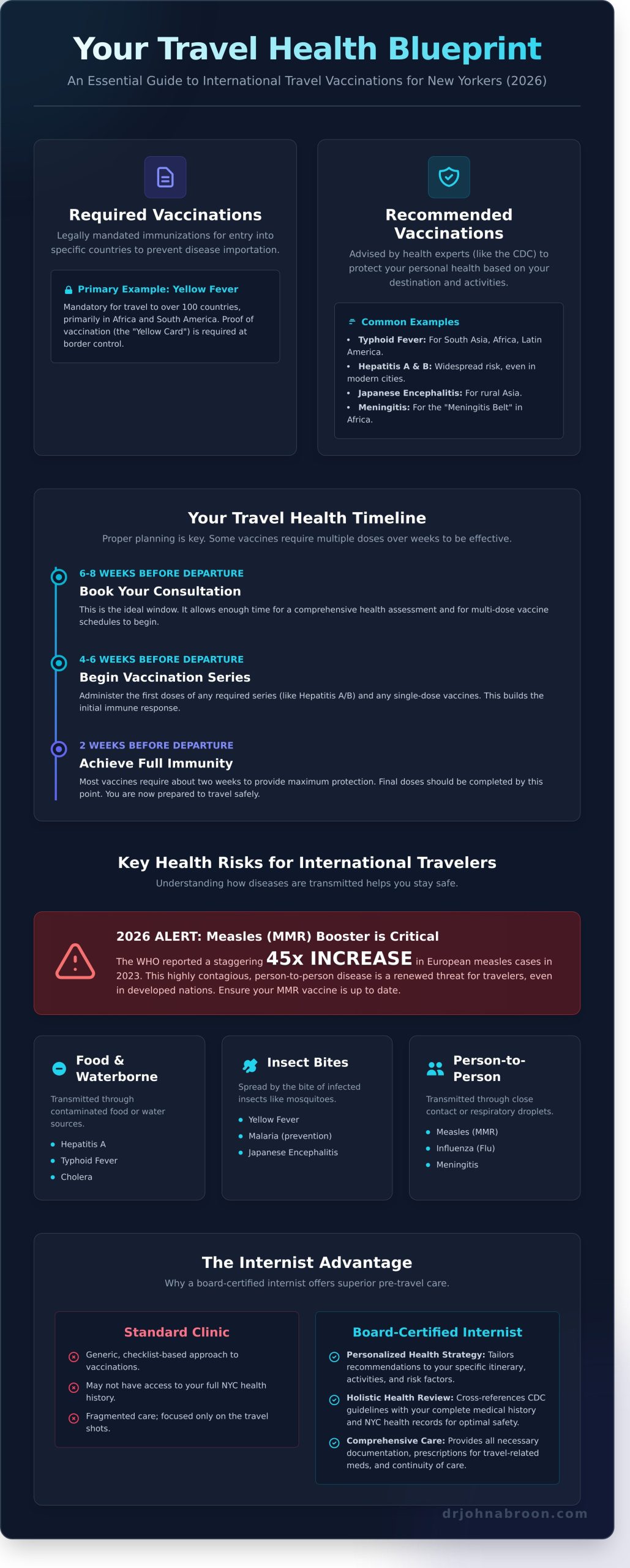
International health risks are typically transmitted through three primary vectors: contaminated food or water (Hepatitis A, Typhoid), insect bites (Yellow Fever, Malaria), and person-to-person contact (Measles, Influenza). It’s a mistake to assume that only developing nations pose a threat. The European Centre for Disease Prevention and Control reported over 15,000 cases of Hepatitis A in 2023, a food-borne illness that can be contracted in modern cities. Looking ahead to 2026, a Measles (MMR) booster is particularly critical. The World Health Organization noted a staggering 45-fold increase in European measles cases in 2023, making this highly contagious disease a renewed threat for travelers to Europe and parts of Asia.
Essential Travel Vaccinations for NYC Residents in 2026
Planning an international journey from New York City is an exhilarating process, but ensuring your health is protected is the most critical part of your preparation. A personalized travel health plan goes far beyond just packing a first-aid kit; it involves a comprehensive, proactive strategy to immunize you against potential health risks specific to your destination. The right travel vaccinations nyc residents need depend entirely on the itinerary, planned activities, and individual health history. These foundational immunizations are designed to help you stay healthy on your trip, preventing common illnesses that can derail your plans.
For most international travelers leaving the U.S., the most common recommendations target food and water-borne diseases. These include:
- Typhoid Fever: A single-shot vaccine or a series of oral capsules can protect you from this bacterial infection, which is prevalent in South Asia, Africa, and Latin America. It’s often transmitted through contaminated food or water.
- Hepatitis A: This viral liver disease is also spread through ingestion of contaminated items. The vaccine is administered in two doses, six months apart, providing long-term immunity for frequent travelers.
Certain destinations or activities demand more specific protection. A Meningitis vaccination, for example, is essential for travelers heading to the sub-Saharan “Meningitis Belt” of Africa, which experiences seasonal epidemics from December to June. It’s also a common requirement for students studying abroad. For adventurous travelers planning long-term stays, caving, or extensive rural exploration in areas like Southeast Asia or parts of South America, a pre-exposure Rabies or Japanese Encephalitis vaccine series should be part of a detailed risk assessment with your physician.
Yellow Fever Certification in Manhattan
Some countries, particularly in sub-Saharan Africa and tropical South America, require proof of Yellow Fever vaccination for entry. This isn’t a shot you can get just anywhere. Only federally designated Stamaril® Yellow Fever Vaccination Centers are authorized to administer the vaccine and provide the official International Certificate of Vaccination or Prophylaxis (ICVP), also known as the “Yellow Card.” As of 2026, the World Health Organization continues to recognize a single dose as providing lifetime protection. We ensure your ICVP is correctly signed, dated, and stamped, as it must be completed at least 10 days before your departure to be valid.
Malaria Prevention and Non-Vaccine Prescriptions
Your travel health plan isn’t limited to vaccinations. For Malaria-endemic regions, there is no traveler’s vaccine; protection comes from oral prophylaxis (pills). By 2026, options like Tafenoquine offer simpler weekly dosing schedules, though they aren’t suitable for everyone. We also proactively prescribe “Traveler’s Diarrhea” kits containing a targeted antibiotic like Azithromycin, which can be a crucial intervention in high-risk destinations and prevent severe dehydration.
Special Considerations for 2026: Emerging Global Trends
The global health landscape is always changing. We’re closely monitoring the spread of Dengue fever and can advise on new-generation vaccines for travelers with a prior infection history heading to endemic zones like Brazil or the Philippines. For 2026, the CDC emphasizes that travelers from high-density hubs like NYC should ensure routine immunizations, including MMR and COVID-19 boosters, are current to prevent outbreaks in crowded transit settings. In an era of information overload, the clinical reality can be lost in sensationalist news. That’s why a consultation with a dedicated travel medicine expert like Dr. Abroon provides the clarity and personalized protection you need for a safe journey.
The Internist Advantage: Why Choose a Private NYC Practice?
When seeking travel vaccinations NYC residents often face a choice: a high-volume, transactional shot clinic or a comprehensive medical consultation. While a walk-in clinic can administer a required vaccine in under 10 minutes, this approach overlooks the most critical element of travel health: you. Your personal medical history is the blueprint for a safe and healthy journey. A board-certified internist like Dr. John Abroon provides a fundamentally different level of care, transforming a simple vaccination into a strategic component of your overall wellness plan.
Your health profile dictates your immunization needs far more than your destination alone. A standard checklist doesn’t account for individual complexities. For example, a history of severe egg allergies may require a specific protocol for the yellow fever vaccine. If you are immunocompromised, live vaccines like MMR or yellow fever may be contraindicated. Dr. Abroon conducts a thorough review of your medical records, considering everything from your cardiac health to current medications before creating a tailored vaccination schedule. This personalized risk assessment ensures that your pre-travel preparations protect, rather than compromise, your health.
Perhaps the most significant long-term benefit is the integration of your travel health into your permanent medical file. Your international immunizations become a lasting part of your health record, ensuring continuity of care. This prevents unnecessary repeat vaccinations years later and provides a complete picture for any future medical needs. It’s the difference between a one-time transaction and an ongoing healthcare partnership.
Managing Pre-existing Conditions While Abroad
Traveling with a chronic condition like diabetes, hypertension, or asthma requires more than just vaccinations. It demands a proactive management plan. Dr. Abroon works with you to create strategies for managing medications across time zones, provides official physician’s letters required by many international customs authorities to carry medical supplies, and prepares you to navigate a medical emergency in a foreign healthcare system. This is comprehensive travel preparedness.
The Luxury of Time: A Concierge Experience
In a city that never stops, your time is invaluable. Our Upper East Side practice is designed for the busy NYC professional, offering streamlined, punctual appointments that respect your schedule without sacrificing clinical depth. Forget long queues and crowded waiting rooms. Here, you receive the undivided attention of a top-rated internist. This concierge approach extends beyond the office, providing you with direct access to Dr. Abroon for any follow-up questions about your itinerary or concerns about potential vaccine reactions.
This dedicated process ensures every recommendation is sound. Dr. Abroon crafts your personalized immunization schedule by cross-referencing your unique health profile with the latest official CDC travel vaccination guidelines for your specific destination. This dual-layered analysis provides a level of safety and confidence that a simple shot clinic cannot match. It’s not just about getting the right travel vaccinations in NYC; it’s about traveling with the assurance that your health is expertly managed.
Your NYC Travel Health Timeline: When to Book
Proactive planning is the cornerstone of a safe and healthy international journey. Your body requires time to build immunity, and certain vaccine series demand a specific schedule. We’ve structured a clear, four-step timeline to ensure you are fully protected long before your plane ever leaves the tarmac. Following this schedule eliminates last-minute stress and allows for a comprehensive, personalized approach to your travel health.
Here is the ideal timeline for your travel vaccinations nyc preparations:
- Step 1: 6-8 Weeks Before Departure. This is the moment for your initial travel health consultation. During this visit, Dr. Abroon will conduct a comprehensive review of your medical history, your specific itinerary, and planned activities. We’ll discuss required and recommended vaccinations based on CDC guidelines for your destination, from Yellow Fever for parts of South America to Typhoid for South Asia.
- Step 2: 4-6 Weeks Before Departure. We administer the primary doses of your necessary vaccines. This window is critical as it provides your immune system the time it needs to produce protective antibodies. For vaccines requiring multiple shots, such as the Hepatitis B series, this is when the first dose is typically given.
- Step 3: 2 Weeks Before Departure. This appointment is for any final boosters or second doses in a series. It’s also the ideal time to pick up any necessary prescriptions, such as anti-malarial medication or antibiotics for traveler’s diarrhea, ensuring you understand the proper dosage and schedule.
- Step 4: 1 Week Before Departure. Your final check-in. We’ll review your vaccination records, confirm all documentation is in order, and provide a final safety briefing on topics like food and water precautions, insect bite prevention, and what to do if you feel unwell abroad.
Why the 4-6 Week Window is Non-Negotiable
Your immune system doesn’t work instantly. After receiving a vaccine, it takes approximately 10 to 14 days for your body to build a sufficient level of antibodies. Rushing this biological process is impossible. Furthermore, multi-dose series like Rabies (three doses administered over 21-28 days) or Hepatitis B simply cannot be compressed. If you’re a last-minute traveler, don’t despair. A consultation is still vital. We can implement an accelerated schedule, prioritize the most critical single-dose vaccines, and equip you with essential prescriptions and preventative strategies to mitigate risk.
Documentation and Digital Health Passports
Proper documentation is as crucial as the vaccines themselves. We provide you with the official International Certificate of Vaccination or Prophylaxis (the “Yellow Card”), which is mandatory for entry into certain countries. We strongly advise keeping a digital photo of it on your phone and a cloud server. Should you lose your records while abroad, having a trusted NYC physician is invaluable. Our office can be contacted to verify your vaccination status for officials, providing you with critical support and peace of mind. Your travel readiness is built on a foundation of consistent care, which is why we always emphasize that your Annual Physical Exam is the first step in any health journey.
Proper planning transforms travel anxiety into confident anticipation. Don’t wait until the last minute to protect your health. Schedule your personalized travel health consultation with Dr. Abroon today to build a timeline that fits your unique itinerary.
Personalized Travel Consultations on the Upper East Side
Preparing for international travel involves more than just booking flights and packing bags. It requires a sophisticated health strategy. Dr. John Abroon provides a level of care for travel vaccinations NYC residents trust, built on a foundation that is simultaneously rigorous, empathetic, and meticulously personalized. His approach moves beyond a simple checklist of shots. It’s a comprehensive risk assessment tailored to your unique health profile and specific destination, ensuring you are protected not just from common illnesses, but from the nuanced health threats of your destination.
To make your consultation as productive as possible, please arrive prepared. A successful travel health plan begins with good information. Your appointment is a collaborative effort, and bringing the right documents allows Dr. Abroon to craft the most effective preventative strategy for you. Please bring the following:
- A Detailed Itinerary: Include all countries, cities, and rural areas you plan to visit, along with the duration of your stay in each location. The specific risks in urban Southeast Asia can differ greatly from those in the Amazon basin.
- Previous Immunization Records: Your complete vaccination history helps us avoid redundant shots and identify any necessary boosters, such as for Tetanus or Measles, Mumps, and Rubella (MMR).
- A List of Current Medications: Provide a complete list of all prescription medications, over-the-counter drugs, and supplements you are currently taking to prevent any adverse interactions with travel medications or vaccines.
Dr. Abroon’s commitment is to provide ‘Comprehensive Care for the Whole Family,’ a promise that extends far beyond the walls of his clinic. He understands that your family’s health is your top priority, especially when you are thousands of miles from home. This philosophy means you have a dedicated medical partner in New York, a point of contact who understands your health history and is available for guidance should any concerns arise during your travels.
A Concierge Feel in the Heart of Manhattan
Located on E 72nd Street, the clinic offers a professional yet warm environment, a calm oasis from the city’s hustle. This concierge-level experience provides the peace of mind that comes from knowing a top-rated internist is managing your global health risks. Patients consistently praise Dr. Abroon’s thoroughness, often remarking that his meticulous attention to detail gave them the confidence to travel freely and without worry.
Securing your appointment is straightforward. We recommend scheduling your consultation at least 4 to 6 weeks before your departure date, as some vaccines require multiple doses or take time to become fully effective. You can arrange your visit by calling our office directly to speak with our welcoming staff.
Returning to NYC: Post-Travel Health Monitoring
Your health journey doesn’t end when you land back at JFK or LaGuardia. If you develop a fever, rash, persistent cough, or gastrointestinal issues after returning, it’s critical to seek medical attention promptly and inform the doctor of your recent travel history. For travelers returning from regions with high risks for diseases like malaria or dengue, follow-up blood work may be recommended to ensure you haven’t contracted a latent illness.
Protect your health before, during, and after your journey. Your global adventure deserves the highest standard of medical preparation. Schedule your travel consultation with Dr. Abroon today.
Travel with Confidence: Secure Your Health for Your 2026 Journey
Your international travel plans for 2026 deserve more than a last-minute checklist. Proactive planning, starting at least 4 to 6 weeks before your departure, is essential for effective immunization. Choosing an experienced internist over a generic clinic also ensures your travel health plan is tailored specifically to your medical history and destination. This personalized approach is the cornerstone of receiving the right travel vaccinations nyc residents need for a safe and healthy adventure.
Dr. John Abroon, a Board-Certified Internist with more than 25 years of experience, provides this exact level of dedicated, concierge-style medical attention. From his convenient Upper East Side office on E 72nd St, he offers comprehensive consultations to protect your well-being abroad. It’s time to ensure your health is as well-planned as your itinerary. Book Your Personalized Travel Consultation with Dr. Abroon and step into your next journey with complete peace of mind.
Frequently Asked Questions About Travel Vaccinations
How far in advance should I get travel vaccinations in NYC?
To ensure you receive the right travel vaccinations NYC requires for your destination, schedule your appointment 4 to 6 weeks before your departure. This timeframe allows your body to build full immunity and accommodates vaccine series that require multiple doses, like Hepatitis A. A consultation with Dr. Abroon will establish a personalized timeline for your specific itinerary, ensuring you’re fully protected. Proactive planning is always best for your health and safety abroad.
Does insurance cover travel vaccines at a private practice?
Insurance coverage for travel vaccines varies significantly between plans. While many PPO and POS plans don’t cover immunizations deemed solely for travel, routine shots like Tetanus or MMR might be covered. Our office will provide the necessary CPT and diagnosis codes for you to submit a claim to your insurer. We strongly recommend you call your insurance provider directly to confirm your specific benefits before your appointment for full clarity.
Which travel shots are required for a safari in Africa?
A Yellow Fever vaccine is often required for entry into at least 15 sub-Saharan African countries, including popular safari destinations like Tanzania and Kenya. Beyond this, Dr. Abroon will likely recommend vaccines for Hepatitis A, Typhoid, and an updated Tetanus booster. Based on the latest CDC guidelines for your specific itinerary, you may also need immunizations for Rabies or Meningitis. A personalized consultation is essential for comprehensive protection.
Can I get all my travel vaccines in one visit at the Upper East Side office?
Yes, it’s often possible to receive multiple necessary vaccinations during a single appointment at our convenient Upper East Side office. We can safely administer several shots like Typhoid, Tetanus, and Hepatitis A at once. However, certain vaccine series, such as for Rabies or Japanese Encephalitis, require doses spaced out over several weeks. Dr. Abroon will create an efficient schedule tailored to your travel dates during your initial consultation.
What are the most common side effects of travel immunizations?
The most common side effects are mild and typically resolve within 24 to 48 hours. You might experience temporary soreness, redness, or minor swelling at the injection site. Some patients report a low-grade fever, a slight headache, or muscle aches. These are normal signs that your immune system is responding and building protection. Serious adverse reactions are exceptionally rare, occurring in less than 1 in 1 million cases.
Do I need a Yellow Fever shot if I’m only on a layover?
Yes, you may still need proof of Yellow Fever vaccination even for a brief layover. Many countries, such as South Africa, require the vaccine if you’ve transited for more than 12 hours through an airport in a nation with a risk of Yellow Fever transmission, like Brazil or Nigeria. It’s critical to verify the specific entry requirements for both your layover country and your final destination, as these health regulations are strictly enforced by immigration officials.
What happens if I lose my vaccination records while traveling abroad?
Our practice maintains a secure electronic health record of all your immunizations. If you misplace your International Certificate of Vaccination or Prophylaxis (the “yellow card”), simply call or email our office. We can promptly send a secure digital copy of your records to you, often within the same business day. As a best practice, we also recommend taking a clear photo of your records on your phone before you depart.
Is there a difference between the travel clinic and my regular doctor?
Yes, a dedicated travel health specialist provides a more focused and comprehensive level of care. While your primary physician manages your general health, Dr. Abroon’s practice concentrates on preventative travel medicine. We stock specialized vaccines like Yellow Fever and Typhoid that most general practices don’t. Our expertise includes up-to-the-minute knowledge of global disease patterns and specific entry requirements, ensuring a tailored health strategy for your international trip.