


What if the most critical document for your green card is one you aren’t even allowed to open? For many applicants, the medical exam feels like a high-stakes mystery where a single missed vaccine or an expired signature could lead to months of unnecessary delays. If you’re asking what is a form i693, you’re likely at a pivotal moment in your immigration journey where clinical precision meets legal necessity. This document serves as your certified proof that you meet the health standards required to live and work in the United States.
It’s natural to feel anxious about being found inadmissible or confused by the shifting rules regarding mandatory immunizations. We’re here to provide the clinical authority and steady reassurance you need to navigate this process. This guide breaks down every requirement of the I-693 medical exam, from clinical testing to the latest validity updates. You’ll gain a clear understanding of the mandatory vaccines, the sealed envelope protocol, and the time commitment involved. We’ll ensure you meet every health standard so you can move forward with your application with total confidence and a clear path toward your future.
Key Takeaways
- Learn exactly what is a form i693 and why this clinical certification must be completed by a USCIS-designated civil surgeon to be legally valid.
- Discover the specific laboratory screenings and physical evaluations required by the CDC to confirm your health admissibility for a green card.
- Understand the 2024 validity updates that may extend the life of your results, helping you avoid the stress of unexpected expiration dates.
- Master the essential “sealed envelope” rules to ensure your medical documentation is accepted by USCIS without procedural delays or rejections.
- Access a professional preparation checklist to streamline your appointment, from gathering historical vaccination records to organizing your government identification.
Understanding Form I-693: The Report of Medical Examination and Vaccination Record
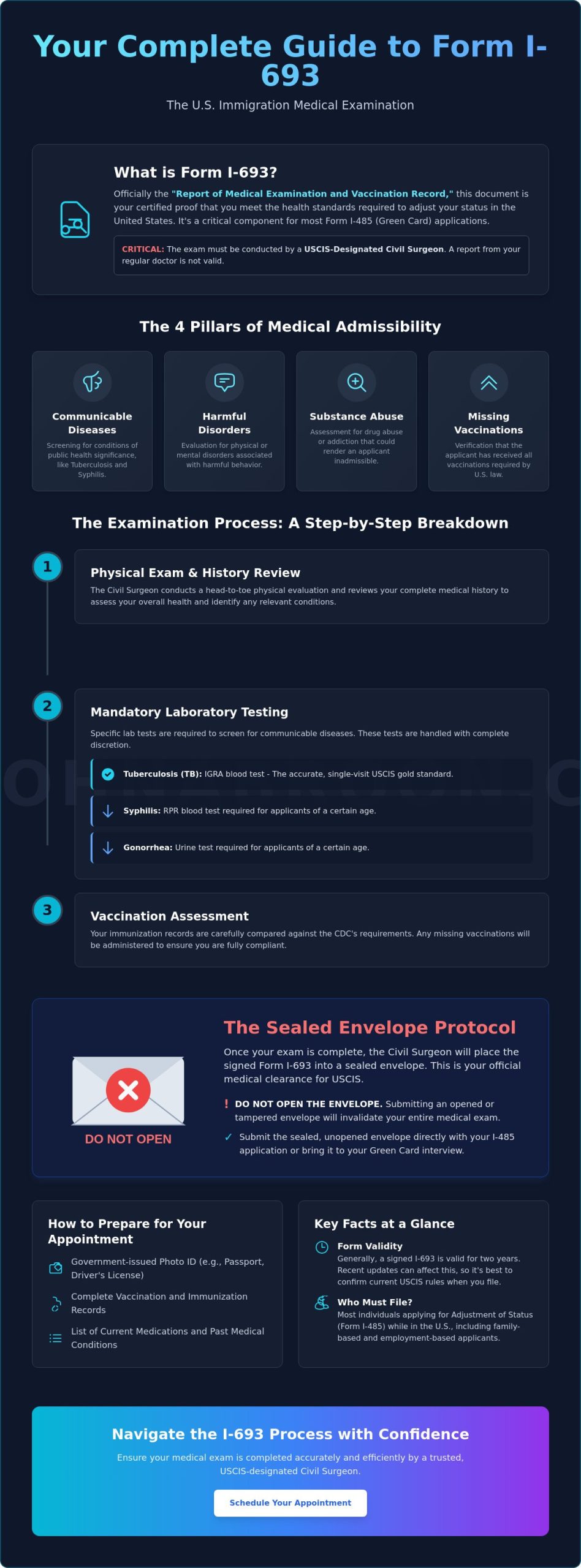
When you begin the journey toward permanent residency, you’ll encounter a specific requirement that bridges the gap between legal status and clinical health. So, what is a form i693? Formally titled the Report of Medical Examination and Vaccination Record, this document is the official mechanism USCIS uses to ensure that every individual seeking a Green Card meets the necessary health admissibility criteria. It isn’t a mere formality; it’s a rigorous clinical certification that protects both the applicant and the public. For those filing Form I-485 to adjust their status, this document is a non-negotiable requirement that must be completed with absolute precision.
Unlike a routine annual physical, this evaluation must be conducted by a USCIS-designated civil surgeon. These physicians have undergone specific authorization to perform exams that align with the medical standards for immigration set by the Centers for Disease Control and Prevention (CDC). While your primary care doctor provides excellent general wellness care, they likely don’t possess the specific credentials required to sign and seal this document. The I-693 is a specialized diagnostic tool designed to verify you don’t pose a health risk to the community, making the choice of an experienced physician vital for a smooth application process.
The Core Purpose: Public Health and Safety
The I-693 serves as a diagnostic shield for the U.S. population. It focuses on four primary pillars of medical inadmissibility: communicable diseases of public health significance, physical or mental disorders associated with harmful behavior, substance abuse or addiction, and a lack of required vaccinations. By conducting thorough screenings for conditions like tuberculosis and syphilis, the exam ensures that new residents are healthy and integrated into the domestic healthcare system properly. It transforms a legal requirement into a proactive step for your total well-being, ensuring you’re ready to start your new chapter in peak health.
Who Must File Form I-693?
Most individuals applying for an Adjustment of Status while already present in the United States must submit this form. This includes family-based and employment-based applicants. While certain groups, such as refugees or K-visa holders, may have completed a medical exam overseas, they often still need a civil surgeon to complete the vaccination portion of the I-693. Understanding what is a form i693 helps you realize that even if you’ve had recent checkups, this specific protocol is unique. For those navigating this process in Manhattan, securing an immigration medical exam nyc is the essential first step to ensuring your paperwork is handled with the precision and care it deserves.
The Medical Protocol: What Happens During the I-693 Exam?
Understanding what is a form i693 requires looking beyond the legal terminology to the clinical evaluation itself. Your appointment is a structured, comprehensive health assessment designed to verify your health admissibility. It begins with a detailed review of your medical history and a head-to-toe physical examination. This evaluation includes a screening for physical or mental disorders that might be associated with harmful behaviors. We focus on ensuring your total well-being while verifying that you meet every federal health standard for residency.
Mandatory Laboratory Testing (TB, Syphilis, and Gonorrhea)
Laboratory precision is the backbone of the immigration medical evaluation. The CDC and USCIS require specific screenings to identify communicable diseases of public health significance. For tuberculosis, the skin test is largely a thing of the past. The IGRA test is the current USCIS gold standard for TB screening. This blood test offers higher accuracy and requires only one visit. Additionally, applicants within specific age ranges must undergo screenings for Syphilis (RPR) and Gonorrhea. These tests are essential for confirming your health admissibility and are handled with the utmost discretion and care.
Vaccination Requirements and Records
A significant part of the protocol involves reconciling your immunization history with the U.S. vaccination schedule. The current requirements include vaccines for Mumps, Measles, Rubella (MMR), Polio, Tetanus and Diphtheria, and Hepatitis B. While the Official Form I-693 lists these as standard, the specific shots you need can depend on your age and medical history. If you lack documentation for your childhood immunizations, we can often perform titer testing. This blood work measures your antibody levels to prove immunity, potentially saving you from unnecessary revaccination.
In cases where a vaccine is medically inappropriate, a civil surgeon can legally grant a waiver. These exemptions are typically reserved for individuals with known allergies to vaccine components or specific health conditions where a shot might be harmful. Our goal is to ensure you’re fully protected and compliant without compromising your health. For those seeking a seamless experience, scheduling your immigration medical exam with an expert who understands these nuances is the best way to avoid delays. By combining rigorous science with a supportive narrative, we make this complex clinical process feel manageable and clear.
USCIS Validity Rules: How Long is Your I-693 Good For?
One of the most significant stressors in the green card process used to be the ticking clock of medical expiration dates. Many applicants feared that by the time USCIS reviewed their case, their medical results would no longer be valid, requiring a costly second exam. However, policy shifts have fundamentally changed how we answer the question: what is a form i693 validity period? Today, the administrative burden on applicants has been lightened, providing a much-needed sense of security during long processing times that can range from 8 to 42.5 months depending on your specific case category.
According to the USCIS Policy Manual on I-693 validity, a landmark update in April 2024 established that forms signed by a civil surgeon on or after November 1, 2023, retain their validity indefinitely when used to support a pending application. However, it’s essential to understand that as of 2026, the general standard remains that a completed Form I-693 is valid for two years from the date of the civil surgeon’s signature. USCIS must typically make a decision on the related application within this two-year period to ensure the clinical data remains a reliable reflection of your current health status. This nuance makes the timing of your appointment and the precision of the documentation more critical than ever.
The Indefinite Validity Rule Explained
The shift from the previous “two-year rule” to the current permanent validity status for certain signature dates has been a game-changer for those caught in the USCIS backlog, which reached 11.6 million pending cases in late 2025. By recognizing the indefinite validity of forms signed after the November 2023 threshold, USCIS has reduced the need for redundant “re-exams,” saving applicants significant costs and emotional fatigue. This change ensures that if you’ve met the health standards once, you aren’t penalized for administrative delays beyond your control.
Maintaining the Integrity of the Sealed Envelope
While the validity of the results is more stable, the physical security of the document remains strictly regulated. The “Sealed Envelope Rule” is a non-negotiable legal requirement for mailed applications. Your civil surgeon will provide you with the completed form in an envelope that has been securely taped and stamped across the seal. You must never open this envelope; a USCIS officer must be the one to break the seal. If the envelope arrives at a field office damaged or tampered with, it’ll likely be rejected, potentially triggering a Request for Evidence (RFE) that could delay your progress.
We understand the curiosity to see your results before they’re submitted. To eliminate any anxiety about what’s inside, Dr. Abroon provides every patient with a complete personal copy of their results. You’ll have all the information you need for your own records while keeping the official version pristine and ready for the government. If you receive an RFE regarding your medicals, it’s often a simple matter of missing documentation or a signature date clarification. We’re here to guide you through those responses, ensuring you understand what is a form i693 requirement and how to protect its legal integrity from the moment you leave our office.
Preparing for Your Appointment on the Upper East Side
Preparing for your clinical evaluation on the Upper East Side requires more than just showing up for an appointment; it’s a collaborative process where your preparation meets our diagnostic expertise. Understanding what is a form i693 and its specific documentation requirements helps you gather the necessary materials before you step into the office. In a global hub like Manhattan, many applicants bring records from diverse international healthcare systems. If your immunization documents aren’t in English, they must be accompanied by a certified translation. This small step prevents significant administrative friction and ensures your history is accurately reflected in your final report.
A qualified USCIS civil surgeon does more than sign a document. They act as a clinical guide who ensures every detail of your health profile meets federal standards. Beyond just checking boxes, we take a holistic view of your medical history, including any chronic conditions or current medications you may be taking. This thoroughness is what protects your application from being returned for clarification. If you’re ready to begin, you can schedule your immigration medical exam to ensure your process is handled with the highest level of professional care.
The I-693 Checklist: What to Bring
To keep your appointment efficient and stress-free, please arrive with a valid passport or a government-issued photo ID. This is essential for identity verification as required by federal law. Additionally, bring your comprehensive immunization records and a list of any current medications. If you’ve had significant medical treatments or surgeries in the past, having those summaries available allows us to provide a more complete clinical picture. Organization is the best tool for a smooth evaluation.
What to Expect at Dr. Abroon’s NYC Office
We’ve designed our practice to offer a concierge experience that feels worlds away from a sterile, impersonal clinic. We understand the high stakes of your immigration journey, so we’ve streamlined our diagnostic capabilities. We perform EKGs and blood draws right here in our office, so you don’t have to navigate multiple locations across the city. Once the initial exam and testing are complete, the timeline for results is typically five to seven days. This period allows for the necessary laboratory processing to ensure every finding is accurate before we provide you with your final, sealed envelope. Our commitment is to provide you with a reliable, personalized path toward meeting your residency health requirements.
Why Choose John Abroon M.D. for Your I-693 Medical Exam?
Selecting the right civil surgeon is the final, essential step in answering what is a form i693 for your specific immigration needs. While many high-volume clinics offer the basic requirements, the quality of clinical oversight and attention to detail can vary significantly. John Abroon M.D. provides a sophisticated blend of elite medical credentials and a warm, patient-centered reassurance that makes high-stakes medical decisions feel manageable. Our Upper East Side location serves as a reliable resource for Manhattan and the tri-state area. We prioritize absolute accuracy to help you avoid the administrative errors that often lead to USCIS rejections or delays.
Expertise in Internal Medicine
Choosing a board-certified internist for your evaluation offers a distinct advantage over generalist clinics. The background John Abroon M.D. possesses as a primary care physician nyc allows for a more thorough interpretation of complex laboratory results. If the exam reveals findings that require further investigation, we can provide immediate guidance and diagnostic action. John Abroon M.D. possesses over 25 years of experience in the NYC medical community, ensuring your health certification is handled with seasoned insight and elite clinical standards.
The Benefits of a Private Practice Setting
Our office avoids the sterile, impersonal atmosphere often found in larger diagnostic centers. We believe a concierge-style environment is essential for providing the customized care our patients expect. You’ll benefit from direct communication, speaking with the physician who is personally reviewing and signing your official documents. This continuity of care is a hallmark of our practice, whether we’re conducting an annual physical exam nyc or a specialized immigration evaluation. By combining rigorous science with a supportive narrative, we ensure your path to residency is clear, efficient, and rooted in high-end medical expertise.
Secure Your Future with Clinical Precision
Navigating the final steps of your residency shouldn’t be a source of uncertainty. Now that you’ve gained a comprehensive perspective on what is a form i693 and the rigorous clinical standards it entails, you’re better prepared to manage your timeline and documentation. This clarity transforms a complex legal requirement into a manageable part of your wellness journey. It allows you to focus on your future in the United States without the fear of procedural delays or health-related inadmissibility.
At John Abroon M.D., we combine elite credentials with a supportive, boutique environment to ensure your medical evaluation is seamless. As a Board-Certified Internist and a USCIS-Designated Civil Surgeon since 1997, we offer the seasoned expertise necessary to handle your clinical certification with absolute precision. From our Upper East Side Manhattan location, we provide a detailed personal copy of all results to keep you informed and empowered. Schedule Your USCIS Medical Exam with John Abroon M.D. Today and take the next step toward your goals with a trusted expert by your side. We’re here to ensure your transition is smooth, healthy, and successful.
Frequently Asked Questions
Can I open the sealed envelope from my civil surgeon?
No, you must never open the sealed envelope provided by your civil surgeon. USCIS requires the medical report to remain in its original, tamper-evident packaging to ensure the integrity of the clinical findings. If the seal is broken or the envelope appears damaged, the immigration officer will reject the document. We provide every patient with a complete personal copy of their results so you can review the information for your own records without compromising the official submission.
How much does an I-693 medical exam cost in NYC?
The total cost of the evaluation depends on several individual factors, including your age, your existing vaccination history, and any specific laboratory tests required by the CDC. Because every patient’s needs are unique, we recommend contacting our Upper East Side office for a personalized consultation. This allows us to provide a clear understanding of the process based on the specific immunizations or titer testing you may require to meet federal health standards.
What happens if I test positive for Tuberculosis (TB) during the exam?
A positive IGRA blood test doesn’t mean your application is over; it simply requires a follow-up chest X-ray to rule out active disease. This is a common part of the screening process for many applicants. If the X-ray confirms that you don’t have active tuberculosis, we document these results on the form, and you can proceed with your application. We handle these findings with clinical authority and provide the necessary guidance to ensure you remain compliant with all health regulations.
Do I need the COVID-19 vaccine for my immigration medical exam?
As of March 11, 2025, the CDC no longer requires the COVID-19 vaccination for immigration purposes. While this specific requirement has been lifted, you must still meet the criteria for other mandatory immunizations, such as Polio, MMR, and Hepatitis B. Understanding what is a form i693 requirement involves staying current with these shifting regulations, and we ensure your record reflects the most up-to-date CDC guidelines at the time of your exam.
How long does it take to get the results of my I-693 exam?
You can typically expect your completed, sealed envelope within five to seven business days. This timeframe allows our laboratory partners to process your blood work with the high degree of accuracy required for federal documentation. Once the results are returned, we meticulously review every detail of the paperwork to prevent any administrative errors that could delay your green card process. We prioritize both speed and clinical precision to help you stay on schedule.
Can I use my own health insurance for the USCIS medical exam?
Most health insurance plans don’t cover immigration medical exams because they’re classified as administrative rather than medically necessary for illness or injury. While the exam itself is typically an out-of-pocket expense, some patients find that their insurance may cover the cost of specific vaccinations or laboratory screenings. We suggest checking with your provider for your specific coverage details, and we’ll provide the clear documentation you need for all clinical services performed.
What if I don’t have my childhood vaccination records?
If you lack documentation for your childhood immunizations, we can perform titer testing to prove your immunity through blood work. This measures the antibody levels in your system for diseases like Measles, Mumps, or Rubella. If the titers show you’re already protected, you won’t need to be revaccinated. If you aren’t immune, we can conveniently administer any necessary vaccines right here in our office to ensure you meet the what is a form i693 health standards.
Does the I-693 form expire after I submit it to USCIS?
Once you submit the form to USCIS, it generally remains valid for the duration of your pending application. Thanks to the policy updates enacted in April 2024, forms signed by a civil surgeon on or after November 1, 2023, now have indefinite validity when used to support a pending adjustment of status. This change provides significant relief for applicants caught in long processing backlogs, as it eliminates the need for expensive and repetitive medical re-examinations.