


The fastest place to be seen isn’t always the right place to start. If you’re wondering when to see an urgent care vs pcp nyc, first consider whether your symptoms could signal an emergency. Severe chest pain, trouble breathing, sudden weakness, or heavy bleeding warrant emergency care. Call 911 rather than waiting for a routine appointment.
For other concerns, it’s understandable to weigh prompt evaluation against an unnecessary emergency-room visit, or to wonder whether your regular doctor should be involved. Match the urgency of the symptom with the kind of care you need, then consider how follow-up fits in.
This guide explains which symptoms may call for urgent care, when primary care is better suited to ongoing or preventive needs, and practical steps to help you decide in New York City. Dr. John Abroon, a board-certified internist and primary care physician on Manhattan’s Upper East Side, provides urgent care and primary care for different needs. Learn how these settings differ, when to seek emergency help, and how to connect immediate care with your longer-term health.
Key Takeaways
- Choose care based first on symptom severity: potentially life-threatening symptoms call for 911, while non-emergency concerns may need prompt assessment or planned follow-up.
- Urgent care can help evaluate new, manageable concerns; your PCP is often better positioned to guide preventive care and ongoing health needs.
- To decide when to see an urgent care vs pcp nyc, weigh how quickly the concern needs attention and whether continuity with a clinician who knows your history matters.
- A simple checklist can help you assess urgency, identify emergency signs, select the right setting, and plan what happens next.
- A personalized evaluation can offer a clearer path than trying to diagnose yourself from a symptom list.
Urgent Care vs. a PCP in NYC: What Each Setting Is For
When a health concern appears, the immediate question is often whether to seek prompt help or contact your regular doctor. Consider how quickly you need an assessment and whether care would benefit from a clinician who knows your health history. Understanding each setting’s role can make the next step clearer without requiring you to diagnose yourself.
Urgent care provides prompt evaluation for non-life-threatening concerns. A primary care physician (PCP) supports ongoing, preventive, and coordinated care. If you’re considering when to see an urgent care vs pcp nyc, this comparison can help clarify the difference:
| Care setting | Main purpose | Continuity | Typical urgency |
|---|---|---|---|
| Urgent care | Assess a new concern that needs timely attention | Often episodic | Prompt, when it can’t reasonably wait for routine care |
| PCP | Preventive care, ongoing health needs, and coordination | Built around a continuing relationship | Routine or planned, with evaluation of new concerns when appropriate |
What urgent care is designed to address
Urgent care is for new health concerns that need timely assessment but aren’t life-threatening. A minor injury or sudden, manageable symptom may be a reason to seek prompt evaluation. The clinician assesses your situation and determines appropriate next steps. A symptom list alone can’t establish a diagnosis or determine which services are suitable.
Urgent care is not a substitute for emergency services or a continuing relationship with a PCP. For a general overview of how an urgent care center differs from other care settings, see this reference. If you believe a situation could be life-threatening, call 911.
What a primary care physician contributes
A PCP can interpret a concern in the context of your medical history, medications, and previous evaluations. That continuing relationship is especially useful for preventive visits, monitoring ongoing conditions, and deciding what follow-up is needed after a new health issue. Your physician can also help coordinate care when input from other clinicians is appropriate.
Some concerns can be assessed by either urgent care or a PCP. The difference may be whether you need prompt evaluation or whether the issue can be addressed through continuing care with someone familiar with your history. Dr. John Abroon is a board-certified internist and primary care physician on Manhattan’s Upper East Side, and his practice provides both primary care and urgent care. Learn more about the role of a NYC primary care physician in comprehensive internal medicine.
In short, urgent care focuses on the immediate concern; primary care adds context, prevention, and follow-through. Those roles can complement each other. If an urgent evaluation is followed by a recommendation for continued monitoring, sharing the visit details with your PCP can connect that episode to your broader care.
When Urgent Care in NYC May Be the Right Choice
A new health concern can disrupt your day and leave you unsure how quickly to act. Urgent care may be appropriate when you need timely evaluation for a problem that isn’t life-threatening and can’t comfortably wait for routine follow-up. The goal is to assess what’s happening and guide next steps, not to replace emergency care or the ongoing role of your primary care physician.
Examples that may warrant prompt clinical advice include a sudden, manageable sore throat, a new rash, mild nausea, or discomfort with urination. These symptoms can have different causes, and no list can tell you what’s causing yours or determine the right treatment. A clinician can consider the full picture, including when the concern began and whether it’s changing.
New symptoms that may need prompt evaluation
Pay attention to changes. A symptom that is worsening, persisting, or interfering with your usual activities may deserve timely clinical guidance, even if it seemed minor at first. Note when it started, what has changed, and any other symptoms. Those details can help a clinician assess your needs.
Urgency also depends on your health history. A symptom that feels manageable for one person may require more prompt attention for someone with a significant medical condition, a weakened immune system, or a medication that affects their risk. If you’re uncertain, seek clinical advice rather than relying on an online symptom list to rule out a serious problem.
Minor injuries and other non-emergency concerns
A small cut, mild sprain, or minor bump may be suitable for urgent-care evaluation if the injury is manageable and you’re otherwise stable. The circumstances matter: the depth of a cut, the amount of pain, your ability to use the affected area, and whether symptoms are getting worse can all affect what care is appropriate.
Severe trauma or bleeding that won’t stop is different from a minor injury. Call 911 for potentially life-threatening symptoms or serious emergencies. Don’t delay emergency help to travel to an urgent-care clinic.
The clinician’s assessment determines the next step, which may include follow-up with your PCP or a different level of care. Urgent care addresses non-life-threatening concerns; emergency services are the right route when a situation may be life-threatening.
For a new, non-emergency concern that needs timely attention, urgent care in Manhattan can be part of a personalized care plan. Consider your symptoms, medical history, and how they’re progressing, and seek emergency help if the situation becomes severe.
When to Contact Your PCP Instead of Choosing Urgent Care
If a concern is stable and can wait for planned care, your primary care physician (PCP) may be the more useful starting point. A clinician who knows your medical history can put symptoms in context, review how they’ve changed, and consider how they relate to existing conditions or treatment. That perspective can be especially valuable when the issue is recurring rather than entirely new.
For readers deciding when to see an urgent care vs pcp nyc, the distinction isn’t that one setting is always better. It’s whether the concern needs prompt episodic evaluation or fits into a broader plan for your health.
| Need | PCP may be a good fit | Urgent care may be a good fit |
|---|---|---|
| Ongoing symptoms | Persistent or recurring concerns that can be addressed through planned care | A new concern that needs timely assessment |
| Health conditions or medication questions | Review informed by your history and continuing care | Evaluation of a separate, immediate non-emergency concern |
| Prevention and follow-up | Routine exams, monitoring, and coordinated care | Focused assessment of a current episode |
Ongoing symptoms, medications, and chronic conditions
For persistent symptoms, a PCP can compare what you’re experiencing now with your health history, test results, and treatment plan. If a condition requires continued monitoring, that context can help guide follow-up and identify when the plan may need reassessment. Bring a clear account of when symptoms started, what affects them, and how they’ve changed.
Medication questions also benefit from a full review of what you take and why. Discuss possible side effects, new symptoms, or concerns about a prescribed medication with a clinician familiar with your history. Don’t stop or change a prescribed medication on your own; get individualized medical guidance.
Prevention and coordinated follow-up
Routine care creates time to discuss preventive needs and health changes even when you don’t have an immediate illness. A one-time urgent evaluation focuses on the concern at hand; continuing primary care can connect that visit with prevention, monitoring, and future decisions. Urgent care evaluates an episode; primary care helps guide your health over time.
An annual exam offers a structured opportunity to review your health and discuss appropriate preventive care. The annual physical exam guide for NYC explains what to expect from that kind of visit. If symptoms become severe, worsen quickly, or feel potentially life-threatening, the appropriate setting may change. Call 911 for an emergency.
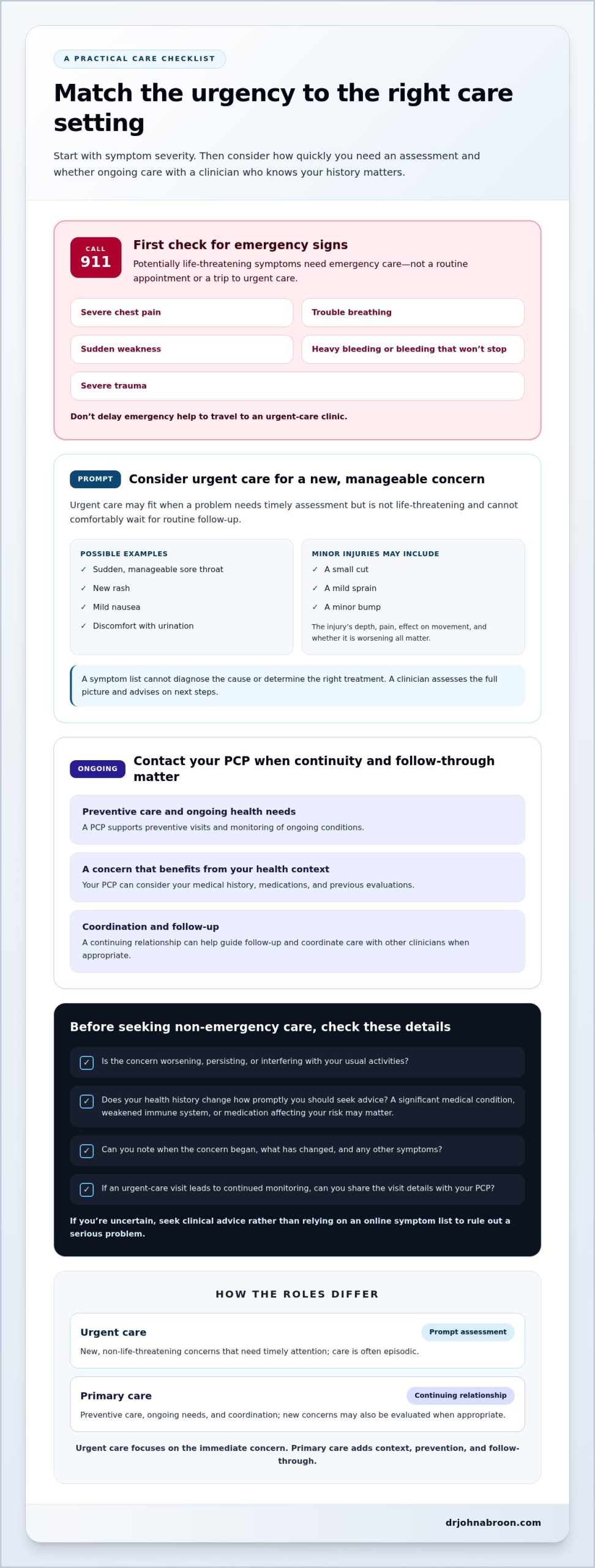
How to Decide: A Safe, Practical Care Checklist for New Yorkers
Choosing where to go can feel difficult when you’re uncomfortable and trying to account for New York City travel times, insurance, and follow-up. Use this checklist to organize your next step, not to diagnose yourself. If your condition changes or your concern feels more serious, reassess rather than sticking with your first plan.
Emergency warning signs require emergency services
Call 911 for potentially life-threatening symptoms, such as severe difficulty breathing or signs of a stroke. Stroke warning signs can include sudden face drooping, weakness in an arm, or trouble speaking. Don’t try to travel independently to an urgent-care clinic when an emergency may be occurring. If you’re unsure whether symptoms are an emergency, call 911 for guidance.
A four-step decision process for NYC patients
- Assess severity. Ask whether symptoms are severe, rapidly worsening, or making it difficult to function safely. Consider when they began and how they’ve changed. A symptom that is escalating may need faster attention than one that remains mild and stable.
- Check for emergency signs. If symptoms could be life-threatening, call 911. Don’t assume urgent care is the middle ground for every concerning problem. Emergency services are appropriate for emergencies, while urgent care generally evaluates non-life-threatening concerns.
- Choose the care setting. For a stable concern that needs timely evaluation, urgent care may be a reasonable option. For a non-urgent issue involving a recurring symptom, ongoing condition, medication question, or preventive need, consider contacting your PCP. If you’re weighing when to see an urgent care vs pcp nyc, match the urgency to the type of care and continuity you need.
- Plan for the practical details. Consider travel time and whether getting to a clinic is manageable. Review your insurance network if you can do so without delaying necessary care. Bring or have access to medication details, allergies, relevant medical history, and records that may help inform the evaluation.
Before you leave an urgent-care visit, understand what follow-up is recommended and which clinician should provide it. If you have a PCP, share the visit summary and instructions so the episode can connect with your ongoing care. Keep copies of test results or discharge paperwork when available.
New Yorkers often choose urgent care because they want prompt help, but “urgent” doesn’t automatically mean an urgent-care clinic is the right setting. The safest choice depends on severity, your health history, and how symptoms evolve. A symptom checklist can help you think through the decision, but it can’t replace an individualized clinical assessment.
For help connecting an immediate concern with ongoing primary care, explore care with Dr. John Abroon in Manhattan.
Getting Personalized Urgent and Primary Care on the Upper East Side
Choosing between urgent care and primary care is easier when the decision starts with your individual health needs, not a symptom search alone. The same symptom can call for different next steps depending on its severity, how long it has been present, your medical history, and any treatment you already receive. A clinician-led assessment brings those details together to determine what care is appropriate.
Dr. John Abroon is a board-certified internist and primary care physician on Manhattan’s Upper East Side. His practice provides both urgent care and primary care, serving different needs within a personalized care journey. Urgent care focuses on evaluating a current concern, while primary care supports continuing health needs, prevention, and follow-up. These settings can complement one another when a new issue requires attention and continued care is also important.
What a clinician-led evaluation can clarify
An evaluation begins with your account of the concern: what you’re experiencing, when it began, and whether it has changed. A clinician may also review relevant medical history, medications, allergies, and examination findings. Together, these details help shape an individualized assessment rather than relying on a checklist that can’t account for your circumstances.
The next step depends on that assessment. It may involve advice, further evaluation, or a follow-up plan, depending on what the clinician finds and what is appropriate for your needs. No symptom list can guarantee a diagnosis or predict which tests, prescriptions, or treatments will be right for an individual. If symptoms are severe or potentially life-threatening, seek emergency help rather than waiting for a routine evaluation.
Plan the next step without losing sight of follow-up
A little preparation can make a visit more informative. Before you speak with a clinician, gather the names and doses of medications you take, note any allergies, and consider when the concern started and how it has progressed. Mention relevant medical conditions and recent changes in your health. You don’t need to have every detail organized perfectly; a clear account of what concerns you is a useful place to begin.
After an urgent evaluation, understand what follow-up is recommended and keep any visit summary or instructions. If the concern needs ongoing attention, sharing those details with your PCP can connect the immediate episode to your broader health history. For anyone deciding when to see an urgent care vs pcp nyc, an individualized evaluation can make the choice more manageable without asking you to diagnose yourself first.
Dr. Abroon’s Upper East Side practice brings urgent and primary care together while keeping their distinct roles in view. Explore Dr. Abroon’s NYC medical practice to learn about care options.
Make Your Next Care Decision With Confidence
Your care needs can change as symptoms evolve, so choosing a setting isn’t a one-time decision. If you’re still weighing when to see an urgent care vs pcp nyc, focus on what you need now and what would help you feel supported after the immediate concern is addressed. You don’t have to arrive with a diagnosis. Sharing what you’ve noticed and asking questions can help you and your clinician decide on a sensible next step.
Dr. John Abroon’s Upper East Side practice has served New York City since 1997, providing urgent care and comprehensive medical services through a personalized approach. As a board-certified internist and primary care physician, Dr. Abroon can help assess a concern and support ongoing care based on your individual needs.
Taking a thoughtful next step can make an uncertain moment feel more manageable. Explore personalized medical care with Dr. John Abroon on Manhattan’s Upper East Side.
Frequently Asked Questions
Is urgent care appropriate for chest pain or trouble breathing?
Chest pain or trouble breathing can signal a medical emergency, so don’t assume urgent care is the right destination. If symptoms are severe, sudden, or accompanied by fainting, confusion, or bluish lips, call 911 rather than driving yourself. Emergency responders can assess the situation and direct you to appropriate care. If symptoms are mild but concerning, seek prompt medical advice about the safest next step.
Can urgent care treat a minor cut or sprain?
Urgent care can assess a minor cut or sprain. For example, a shallow cut with bleeding that stops differs from a deep wound, and a mild ankle twist differs from an injury with severe pain or visible deformity. If you’re unsure how serious it is, seek clinical guidance rather than relying on a self-assessment.
Can I go to urgent care if I already have a primary care doctor?
Yes. Having a PCP doesn’t prevent you from seeking urgent care for a new concern that needs timely assessment. If you’re deciding when to see an urgent care vs pcp nyc, consider whether the issue needs prompt attention or fits better with your ongoing care. After the visit, share the clinician’s recommendations and any records with your PCP so they can inform your follow-up.
Should I see my PCP for a symptom that keeps coming back?
Often, yes. A PCP can review a recurring symptom alongside your health history, medications, and previous evaluations, which may help shape a more complete plan. Before your visit, note when episodes occur, how long they last, and anything that seems to trigger or relieve them. If the symptom suddenly becomes severe or you develop emergency warning signs, seek emergency help instead of waiting for a routine appointment.
What should I bring to an urgent-care visit in NYC?
Bring a photo ID, insurance information if you plan to use it, and a current list of medications and allergies. If you have relevant records, recent test results, or instructions from another clinician, bring those too. It can help to write down when the concern began and how it has changed. These details give the clinician useful context and can make the visit more focused.
Can urgent care replace a primary care physician?
No. Urgent care generally focuses on evaluating a particular, immediate concern, while a PCP supports preventive care, ongoing conditions, and follow-up over time. An urgent-care visit may address one episode, but it doesn’t automatically provide the continuing context of a primary care relationship. If a concern persists after an urgent-care visit, arrange follow-up with your PCP and share the visit information.